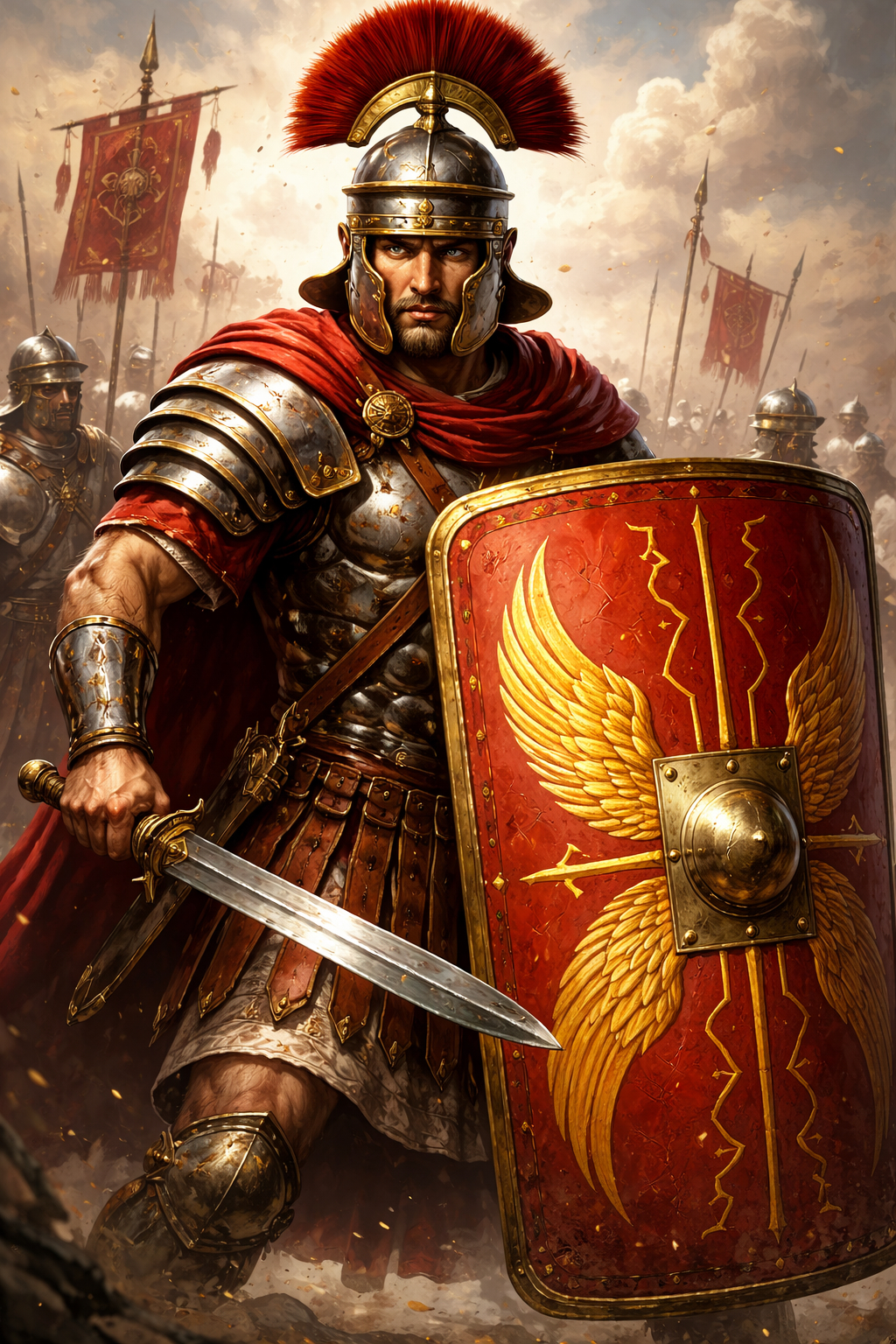
A knight is one who fights wholeheartedly in battle. He does not step onto the battlefield half-committed or uncertain about his cause. A true warrior throws himself into the fight because he knows two things: his cause is just and his leader is trustworthy.
But imagine a soldier who begins to doubt his commander. If he questions the orders he receives or if he begins to wonder whether victory is possible, hesitation creeps in. Hesitation leads to weakness, and weakness leads to defeat.
Paul warns Christians not to be such warriors. Instead, he tells us: “Above all, taking the shield of faith with which you will be able to quench all the fiery darts of the wicked one” (Eph. 6:16).
Faith is the difference between a hesitant soldier and a confident knight. It is the shield that protects the believer from Satan’s attacks. When we trust the promises of God and rely on His power, our faith becomes a defense against doubt, fear, and deception.
Unlike the other pieces of the armor of God, the shield of faith has no direct counterpart in Isaiah’s description of the divine warrior. Paul may instead be drawing on imagery from the Psalms, where God is frequently described as a shield (e.g., Psalms 3:3; 18:2, 30; 28:7; 84:11; see also Proverbs 30:5). Another possibility is that Paul merges the biblical imagery with the Roman armor commonly seen in everyday life. The Roman shield (scutum) was large, often covering a soldier from shoulder to knee. In battle, arrows tipped with burning pitch were sometimes fired into enemy ranks. Soldiers would raise their shields—often covered with leather and capable of being soaked with water—to intercept these flaming arrows and extinguish them before they could cause harm.
Satan launches similar attacks today. His flaming arrows are lies, temptations, discouragement, and fear. Faith, however, acts like a shield. When doubts, temptations, accusations, or fears are launched against the believer, trust in God and His promises prevents these attacks from igniting and spreading damage in the heart.
The Nature of Faith
Faith is not blind optimism or wishful thinking. In Scripture, faith is confidence grounded in the truth of God’s Word. Paul refers to the Gospel as “the message of truth” (Eph. 1:13). When we hear and believe that message, faith begins to grow.
Throughout the letter to the Ephesians, Paul repeatedly emphasizes faith. In fact, his opening prayer reveals just how central faith is to the Christian life.
When Paul heard of the believers’ faith and love, he gave thanks for them and prayed that they would gain deeper understanding of the blessings they possessed in Christ (Eph. 1:15–17). He wanted their “hearts enlightened” so they could see three great realities that strengthen faith.
I. The Hope of His Calling, Ephesians 1:18a
First, Paul prayed that believers would understand “the hope of His calling.”
God has called us through the Gospel. That calling brings hope—the confident expectation that God will fulfill His promises. Christians are not wandering aimlessly through life; we are moving toward a promised future.
Paul reminds us that:
- God chose us in Christ (Eph. 1:3–4).
- We are saved by grace through faith (Eph. 2:8).
- Our faith comes through hearing the message of truth (Eph. 1:13).
- We share one faith that unites us as believers (Eph. 4:5).
Faith lifts our eyes beyond the struggles of the moment. Even when the road becomes difficult, the hope of God’s calling reminds us that our journey leads to something far greater than this present world.
This hope becomes a shield against despair. When Satan tries to convince us that following Christ is pointless, faith reminds us that God’s promises are sure.
II. The Riches of Our Inheritance, Ephesians 1:18b
Paul also prayed that believers would grasp “the riches of the glory of His inheritance in the saints.”
Christians possess a spiritual inheritance beyond measure. Earlier in the chapter Paul explains that believers were chosen, redeemed, forgiven, and sealed with the Holy Spirit (Eph. 1:11–14). These blessings belong to all who are in Christ.
Through faith, Christ Himself dwells in our hearts (Eph. 3:17). That means the greatest treasure we possess is not earthly wealth but a living relationship with the Savior.
Yet Satan constantly tries to convince us otherwise. He whispers that serving God isn’t worth the sacrifice, that worldly pleasures are more satisfying, and that spiritual rewards are insignificant.
Faith answers those lies by remembering the riches that belong to God’s people. Our inheritance includes forgiveness, fellowship with God, and the promise of eternal life. No earthly treasure can compare with these blessings.
When we truly understand the riches of what God has given us, the temptations of this world lose their power.
III. The Greatness of God’s Power, Ephesians 1:19-21
Finally, Paul prayed that believers would understand “the surpassing greatness of His power toward us who believe.”
The language Paul uses here piles one word for power on top of another. He speaks of power, working, strength, and might. Each term emphasizes the incredible power of God that is available to believers through faith.
This is the same power that:
- raised Christ from the dead,
- seated Him at God’s right hand,
- placed all things under His authority,
- and made Him head over the church (Eph. 1:20–23).
Faith recognizes that God’s power far exceeds anything Satan can bring against us. When the enemy tries to convince us that we are too weak to stand, faith reminds us that we serve the all-powerful God.
In Ephesians 3:12, Paul informs us that through Christ we have:
- boldness,
- access,
- confidence
And God is able to do “exceedingly abundantly above all that we ask or think” (Eph. 3:20).
This understanding strengthens the shield of faith. We do not stand by our own strength—we stand by God’s.
A Champion of Faith
One of the greatest examples of faith in Scripture is Abraham, often called the “father of the faithful.”
God promised Abraham that he would become the father of a great nation (Gen. 12:1–3). Yet Abraham and Sarah were far beyond the age when children were normally born. From a human perspective, the promise seemed impossible.
But Abraham believed God.
Paul writes that Abraham “did not waver at the promise of God through unbelief, but was strengthened in faith” (Rom. 4:20). Eventually, God fulfilled His promise when Isaac was born (Gen. 21:1–3).
Yet Abraham’s faith was tested even more severely later. God commanded him to offer Isaac as a sacrifice (Gen. 22:1–2). The command must have been heartbreaking, but Abraham obeyed without hesitation.
Why? Because Abraham trusted that God would keep His promise—even if it required raising Isaac from the dead (Heb. 11:17–19).
Abraham believed promises that would not be fulfilled during his lifetime. He was told his descendants would inherit the land centuries later (Gen. 15:13–16), and that through his seed all nations would be blessed—a promise ultimately fulfilled in Christ (Gal. 3:16).
Even beyond those promises, Abraham was looking for something greater: “a city whose builder and maker is God” (Heb. 11:10).
That is the kind of faith that forms an unbreakable shield.

Strengthening the Shield
There is another subtle distinction between faith and the previous three pieces of the armor. We are told to put on the belt of truth, the breastplate of righteousness, and feet shod with the gospel of peace, but the shield of faith is the first item we are told to take up. It may be that the first three represent our everyday readiness and preparation, while the shield of faith involves a more immediate response in the moment of attack. When the enemy strikes, the shield must be raised. Yet it cannot be effective unless it has been strengthened beforehand.
Faith grows when it is exercised. Consider these questions:
- Do you follow God’s Word even when another path seems easier or more logical?
- Are you willing to tell the truth even if it means admitting wrongdoing?
- Will you live righteously even when others mock you?
- Do you ever worry that God’s way may not be the best way?
Satan constantly launches attacks against believers. Sometimes he tempts us toward sin. Sometimes he discourages us. Sometimes he whispers that obedience to God is pointless.
Faith answers each of these attacks. If Satan encourages foolishness, faith seeks wisdom and the will of God (Eph. 1:17). If Satan tries to discourage us, faith lifts our eyes to the hope of our calling (Eph. 1:18). If Satan claims serving God is worthless, faith remembers the riches of our inheritance (Eph. 1:18). If Satan insists we are too weak to stand, faith looks to the surpassing greatness of God’s power (Eph. 1:19–21). In every case, faith extinguishes the flaming darts of the enemy.
Standing Behind the Shield
Faith is confidence in what God has said. It trusts His promises, relies on His power, and looks forward to His reward. When that confidence is strong, the believer is protected from Satan’s lies.
But faith is not merely a way of thinking—it is a way of living. True faith always leads to obedience. If our faith does not grow out of the knowledge of God’s Word and produce a life that follows His commands, then it is not the faith Paul describes.
When our faith is rooted in truth and expressed in obedience, it becomes a shield that protects us in every battle.
And with that shield raised, we can stand firm against every attack of the enemy.

 Knights of The Father