
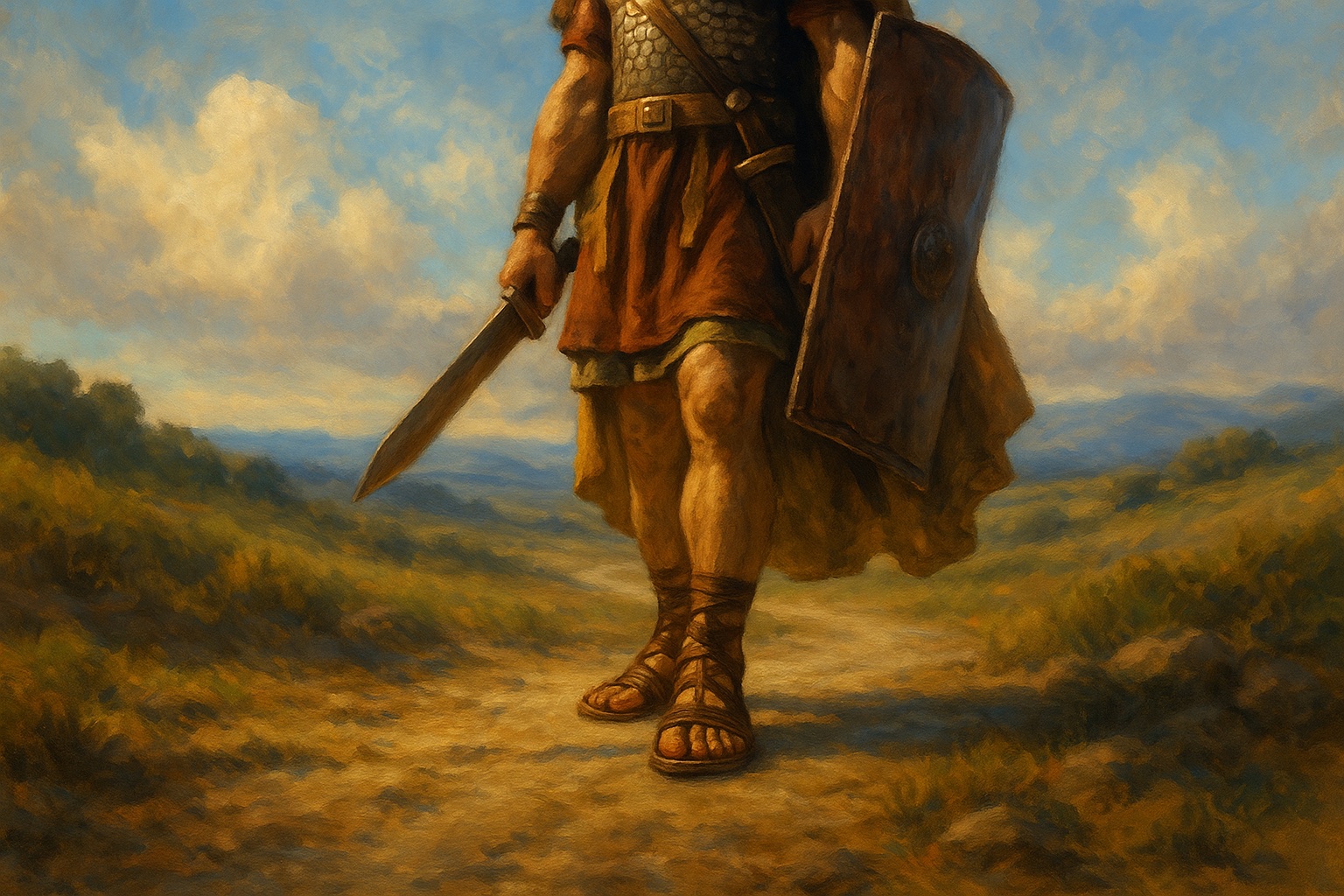
Getting out of the house with kids can be a test of patience. I often ask them if they are ready and they say “yes,” but when I check on them they have no shoes. There is still 5-10 minutes of shoe and sock searching before they will ever be truly ready to go.
In the same way, we’re not ready to face spiritual battle until we have our shoes on. God told Israel the same thing during the first Passover: “Thus you shall eat it, with your belt on your waist, your sandals on your feet, and your staff in your hand” (Ex. 12:11). Preparedness was essential then—and it still is.
Paul describes the believer’s readiness this way: “And having shod your feet with the preparation of the gospel of peace” (Eph. 6:15).
The Gospel equips us to stand firm because it grounds us in peace—peace with God, peace with one another, and peace that holds fast under pressure.
The Readiness of Peace
The word preparation is a term used only here in the New Testament. It means to have an intellectual readiness of mind, a firmness, or a resolution of mind. It describes the spiritual footing that allows a soldier to stand his ground. A believer whose life is built on the Gospel is stable and confident; he does not panic when attacked or retreat when opposed.
The gospel of peace prepares us because it secures our standing before God. Once enemies, we are now reconciled through Christ. Paul writes: “But now in Christ Jesus you who once were far off have been brought near by the blood of Christ. For He Himself is our peace…” (Eph. 2:13–14).
Through the cross, Jesus removed hostility—between humanity and God, and between Jew and Gentile. He made “one new man” out of both, abolishing the wall of separation (Eph. 2:15–16). In Him, we have access to the Father by one Spirit (2:18). That peace—reconciliation with God and unity with His people—is what steadies our hearts and guides our steps.
We no longer walk as strangers and aliens but as fellow citizens and saints (Eph. 2:19). The Gospel gives us a home and a purpose. When our feet are shod with that message, we can walk through the rough terrain of this world with calm assurance.
We go out into the world sharing the peace of God having readiness of mind (confidence in our own mind that we are at peace with God). No matter what others try to do to us or accuse us of, we know we have a solid relationship with God. This will keep us from giving in to temptations from Satan.
I. The Gospel Gives Peace With God (Ephesians 2:13–18)
Before we can walk with God, we must first be reconciled to Him. Paul explains that those who were “far off” (the Gentiles) and those who were “near” (the Jews) were brought together by the blood of Christ (2:13).
What is remarkable is not only that Christ made peace—Paul says He Himself is our peace (2:14). Peace is not merely a feeling or a doctrine; peace is a Person.
Through His cross:
- Hostility between Jew and Gentile was abolished (2:15).
- A “new man” was created in Christ (2:15).
- Both are reconciled to God in one body (2:16).
- All have access to the Father through Christ in one Spirit (2:18).
Christ did not turn Jews into Gentiles, or Gentiles into Jews. He made them one new humanity. Two roads became one. Two peoples became one household. The Gospel doesn’t just forgive sins—it creates a new world where divisions fall and peace reigns.
This peace with God is the foundation of our readiness. A soldier who knows his commander is with him stands with confidence. A Christian who knows he is reconciled to God fights without fear.
II. The Gospel Gives Peace With God’s People (Ephesians 4:1–6)
Peace with God naturally leads to peace within the body of Christ. Paul urges believers to “preserve the unity of the Spirit in the bond of peace” (4:3). The word bond (sundesmos) means a ligament—something that binds parts together securely. Peace is what keeps the church from falling apart under pressure.
Peace with God naturally leads to peace within the body of Christ. But unity, like peace, doesn’t happen by accident—it must be pursued with diligence. The same Gospel that made peace between God and man now calls us to live peaceably with one another.
When believers treat each other with kindness and forgiveness, peace prevails. But where pride, anger, or selfish ambition enter, peace disappears. Walking worthily means submitting our “I” to Christ’s will, so the body of believers can remain united under one Lord.
Truth determines unity. It is not a matter of faith, we need to do all we can to maintain unity. In any group there will be a lot of differences. The apostles came from various backgrounds. A publican who worked with the Romans, a zealot who used guerilla warfare against the Romans, some were fishermen, etc… We may have opposite views on something, but God still expects us to have unity. Sometimes you have to have a faction for truth to be manifested, 1 Corinthians 11:19. Most splits are not over doctrine, but over personalities.
Paul lists seven foundations of unity—seven “ones” that bind the church together: one body, one Spirit, one hope, one Lord, one faith, one baptism, one God and Father of all.
These truths stabilize our footing in a divided world.
- One Body: The church is Christ’s body; division weakens its witness.
- One Spirit: The Spirit provides the same revelation to all; He does not contradict Himself.
- One Hope: We share one destiny—eternal life with God.
- One Lord: Our allegiance is singular. No Christian follows competing commands.
- One Faith: We live by one revealed standard—the Word of God.
- One Baptism: The moment we were buried with Christ, we entered this new life together (Rom. 6:3–4).
- One God and Father: He reigns above all and works through all His people.
This unity isn’t theoretical—it’s practical. When we honor these truths, we walk together in peace, and the enemy finds no foothold to divide us.
Keys to overcoming division:
- Understand that problems are going to be around, cf. Acts 6:1, 15; 1 Corinthians 5:1; Galatians 2:10-11; Philippians 4:1-2.
- Respect the standard of God’s Word, cf. Acts 5:29.
- Deal with the problem, it doesn’t help to ignore the problem, cf. 1 Corinthians 5, Galatians 6:1.
- Separate between matters of faith and matters of opinion. We must be united on matter of faith, we can differ on matters of opinion.
- We should strive not to hinder the work of the church.
When believers are grounded in this truth, they walk worthy of their calling—with humility, gentleness, patience, and tolerance (4:2). These are the qualities that allow peace to thrive.
And this ties directly to our armor: Shoes are what let you stand firm or move smoothly. Unity keeps the church ready, steady, and hard to trip.
III. The Gospel Gives Inner Stability and Strength (Ephesians 3:14–21)
The Gospel does more than save—it stabilizes. Paul prays that believers would be:
- strengthened with power
- rooted and grounded in love
- filled with all the fullness of God
Roots hold a tree in place. A foundation keeps a building from shifting. Shoes allow a soldier to stand unmoved on uneven terrain.
The peace that comes from the Gospel gives this inner security. It replaces anxiety with confidence, fear with faith, panic with purpose. We know who we are. We know whom we serve. We know where we are going.
This inner stability is essential for spiritual battle. Unprepared feet stumble. Peace-prepared feet stand.
IV. The Gospel Prepares Us to Work Together (Ephesians 4:7–16)
God gives each believer gifts to strengthen the church—apostles, prophets, evangelists, shepherds, and teachers (4:11). Their purpose:
- To equip the saints for service,
- To build up the body of Christ,
- To help us mature in the faith.
Maturity produces stability. When we are grounded in truth, we’re not “tossed about by every wind of doctrine” (4:14). Speaking truth in love, we grow up into Christ, our head. The body thrives when “each part does its share” (4:16).
The peace of the Gospel is not passive—it is productive. United service builds a strong and steadfast church, one that walks in peace and works in harmony.
V. The Gospel Prepares Us to Walk Worthily (Ephesians 4:17–5:21)
Three times Paul describes the Christian life in terms of walking:
- Walk in love (5:2).
- Walk as children of light (5:8).
- Walk carefully, not as fools but as wise (5:15).
This “walk” imagery ties directly into the shoes metaphor. The Gospel doesn’t just give us peace—it gives us new steps, new paths, and new patterns of behavior.
We walk differently because:
- we have different priorities
- we have a different King
- we are headed toward a different home
- we are empowered by a different Spirit
- we see the world through different eyes
The Gospel makes us ready to walk—ready to endure, ready to obey, ready to speak, ready to shine.
VI. The Gospel Makes Us Bearers of Good News (Ephesians 5:8–14)
Paul’s phrase “gospel of peace” echoes Isaiah 52:7—
“How beautiful are the feet of those who bring good news!”
In Isaiah, the messenger was a runner who carried news of salvation and victory to a city under siege. In Ephesians, the runners are us.
Paul says believers are:
- light in the Lord, shining into darkness (5:8)
- exposing evil, like torches in a cave (5:11)
- awakening the dead with the call of Christ (5:14)
Our feet are not just protected—they are sent.
Your shoes are not only for standing but for going. The Gospel gives us readiness not only to resist evil but to advance the Kingdom.
VII. The Gospel Gives Courage in Conflict (Ephesians 6:10–15)
By the time Paul reaches the armor, he has spent five chapters explaining why Christians can have courage:
- We have peace with God.
- We have unity with God’s people.
- We have confidence in God’s plan.
- We have strength from God’s Spirit.
- We have clarity from God’s truth.
- We have hope in God’s promises.
Now he says: Put on your sandals. You are ready.
Just as a knight cannot fight barefoot, a Christian cannot fight spiritually unless he stands firmly in Gospel peace. When you know you are right with God, no accusation, insult, persecution, or circumstance can shake you.
Peace is not the absence of conflict—it is the presence of divine confidence.
VIII. A Living Illustration: Stephen’s Peace (Acts 6–7)
Stephen, the first recorded martyr, shows what it looks like when a believer’s feet are shod with the gospel of peace. He preached boldly, defended the truth courageously, and confronted error without fear. His enemies seized him, dragged him outside the city, and stoned him.
But Stephen looked upward and prayed:
“Lord, do not hold this sin against them.”
How could he respond like that?
His heart was anchored.
His mind was prepared.
His feet were planted in peace.
Stephen knew he was right with God.
He knew heaven awaited him.
He knew the Gospel was true.
Because of that peace, he could face death with the calmness of a soldier who knows the war is already won.
Standing Firm in the Gospel of Peace
The Gospel doesn’t prepare us to avoid battle—it prepares us to face it with steady feet and peaceful hearts. Peace with God gives courage before men. Peace with the church gives stability in hardship. Peace within ourselves gives confidence when the enemy attacks.
Stephen, the first recorded martyr, embodied this readiness. As stones fell, he prayed for his killers and looked toward heaven. His footing was firm because his peace was real. His heart was anchored. His steps were steady. His hope was sure.
The Gospel:
- saves us (1:13)
- reconciles us (2:13–18)
- unites us (4:1–6)
- strengthens us (3:14–21)
- directs our walk (4:17–5:21)
- sends us out (5:8–14)
- prepares us for battle (6:15)
When our feet are fitted with this readiness, we can go anywhere with confidence—into conflict, uncertainty, or hardship—and still stand firm.
Before you face the world each day, make sure your shoes are on.
Be ready. Be steady. Walk in the Gospel of peace.
Responding to the Gospel: Taking the First Steps of Peace
The Gospel of peace is not just something we admire—it’s something we obey (2 Thess. 1:8; 1 Pet. 4:17). God’s peace is offered freely through Christ, but it is received only when we submit our lives to His will. Before our feet can be shod with the readiness of the Gospel, they must first step onto the path Christ has laid out.
Scripture describes a clear and consistent pattern for how people responded to the message of salvation.
1. Hear the Gospel
Faith begins with God’s Word (Rom. 10:17).
Before anyone can believe, they must first listen—really listen—to the story of the crucified and risen Christ (1 Cor. 15:1–4).
2. Believe in Christ
The Gospel calls for personal trust:
“Without faith it is impossible to please Him” (Heb. 11:6).
Faith is more than agreement—it is reliance, conviction, and confidence that Jesus is Lord and that His resurrection is the foundation of our hope (Rom. 10:9–10).
3. Repent of Sin
Peace with God cannot coexist with rebellion against Him.
Repentance is a change of mind and direction—a willingness to walk in a new way (Acts 17:30–31). It is the first step in putting on the new self (Eph. 4:22–24).
4. Confess Christ as Lord
Jesus said,
“Whoever confesses Me before men, I will also confess before My Father” (Matt. 10:32).
Confession is not a ritual—it is a declaration of allegiance.
There cannot be “one Lord” (Eph. 4:5) if we have not openly made Him our Lord.
5. Be Baptized into Christ
Paul wrote of the “one baptism” (Eph. 4:5). He spoke of it as a moment of:
- union with Christ’s death and resurrection (Rom. 6:3–4)
- forgiveness of sins (Acts 2:38)
- washing of regeneration (Titus 3:5)
- putting on Christ (Gal. 3:27)
- being added to the body (1 Cor. 12:13)
Baptism is not a symbol of a salvation already received—it is the biblical moment in which God applies His saving work.
6. Walk in the Peace of the Gospel
After baptism, the Christian rises to “walk in newness of life” (Rom. 6:4).
This walk is exactly what Paul describes throughout Ephesians:
- a walk of unity (4:1–3)
- a walk of maturity (4:13–16)
- a walk of righteousness (4:17–32)
- a walk in love (5:1–2)
- a walk in light (5:8)
- a walk in wisdom (5:15)
When we obey the Gospel, God places peace into our hearts, purpose into our steps, and readiness onto our feet. We do not enter the battle alone—He equips us, strengthens us, and walks with us.
A Final Invitation
If you have not yet obeyed the Gospel, the call of Christ stands open.
If you have walked away, the path of peace waits to welcome you back.
If you belong to Him, keep your shoes on—walk worthy of your calling, and let the Gospel of peace carry you through every conflict.

 Knights of The Father