
When young David faced Goliath, King Saul offered him his royal armor. It was heavy, cumbersome, and—above all—unfamiliar. David tried to walk in it but quickly realized, “I cannot go with these, for I have not tested them” (1 Samuel 17:39). Saul’s armor wasn’t made for him, and if he tried to fight in it, it would only get in the way.
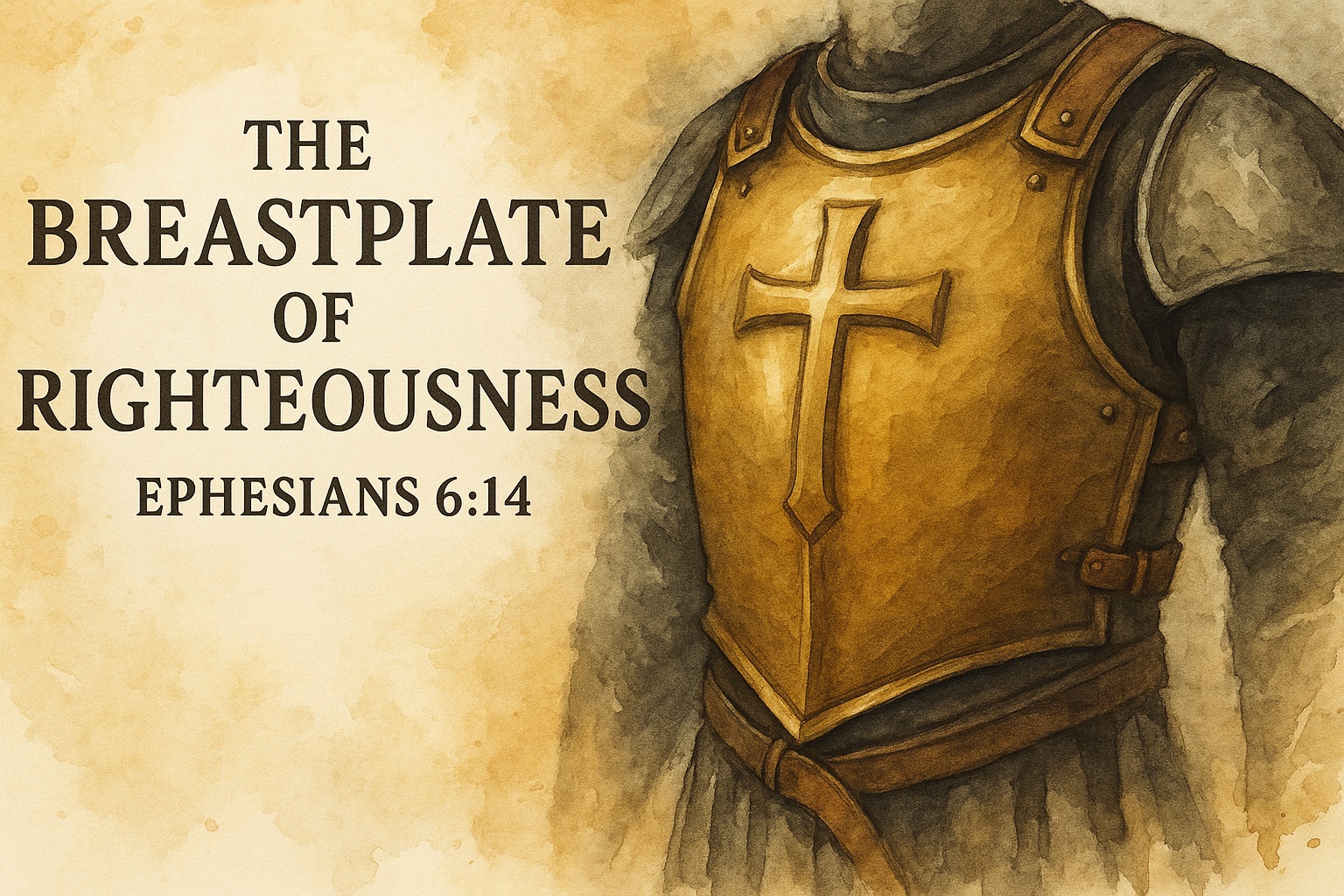
Paul’s command in Ephesians 6:14 is different but similar in principle: “Put on the breastplate of righteousness.” This armor cannot be reshaped to fit our comfort or convenience. Instead, our lives must be reshaped to fit it. Like a bride who buys a dress a few sizes too small, we must grow into it—not shrink it down to our liking.
Isaiah foretold this very armor centuries earlier: “He put on righteousness as a breastplate, and a helmet of salvation on His head” (Isaiah 59:17). The prophet pictured God Himself clothing the coming Messiah for battle against sin and injustice. The armor is divine—meant first for Him, and now extended to all who follow in His steps.
Paul’s letter to the Ephesians has already taught us how to put it on. In Ephesians 4:20–24, he shows the process:
- Hear the truth (4:20–21)
- Lay aside the old self (4:22)
- Be renewed in the spirit of your mind (4:23)
- Put on the new self, created in righteousness and holiness of the truth (4:24)
The belt of truth prepares us to fight by grounding us in God’s Word; the breastplate of righteousness strengthens us to stand by living out that truth in action.
The Function of the Breastplate
In medieval times, armor changed as warfare advanced, but the breastplate was one of the last piece to go. A knight could survive without armor pieces for his arms and legs—but not without protection over the chest. The heart, lungs, and vital organs were too important to leave exposed.
So it is with righteousness. There are many flaws in our character that God will work on over time, but without righteousness—the desire and commitment to do what is right—we are spiritually exposed. Righteousness guards the heart. Hypocrisy is a fatal wound.
Paul isn’t describing the righteousness that saves (our justification before God), but the righteousness that defends—the daily pursuit of living uprightly in a corrupt world. As David once sang, “He who walks blamelessly and does what is right… shall never be moved” (Psalm 15:2, 5).
I. Righteousness in Your New Self
Putting on the breastplate of righteousness begins by putting off the old self. Before a knight could don his armor, he first had to strip off whatever garments might interfere with it. In the same way, righteousness cannot rest over the old nature—it must be fitted upon a renewed life.
Paul paints a vivid picture of this transformation throughout Ephesians 4 and 5. Every verse shows a deliberate turning—from one way of living to another. Each turn is an act of righteousness, each a small plate added to the armor of the soul.
Turn from Falsehood to Truth (4:25)
“Therefore, laying aside falsehood, speak truth each one of you with his neighbor, for we are members of one another.”
Righteousness begins with honesty. The first mark of the new self is truthfulness in word and deed. Lies, exaggerations, and half-truths are tools of the enemy—the “father of lies” (John 8:44). To follow Christ, who is “the truth” (John 14:6), is to speak truth even when it costs something. Truth-telling strengthens the body of Christ because deceit fractures trust. A righteous heart values truth over convenience.
Turn from Anger to Self-Control (4:26–27)
“Be angry, and yet do not sin; do not let the sun go down on your anger, and do not give the devil an opportunity.”
Anger in itself is not sin, but unrestrained anger gives the enemy a foothold. Righteousness calls for temperance—controlled emotion guided by love and patience. The new self recognizes that wrath does not produce the righteousness of God (James 1:20). The breastplate of righteousness guards our hearts from bitterness and revenge by teaching us to master our passions before they master us.
Turn from Stealing to Honest Work (4:28)
“He who steals must steal no longer; but rather he must labor, performing with his own hands what is good, so that he will have something to share with one who has need.”
Righteousness is not only about avoiding sin—it’s about replacing it with what is good. The thief who repents must not only stop stealing but start working. More than that, his work should be generous. Righteousness transforms greed into generosity and selfish taking into sacrificial giving. Honest labor becomes an act of worship, a way of imitating the Creator who worked and rested in goodness.
Turn from Corrupt Speech to Edifying Words (4:29)
“Let no unwholesome word proceed from your mouth, but only such a word as is good for edification according to the need of the moment, so that it will give grace to those who hear.”
The words that come from our mouths reveal the condition of our hearts (Matthew 12:34). Unwholesome speech—whether gossip, profanity, or cynicism—corrupts both speaker and listener. The new self speaks to build, not to break. Righteous speech strengthens others, encourages faith, and spreads grace like a healing balm. The righteous warrior guards his tongue as carefully as his sword.
Turn from Bitterness to Forgiveness (4:30–32)
Bitterness corrodes the soul and grieves the Holy Spirit. Righteousness replaces resentment with compassion. “Be kind to one another, tender-hearted, forgiving each other, just as God in Christ also has forgiven you.”
When we forgive, we imitate our King. Forgiveness is not weakness—it is divine strength, freeing us from the armor-piercing wounds of grudges and hatred. A soldier weighed down by bitterness cannot fight effectively.
Turn from Impurity to Imitation of God (5:1–5)
Paul continues, “Therefore be imitators of God, as beloved children; and walk in love, just as Christ also loved you.”
Righteousness calls for purity in thought, speech, and conduct. In a culture that treats immorality as entertainment, God’s people are called to reflect His holiness. To imitate God is to love sacrificially and live blamelessly. When we pursue purity, we mirror the character of our Captain.
Turn from Darkness to Light (5:6–14)
“For you were formerly darkness, but now you are light in the Lord; walk as children of light.”
This is not merely walking in light—it is being light. Righteousness radiates from a life aligned with truth, exposing sin and reflecting God’s goodness. The believer’s conduct should make visible the contrast between light and darkness, life and death, righteousness and wickedness.
Turn from Foolishness to Wisdom (5:15–17)
“Therefore be careful how you walk, not as unwise men but as wise, making the most of your time, because the days are evil.”
Wisdom is righteousness applied. Foolishness wastes opportunities; wisdom redeems them. A righteous person orders life around eternal priorities, discerning God’s will instead of drifting with the crowd. Each wise choice adds another layer of protection to the heart.
Turn from Drunkenness to Being Filled with the Spirit (5:18–21)
“Do not get drunk with wine, for that is dissipation, but be filled with the Spirit.”
The contrast is one of control—either the flesh governs you, or the Spirit does. Righteousness yields to the Spirit’s influence, producing joy, gratitude, and harmony. A heart filled with the Spirit will sing, serve, and submit in love.
Each of these transformations represents a piece of divine craftsmanship—righteous habits forged by truth and fitted to the new self. We are not righteous because we have achieved perfection, but because we continually align our hearts with God’s standards.
To live righteously is to let God’s truth reshape your habits, thoughts, and desires until they reflect His own character. This is how the breastplate of righteousness is formed—one obedient choice at a time, hammered into place by repentance and faithfulness. When the enemy’s accusations come, this breastplate will not fail, for it is made of the very metal of God’s truth lived out in the life of His servant.
II. Righteousness in Your Relationships
Paul’s call to “walk worthy of the calling” (Ephesians 4:1) doesn’t stop at personal holiness—it continues into the relationships that define our daily lives. Beginning in Ephesians 5:22, Paul moves from general exhortations to specific examples of what righteousness looks like in practice: in marriage, in the home, and even in the workplace.
These household instructions are not cultural relics; they are examples of how a heart clothed in righteousness behaves toward others. Each relationship becomes a testing ground for the breastplate—proving whether our character truly reflects Christ.
Paul’s teaching begins with three pairs of relationships common in every Greco-Roman household:
- Husband and Wife (5:22–33)
- Parent and Child (6:1–4)
- Master and Servant (6:5–9)
In each, righteousness requires both submission and responsibility—each person reflecting the nature of Christ in their role.
Righteousness in Marriage (5:22–33)
Wives: Submitting as to the Lord (vv. 22–24)
Paul begins: “Wives, submit to your own husbands, as to the Lord.” The instruction is not about value or inferiority but about order and harmony. Spiritually, women are in subjection to the Lord, and Paul draws a parallel—there is a similar willingness of heart in godly marriage.
The verb “submit” (hupotassō) is passive—it means to subject yourself, to yield by choice. It is not forced obedience. This distinguishes it from Paul’s commands to children and servants, who are told to obey (Ephesians 6:1, 5). The wife’s submission is voluntary, born from faith and respect, not compulsion.
Submission in Scripture is not unique to wives.
- Jesus submitted to His parents (Luke 2:51).
- Christians submit to government (Romans 13:1–5).
- We submit to one another (Ephesians 5:21).
- The church submits to Christ (Ephesians 5:24).
- Servants submit to masters (Titus 2:9).
- Angels and authorities submit to Christ (1 Peter 3:22).
- Believers submit to their elders (1 Peter 5:5).
Submission, therefore, is not a mark of weakness but of spiritual strength—a reflection of Christ’s own humility.
Paul grounds this command in creation and redemption: “For the husband is the head of the wife, as Christ also is the head of the church, He Himself being the Savior of the body” (v. 23). The imagery returns to the “one new man” theme in Ephesians—the head and body joined in unity.
To deny that a wife is called to submit to her husband would be to deny that the church is subject to Christ. Yet Paul qualifies this with wisdom: “as to the Lord.” Submission has boundaries. It must never mean compliance with sin or abandonment of conscience. Colossians 3:18 clarifies: “Wives, submit to your husbands, as is fitting in the Lord.”
The example of Sarah, who called Abraham “lord” (1 Peter 3:5–6), shows a respectful, willing spirit—not a resentful one. Righteous submission is not servitude; it is service offered freely to God through one’s marriage.
Husbands: Loving as Christ Loved the Church (vv. 25–29)
If wives are called to submission, husbands are called to sacrifice. Paul commands: “Husbands, love your wives, just as Christ also loved the church and gave Himself up for her.”
This is agapē love—the highest kind of love. It is not rooted in emotion or attraction, but in choice. It seeks the good of the beloved even at personal cost.
Wives are never commanded to love their husbands with agapē—but husbands are. Paul lifts their duty far above cultural expectations. Headship is not dominance; it is devotion. The husband’s authority is bound by love’s limitations. He leads not by demanding obedience, but by modeling Christ’s selflessness.
Christ’s love had purpose:
- That He might sanctify her (v. 26)
- That He might present her to Himself (v. 27)
- That she might be holy and blameless
If a husband loves his wife with this kind of self-giving, purifying love, submission ceases to be burdensome.
George Bernard Shaw once cynically wrote, “When two people are under the influence of the most violent, most insane, most delusive, and most transient of passions, they are required to swear that they will remain in that condition until death do them part.” But Christian marriage is not built on transient passion—it is founded on enduring righteousness. It survives not because of constant feelings, but because of constant faithfulness.
True headship is not “my way or no way”—it is “what is best for her.” A righteous husband lays down pride, ambition, and comfort for the spiritual good of his wife.
The Mystery and the Model (vv. 30–33)
Paul concludes by lifting marriage to its highest meaning: “We are members of His body.” Quoting Genesis 2:24, he shows that the two become one flesh. The union of husband and wife mirrors the union of Christ and the church—distinct yet inseparable, individual yet one in purpose.
When Paul calls this a mystery, he means it reveals something previously hidden: that God designed marriage to reflect the relationship between Christ and His people.
This doesn’t turn marriage into a mere symbol—it magnifies it as a living parable. To corrupt marriage is to misrepresent the gospel; to live righteously within it is to display Christ’s love to the world.
Righteousness in the Home (6:1–4)
The family is the first place where children learn what righteousness looks like in practice. That’s why Paul turns next to children and parents.
Children: Obedience from the Heart (vv. 1–3)
“Children, obey your parents in the Lord, for this is right.”
Paul speaks directly to children who would have been present when the letter was read aloud. The command applies to all ages, but the motivation is key—obedience “in the Lord.” Children obey not merely because parents demand it, but because Christ deserves it.
Paul quotes the fifth commandment—“Honor your father and mother”—calling it “the first commandment with a promise.” Honor includes obedience but goes beyond it. It means esteem, respect, and lifelong gratitude. It continues long after childhood ends, often taking the form of caring for parents in their later years.
Obedience brings blessing: “That it may go well with you and that you may live long on the earth.” These are not rigid guarantees but general truths. A home grounded in respect and discipline tends to produce stability and peace.
Fathers: Guiding without Provoking (v. 4)
Paul singles out fathers—not because mothers are unimportant, but because leadership and accountability ultimately rest with the husband. “Fathers, do not provoke your children to anger, but bring them up in the discipline and instruction of the Lord.”
Provoking does not refer to necessary correction but to harshness, hypocrisy, or imbalance that breaks a child’s spirit. Overprotection, overdiscipline, impossible expectations, neglect, verbal abuse, or legalistic religion can all embitter the heart.
Discipline looks forward—it corrects to shape the future. Punishment looks backward—it reacts to the past. Godly fathers discipline in the Lord, aiming to cultivate maturity, not resentment.
A righteous father trains with tenderness, teaches by example, and keeps Christ at the center of his home.
Righteousness in Service (6:5–9)
Finally, Paul addresses servants and masters—a relationship that often troubles modern readers. But in Paul’s time, the oikos (household) included slaves as well as family members. His instructions here continue the same principle: walking worthily in every station of life.
Servants: Serving as to the Lord (vv. 5–8)
“Slaves, obey your earthly masters with fear and trembling, in sincerity of your heart, as to Christ.”
Paul is not endorsing slavery; he is addressing believers already within it. First-century slavery was not identical to modern racial slavery—many were debtors, war captives, or workers bound for a time. Still, Paul’s command is revolutionary: serve sincerely, not by way of eye-service, but “as slaves of Christ, doing the will of God from the heart.”
Even in lowly positions, believers could transform their circumstances by viewing their work as service to God. Their obedience became worship; their labor, a testimony.
Righteousness in service means integrity when no one is watching and diligence that honors Christ above all. Paul adds a promise: “Whatever good thing each one does, this he will receive back from the Lord.” The ultimate reward does not come from men but from God.
Masters: Leading with Justice and Mercy (v. 9)
Paul then turns to masters: “Do the same things to them, and give up threatening, knowing that both their Master and yours is in heaven, and there is no partiality with Him.”
Authority brings accountability. Christian masters are reminded that their leadership must reflect the character of Christ. Threats, cruelty, and arrogance have no place in the heart of one who himself serves the Lord.
In a single sentence, Paul levels the social order: both master and servant have the same Master in heaven. Before Christ, all stand equal.
Over time, as the gospel spread and believers learned to love their neighbors as themselves, this teaching undermined the foundations of slavery. The same Spirit that led masters to give up threatening would, in time, lead the world to give up the practice itself.
From marriage to parenting to work, Paul shows that righteousness is not limited to private piety. It governs every sphere of life. When our relationships are ordered by God’s design—rooted in love, submission, honor, and fairness—our hearts are protected from pride, resentment, and rebellion.
A breastplate covers the vital organs. It guards not only the heart but also the connections between them. In the same way, relational righteousness guards the unity of the body of Christ. The home, the church, and the workplace become living testimonies of the gospel’s power.
To wear the breastplate of righteousness, then, is not merely to avoid sin but to live rightly toward others—to love as Christ loved, to submit as the church submits, and to serve as unto the Lord.
When righteousness fills our relationships, the enemy finds no opening to strike.
Conclusion
The breastplate protects the heart—the seat of our will, conscience, and devotion. When Paul says “put on the breastplate of righteousness,” he’s calling us to guard our hearts with obedience and integrity.
We cannot tailor this armor to fit our lives; we must let our lives be conformed to fit the armor.
Righteousness begins with being justified by faith, as Abraham was, but it continues in daily faithfulness. It is the habit of doing what is right because our King is right. When accusations fly, righteousness defends us. When temptations come, righteousness strengthens us.
Jesus Himself was condemned as a criminal, yet His righteousness made Him acceptable to God—and through Him, we stand righteous too.
So take up the breastplate. Let your heart be guarded by holiness, your conscience shielded by integrity, and your life protected by obedience. A knight without a breastplate will not last long in battle—but the one who wears righteousness will stand firm in the strength of his Lord.

 Knights of The Father