In Jeremiah 13, we are given a powerful demonstration. God tells Jeremiah to get a linen belt. This linen belt or sash perhaps represents a special woven belt which was part of the priestly garments (cf. Exodus 28:39-41).
The purpose of this belt (and the other part of a priest’s attire) was for beauty and glory, to ordain and sanctify them to serve before God. God had taken Israel as His own possession for His glory. Israel, however, had let themselves become corrupt and what God should have been able to take pride in now became a disgrace. To represent this, God tells Jeremiah not to take care of this belt and then later to hide it in a hole next to the Euphrates River.
Notice what happens in Jeremiah 13:6-11 when God tells Jeremiah to go get the belt again. It had become worthless and ruined. Good for nothing. This happened because they refused to hear the Word of God and they had turned aside to idolatrous abominations. In essence, they turned their ears away from truth and turned aside to lies.
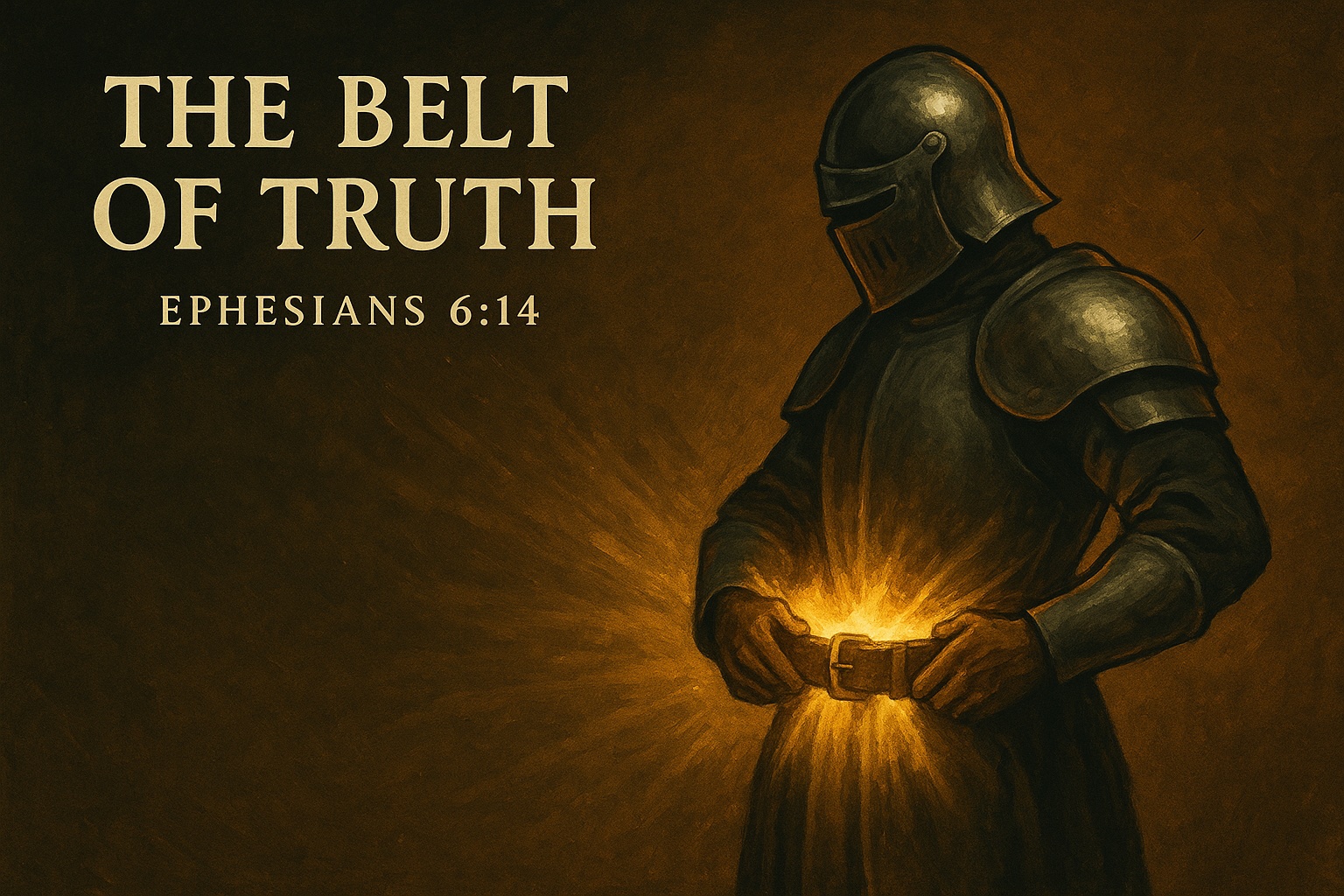
There is, however, another belt Isaiah describes as he prophecies about the coming Messiah (Isaiah 11:1-5). The Messiah was one who would gird on a belt of truth. It is this belt Paul tells the Church to take up in Ephesians 6:14. We are to cast off the belt of ruin and lies and take up our Master’s belt of truth.
Truth is important to us in the war against Satan. Satan attempts to deceive us with trickery, craftiness, and lies. Jesus called him the “the father of lies” (John 8:44). If you grab hold of something that is a lie, you will go astray. You may believe, you may be sincere, but none of that will change the fact that it is a lie. Truth is important. We must have truth to overcome the enemies trying to deceive us and to be strong in the Lord.
From the opening chapter onward, Ephesians celebrates the revelation of God’s truth in Christ—the word of truth, the gospel of your salvation (1:13). Truth is the atmosphere of the Christian life. We are to speak the truth in love (4:15), lay aside falsehood (4:25), and walk as children of light, for “the fruit of the light consists in all goodness and righteousness and truth” (5:9). When Paul finally calls us to take up the armor of God, the first command—“gird your loins with truth”—is not a new idea but the culmination of everything he has already taught. Truth is both the beginning and the binding of the Christian’s armor.
Let us consider what girding our loins with truth means in light of the context of the Letter to the Ephesians.
I. The Truth Must Be Known
Before truth can protect you, it must be known.
The Word of Truth and the Gospel (Ephesians 1:13–14)
Paul began his letter to the Ephesians by reminding them how they first came to faith:
“In Him you also, after listening to the message of truth, the gospel of your salvation—having also believed, you were sealed with the Holy Spirit of promise.”
The gospel itself is called “the word of truth.” This is not one truth among many; it is the ultimate truth. It proclaims who Jesus is, what He has done, and what we must do in response. When we hear, believe, and obey this truth, God seals us with His Spirit (cf. Acts 2:38).
Truth, then, is not merely information—it is revelation. It is the message of God’s salvation revealed in Christ.
Truth Is in Jesus (Ephesians 4:17–21)
Paul later contrasts the empty thinking of the world with the way of Christ:
“You did not learn Christ in this way, if indeed you have heard Him and have been taught in Him, just as truth is in Jesus.”
Truth is not discovered by human reason or philosophy. It is found in a person. The more we know Christ, the more we know truth.
When the Ephesians heard the gospel, they “heard Him.” When they were taught after conversion, they were “taught in Him.” The truth is not just learned—it is lived in fellowship with Jesus.
Truth Brings Stability (Ephesians 4:12–14)
Truth grounds us. Paul describes the immature believer as “tossed here and there by waves and carried about by every wind of doctrine, by the trickery of men, by craftiness in deceitful scheming.” Without truth, we drift from one idea to another, vulnerable to every new deception.
By contrast, the believer who studies and clings to Scripture is anchored. Reading, memorizing, and meditating on the Word builds a belt of strength around the mind and heart. As Jesus prayed, “Sanctify them in the truth; Your word is truth” (John 17:17).
Truth must be known—deeply, personally, biblically—before it can be lived or spoken.
II. The Truth Must Be Lived
Knowing truth is not enough; it must shape our lives. The belt of truth was fastened around the waist before battle to secure the tunic and prepare for movement. In the same way, truth prepares the believer for action.
A New Way of Life (Ephesians 4:22–24; 5:9)
Paul writes that those who have been taught the truth are to “lay aside the old self” and “put on the new self, which in the likeness of God has been created in righteousness and holiness of the truth.”
Righteousness and holiness flow out of truth—they are its fruit. Truth teaches us what God approves and exposes what He condemns. To live by the truth is to align our lives with God’s revealed will.
In 5:8–10 Paul adds, “Walk as children of light (for the fruit of the light consists in all goodness and righteousness and truth), trying to learn what is pleasing to the Lord.” Truth is not abstract doctrine; it produces visible goodness.
Truth as Preparation (Ephesians 6:14)
Paul writes, “Stand therefore, having girded your loins with truth.” The Greek word for “loins” (osphus) refers to the waist or midsection—the place where a belt or girdle was fastened. To “gird up the loins” meant to gather one’s long robe for readiness and freedom of movement. It symbolized preparation for strenuous work or battle (cf. Luke 12:35).
To “gird your loins with truth” means to let truth hold everything in place—your thoughts, motives, and actions. It keeps the loose ends of your life from tripping you in battle.
Truth must be lived—embodied in integrity, honesty, and consistency. A believer who knows truth but lives a lie is as unprepared as a knight whose belt is unbuckled.
III. The Truth Must Be Spoken
A belt doesn’t only secure—it also identifies. A soldier’s belt bore the insignia of his commander, marking who he served. In the same way, truth spoken identifies whose kingdom we belong to.
Speaking Truth to One Another (Ephesians 4:25)
Paul commands: “Therefore, laying aside falsehood, speak truth each one of you with his neighbor, for we are members of one another.”
We are not isolated believers; we are parts of a single body. A body cannot function if its parts lie to each other. Deception within the church causes the whole body to stumble.
To “lay aside falsehood” includes every kind of deceit—half-truths, exaggerations, manipulations, or silence that hides what honesty would reveal. A church clothed in truth is a church united in purpose.
Speaking the Truth in Love (Ephesians 4:14–15)
Earlier Paul urged believers to “speak the truth in love.” Truth without love can crush; love without truth can corrupt. But together, they protect and strengthen the body.
Truth opposes “every wind of doctrine.” Love opposes “trickery, craftiness, and deceitful scheming.” Both are armor against the enemy’s lies.
As one scholar noted, “Truth spoken in love will triumph over error and ensure the perpetual growth of the church both numerically and spiritually.”
Speaking the Truth to the World
The church must also speak truth to the world—lovingly, clearly, and without fear. The world does not need our opinions; it needs God’s truth. Lies may sound compassionate, but they destroy. Only truth saves.
To proclaim the gospel is to unsheathe the sword of truth, but it begins with fastening the belt—our own commitment to live and speak honestly before God.
Conclusion
The war for truth is a battle for people’s minds. Paul wrote elsewhere, “Though we walk in the flesh, we do not wage war according to the flesh… We destroy arguments and every lofty opinion raised against the knowledge of God, and take every thought captive to obey Christ” (2 Corinthians 10:3–5).
Satan’s greatest weapons are not claws or flames but lies—ideas that distort reality. He whispers the same old deceptions: “Did God really say?” “You won’t surely die.” “You deserve better.”
The belt of truth protects the mind from these lies. Without it, the rest of the armor falls apart:
- Our righteousness depends on truth—without it, we cannot know what is right.
- Our gospel depends on truth—without it, there is no good news.
- Our faith depends on truth—without it, there is nothing solid to trust.
- Our salvation depends on truth—without it, we cannot obey the true message.
- Our sword depends on truth—for the Word of God is truth.
Every piece of armor is connected to truth. Lose the belt, and the whole suit unravels.
When Jeremiah’s belt rotted by the river, it became a symbol of a nation that had turned away from truth. When Isaiah described the coming Messiah, he saw One who would be girded with truth and righteousness. And when Paul told the church to stand firm, he called them to fasten that same belt—the belt of their Lord.
The belt of truth is more than doctrine; it is devotion. It means knowing the truth, living the truth, and speaking the truth in love. It means clinging so tightly to God’s Word that no lie can pry it from you.
Every battle begins with fastening the belt. No knight would take the field without it. No Christian can stand against the enemy without it.
So tighten it. Bind your mind and heart with the truth of God’s Word. Let honesty guard your speech, integrity guide your actions, and Scripture steady your thoughts. Then you will stand firm—prepared for battle, anchored in Christ, and clothed with the armor of God.

 Knights of The Father