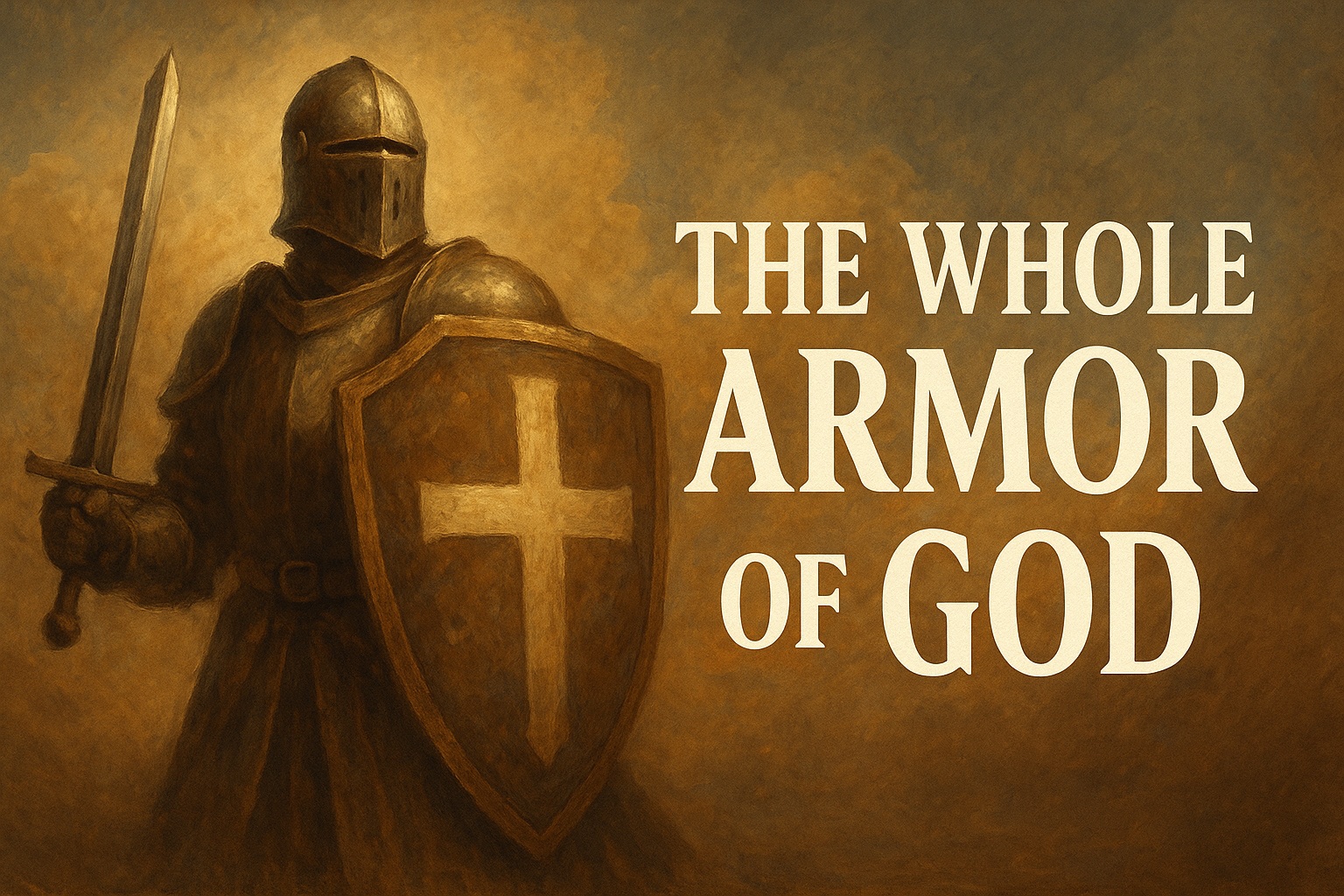
Among a knight’s most treasured possessions were his weapons and armor. These were not ornamental trinkets but the very tools that equipped him to fight and survive in battle. Armor meant life. A knight without armor was simply a man with a sword, vulnerable to every arrow and spear. Armor distinguished the knight from the common fighter; it was his protection, his identity, and his strength.
The apostle Paul uses this imagery in Ephesians 6:10–20 to describe the spiritual resources God provides His people. Before we can look at the individual pieces—the belt, breastplate, shield, helmet, and sword—we must pause at the introduction in verses 10–13. Here Paul explains why armor is necessary, where our strength comes from, and what kind of battle we face. These verses are the rallying cry before the arming.
Be Strong in the Lord (6:10)
Paul begins: “Finally, be strong in the Lord and in the strength of His might.”
The verb “be strong” is in the passive (endunamousthe), meaning literally, “be strengthened.” We do not generate this power ourselves—it must be received. The root is dunamis, the same word used in Romans 1:16 for the “power of God unto salvation.” Paul’s command is: “Let yourselves be empowered by the Lord.”
This is not a call to grit our teeth, square our shoulders, and rely on sheer willpower. Knights knew the limits of their flesh; even the strongest warrior could fall to fatigue or ambush. Likewise, Christians cannot face spiritual forces with human strength. The command is not “be strong in yourself” but “be strong in the Lord.” Our courage, endurance, and resilience are drawn from Christ, the Head of the body (Eph. 1:22–23).
Throughout Ephesians, Paul has painted the picture of the one new man (2:15)—a new creation united in Christ. Individually we are parts of the body, but together, under Christ our Head, we are made strong. This is the only man who will stand in the end. To be outside of Christ is to stand unarmed and exposed. To be in Christ is to be clothed with His strength, decked out in His armor.
The Whole Armor of God (6:11)
Paul continues: “Put on the whole armor of God, that you may be able to stand against the schemes of the devil.”
Some imagine Paul writing these words while chained to a Roman guard, drawing inspiration from the soldier’s kit. While it is possible that Roman armor imagery influenced his language, the closer background is not Roman but biblical. Paul is not pointing us to Caesar’s troops but to God Himself. In Isaiah, the Lord Himself is pictured as a warrior clothed in armor:
- Belt of Truth, Isaiah 11:5—“Righteousness shall be the belt of his waist, and faithfulness the belt of his loins.” This describes the Messiah’s reign, where truth and righteousness define His character.
- Breastplate of Righteousness and Helmet of Salvation, Isaiah 59:17—“He put on righteousness as a breastplate, and a helmet of salvation on his head.” God Himself intervenes as a warrior to save His people, because no one else can.
- Feet of shod with the gospel, Isaiah 52:7—“How beautiful upon the mountains are the feet of him who brings good news… who publishes peace.” A prophecy of the good news of God’s reign and redemption for His people.
- Sword, Isaiah 49:2—“He made my mouth like a sharp sword.” Here the Servant’s word is pictured as a sword, powerful to cut and to save.
- Shield of faith—It doesn’t have a direct reference like the other parts of the armor. Paul is perhaps pulling from a wider OT theme—especially the Psalms and Abraham (cr Psalm 3:3; 18:30; 91:4; Genesis 15:1)—but Isaiah 26:1–4 provides a close tie since it connects “trust” (faith) with God’s protective salvation.
In Isaiah’s context, this armor belonged to God alone—He girded Himself with truth, salvation, and righteousness to deliver His people when no one else could. Paul now declares that the same armor God wore, we are commanded to put on. The Christian does not wear borrowed Roman gear, but divine armor forged in God’s own saving work.
The phrase “whole armor” is one word in Greek: panoplia. It referred to the complete equipment of a soldier—every weapon and every defense. No knight would go to battle with only a shield but no helm, or with a sword but no mail. To be half-armed is to be half-defeated. Paul insists that believers must take up the entire set God provides. Every piece matters.
Notice also that this armor is not of our own making. Knights might inherit armor from their fathers, win it in tournaments, or receive it from their lords. But the armor we need is provided directly by God. Isaiah foresaw this when he pictured the Lord Himself donning armor: a breastplate of righteousness and a helmet of salvation (Isa. 59:17). Christ girds His waist with truth (Isa. 11:5), His mouth is like a sharp sword (Isa. 49:2), His feet bring good news of peace (Isa. 52:7). What God Himself wears, He now supplies to us.
To put on the armor of God is to be clothed in God’s own strength and character. Without it, we are exposed. With it, we can stand firm.
The Schemes of the Devil (6:11b)
Why do we need this armor? Because we face an enemy who is cunning, relentless, and deadly serious. Paul warns that the devil works through schemes (methodeia). This word describes premeditated strategies, calculated deceptions, clever ambushes. Satan is no reckless brawler. He studies, plans, and lays traps. He knows our weaknesses and will exploit them.
The devil’s ultimate goal is to tear down the “one new man” that God has created in Christ. He wants to break our unity, corrupt our holiness, and distract us from our mission. He wants to convince us to lay aside the armor piece by piece until we stand defenseless.
But God has not left us vulnerable. He has given us the strength and armor necessary to withstand every scheme. The question is whether we will take it up.
The True Nature of the Battle (6:12)
Paul makes a crucial clarification: “For we do not wrestle against flesh and blood, but against rulers, against authorities, against the cosmic powers over this present darkness, against the spiritual forces of evil in the heavenly places.”
The word translated “wrestle” (palē) pictures close combat—grappling, not long-distance fighting. The enemy is not just “out there”; the struggle presses right up against us.
Our battle is not against “flesh and blood.” This is a hard truth, because people often appear to be the source of our struggles—those who persecute us, tempt us, betray us, or mock our faith. Yet Paul insists: they are not the enemy; they are the mission. Our true adversaries are unseen spiritual powers working behind the curtain of human affairs.
Paul names them in a kind of hierarchy:
- Rulers (archas) and authorities (exousias) – ranks of fallen angels, mirroring the order among God’s holy angels.
- Cosmic powers (kosmokratoras) over this present darkness – the global, pervasive influence of evil in every corner of the world.
- Spiritual wickedness in the heavenly places – wickedness rooted in the spiritual realm, Satan’s arsenal against God’s people.
This description is sobering. The battlefield is universal; there is no neutral ground. It is also spiritual; no fortress of stone can keep these forces out. Yet we should not despair. In Ephesians 1:21 Paul already proclaimed that Christ is “far above all rule and authority and power and dominion.” Our General is greater than every adversary.
The Call to Stand Firm (6:13)
Paul concludes this section: “Therefore take up the whole armor of God, that you may be able to withstand in the evil day, and having done all, to stand firm.”
Here again the call is to “take up” (analabete), a deliberate act of equipping. We are not to wait passively for strength—we must actively clothe ourselves with what God has provided.
The purpose: “that you may be able” (dunai). This is the same root as “power” (dunamis). God’s strength becomes operative in us when we take up His armor.
The goal: “to withstand” (antistēnai) and “to stand” (histēmi). These words emphasize holding the line, resisting the assault, not collapsing under pressure. Every soldier knows there are decisive moments—days when the enemy presses hardest, when the battle reaches its climax. Paul calls this “the evil day.” It may be a season of temptation, persecution, doubt, or loss. Satan will hurl his fiercest assaults. On such days, half-hearted faith will crumble. But the soldier clothed in God’s armor will stand.
The imagery fits perfectly with knights. Holding the line was often the difference between victory and defeat. For Christians, standing firm in faith protects not only ourselves but the witness of the gospel.
Living the Reality of the Armor
What does this mean for us in daily life?
- Depend on God’s strength, not your own. Our battles are too great for human effort. Prayer, worship, and Scripture study are not optional extras; they are lifelines to the strength of Christ.
- Recognize the real enemy. People are not our foes. They are captives in need of rescue. Anger at flesh and blood only distracts from the true war.
- Stay fully armed. Do not grow complacent or selective about which virtues or disciplines matter. Truth, righteousness, faith, salvation, the Word, and prayer all work together.
- Stand your ground. Victory is not measured by worldly success but by faithfulness. If, at the end of the day, you are still standing in Christ, you have won.
Conclusion:
Paul’s introduction to the armor of God reminds us that we are at war—an invisible but deadly serious conflict. The enemy is cunning and powerful, but God’s strength is greater. Our King supplies armor forged by His own righteousness, salvation, faith, truth, and Word. The call is simple: take it up, and stand firm.
In the articles that follow, we will examine each piece of this divine armor. Like a knight preparing for battle, we will strap on the belt of truth, fasten the breastplate of righteousness, fit our feet with the gospel of peace, lift the shield of faith, don the helmet of salvation, and wield the sword of the Spirit. Each piece matters. Each piece protects. And together, they equip us to fight the good fight and finish the race.
The blacksmith’s work is done. The armor lies before us. The question is: will we put it on?

 Knights of The Father