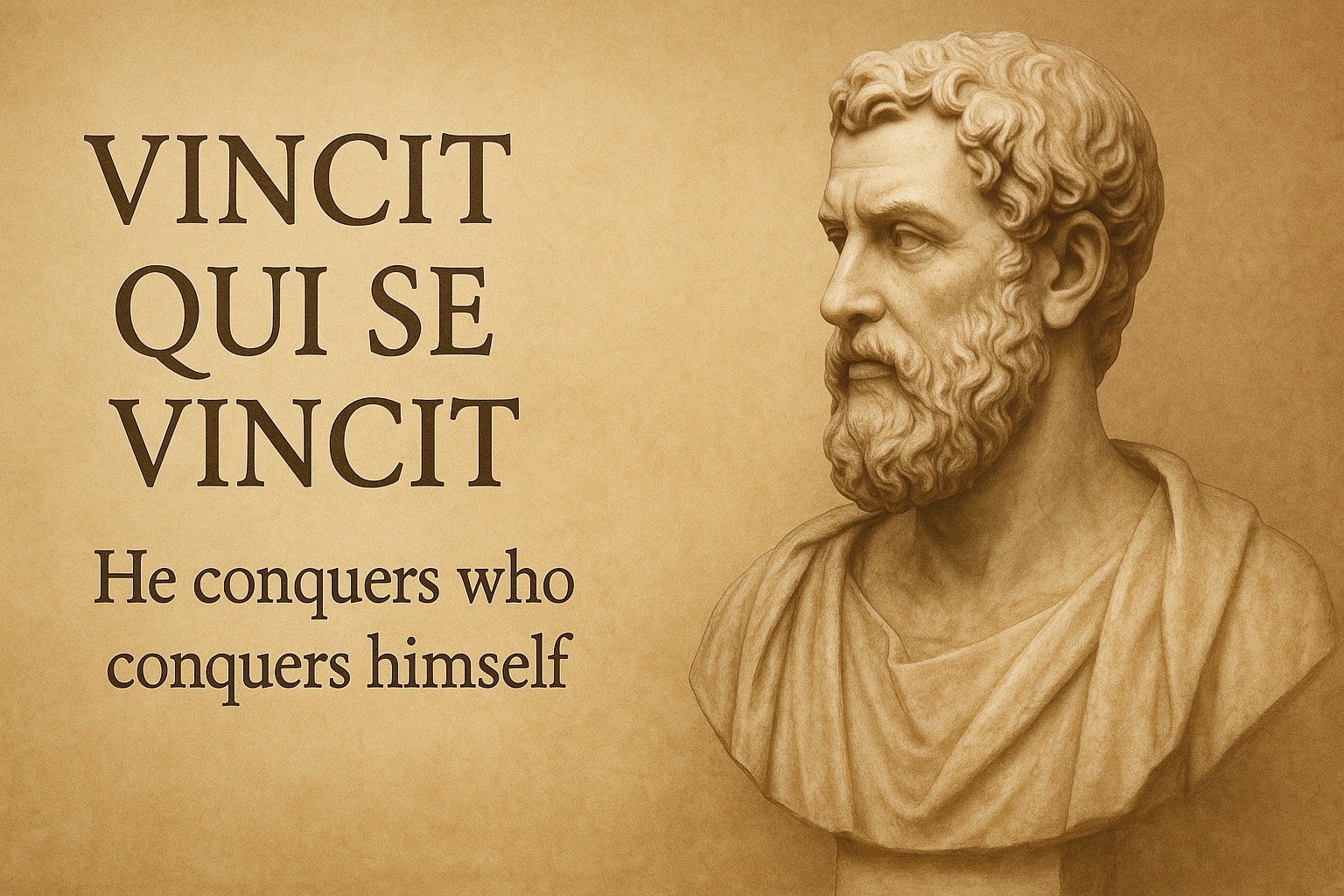
“Vincit qui se vincit” — He conquers who conquers himself.
This Latin maxim, often linked to the Roman writer Publilius Syrus, captures a truth deeper than battlefield glory or personal success. In its fuller form, he wrote: “Bis vincit qui se vincit in victoria” — He conquers twice who conquers himself when he is victorious.
Victory is not only about prevailing over external foes. There is a greater conquest: the one within.
The Wisdom of the Ancients
From the Stoics to the Scriptures, the message resounds: discipline is strength, and restraint is wisdom.
“Within your control are your own opinions, aspirations, desires, and the things that repel you… Not within your control is literally everything else.” — Epictetus
Self-control was central to ancient philosophy, not as repression, but as freedom — the ability to master one’s desires and act according to virtue rather than impulse. This moral ideal echoes through the Bible as well, especially in the concept of the fruit of the Spirit.
I. The First Victory: Discipline Before Triumph
The Apostle Paul places self-control last among the fruit of the Spirit (Galatians 5:22–23), not because it’s least important, but perhaps because it is the most demanding. Without it, the rest falters. (Note: in Peter’s list of Christian virtues in 2 Peter 1:5-7, self-control is near the beginning perhaps indicating that it is foundational to our spiritual development.)
What Is Self-Control?
The Greek word enkrateia implies mastery — taking hold of oneself. It is the ability to direct desires, not be directed by them. It is strength of soul.
“Make every effort to add to your faith… self-control…”— 2 Peter 1:5–7
This quality:
- Keeps the flesh in check (Galatians 5:24)
- Allows us to resist sin’s appeal (James 1:13–15)
- Enables spiritual growth and effectiveness (2 Peter 1:8–9)
Paul’s Emphasis on Mastery
Paul speaks plainly to Felix about “righteousness, self-control, and the judgment to come” (Acts 24:25). He urges believers to be like athletes — temperate in all things, striving for mastery (1 Corinthians 9:25–27). He even recommends marriage to those struggling with self-control, lest passion lead them to sin (1 Corinthians 7:9).
This is not mere stoicism. It is rooted in submission to God — a recognition that holiness requires restraint, and restraint requires strength.
Areas to Master
- Lust – 1 Thessalonians 4:3–6; 1 Peter 4:1–4
- Speech – James 3:1–12
- Body – 1 Corinthians 6:12–20
- Mind – Philippians 4:8; 2 Corinthians 10:5
- All things – 1 Corinthians 9:25
You may be strong in one area but weak in another. Self-control must grow in all areas of life.
How to Develop It
- Recognize Temptation Is Resistible – 1 Corinthians 10:13
- Pray for Strength – James 5:13–16
- Stop Sin at the Source – James 1:14–15; guard your thoughts early
- Use Scripture as a Sword – Like Jesus in Matthew 4
- Replace Evil with Good – Ephesians 4:28–32
- Fast to Train the Will – Though never commanded, it can develop discipline
“Addicts rarely slip—they smash.” Mastery starts long before the moment of temptation.
The Deceptive Opposite
Peter gives a vivid description of the opposite of self-control (2 Peter 2–3):
- Following destructive ways
- Acting like unreasoning animals
- Slaves of corruption
- Walking in lust and scoffing at righteousness
A person without self-control is open to every spiritual attack. Without walls, they are a city already conquered (Proverbs 25:28).
II. The Second Victory: Restraint After Triumph
Publilius Syrus’s fuller phrase points to a deeper truth: It is even harder to conquer oneself after success.
When victory comes — praise, promotion, vindication — there is a temptation to gloat, boast, or exact revenge. But the truly victorious man is the one who restrains himself in victory.
Ruling the Spirit
“He who is slow to anger is better than the mighty, And he who rules his spirit than he who captures a city.” — Proverbs 16:32
It is easy to react with pride, sharp words, or vengeance. It takes far more strength to stay composed. True greatness is seen not just in the fight, but in the aftermath.
“A fool’s anger is known at once, but a prudent man overlooks an insult.” — Proverbs 12:16
Reacting in anger is often praised as strength, but it’s actually a form of surrender — letting others control your spirit.
The Power of Silence and Restraint
“He who restrains his words has knowledge, And he who has a cool spirit is a man of understanding.” — Proverbs 17:27
Words are powerful — James calls the tongue a fire, a restless evil (James 3). Those with wisdom speak sparingly, carefully, not to wound but to guide.
A person with a cool spirit does not allow others’ chaos to become his own. He remains composed, not reactive.
When Praise Becomes a Test
“The crucible is for silver and the furnace for gold, And a man is tested by the praise accorded him.” — Proverbs 27:21
Praise can be a test of character just as much as hardship. There are two common dangers:
1. Pride
- Gloating, self-glory, or boasting reveals arrogance.
- We forget that all we have is from God (cf. Romans 12:3; Matthew 6:1).
- Pride leads to a fall (Proverbs 16:18).
2. False Humility
- Shrugging off praise with “It was nothing” can insult the giver.
- Better to accept praise graciously: “Thank you.”
- Use it as a mirror for growth — learn what was done well and repeat it.
The one who can remain humble under praise has conquered himself.
When Others Fall
“Do not rejoice when your enemy falls…” — Proverbs 24:17–18
Even if someone’s fall feels justified, it is not ours to celebrate. God is the judge (Romans 12:19). Gloating shows we are still mastered by vengeance, not mercy.
“He who mocks the poor taunts his Maker…” — Proverbs 17:5
“Woe to Edom… you gloated over your brother in the day of his misfortune.” — Obadiah 12
Job offers a noble contrast:
“Have I rejoiced at the extinction of my enemy…? No.” (Job 31:29)
Restraint after victory also means mercy toward those who suffer — even those who once wronged us.
Conclusion: The Greater Victory
A college president once told graduating seniors: “It gets easier and easier for man to dominate his universe — and harder for him to dominate himself.” — Mrs. A. E. Janzen
The battles we fight in the world matter little if we lose the battle within. But the man who conquers himself — his anger, pride, lust, tongue, and desire for revenge — wins twice. Once in striving, and once in victory.
“He who conquers his soul is greater than he who takes a city.”
Let us be conquerors not by force, but by faith. Not by pride, but by restraint.
For true strength is measured not by how many fall before you —
But by how often you stand firm within yourself.
By Jeremy Sprouse
Jeremy has been married to Erynn since August 1999. They are blessed with six children: Jaden, Isaiah, Isaac, Ean, Joseph, and Evelyn. Jeremy preaches for the Patrick St. church of Christ in Dublin, TX and is the author of To Train Up a Knight.

 Knights of The Father