
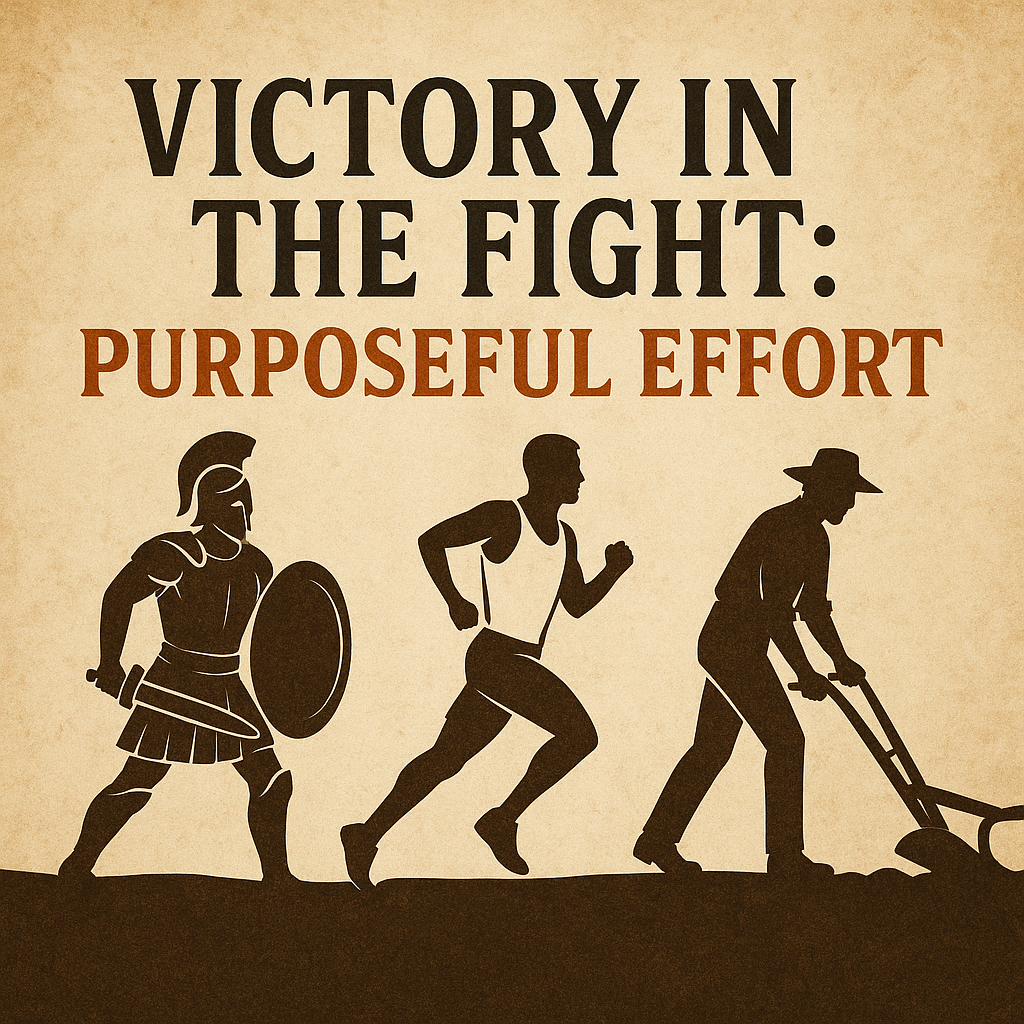
The Christian life is not one of ease or passivity. From the moment we confessed Christ, we enlisted in a battle, entered a race, and took up the steady labor of the field. Consider Paul’s godly advice to Timothy:
Suffer hardship with me, as a good soldier of Christ Jesus. No soldier in active service entangles himself in the affairs of everyday life, so that he may please the one who enlisted him as a soldier. Also if anyone competes as an athlete, he does not win the prize unless he competes according to the rules. The hard-working farmer ought to be the first to receive his share of the crops. (2 Timothy 2:3-6)
Paul’s charge to Timothy in 2 Timothy 2:3–6 is not about comfort, but about purposeful effort. Timothy had begun to shrink back under the pressure of hardship, but Paul reminds him—and us—that victory requires perseverance. Whether on the battlefield, in the arena, or in the fields, success comes only to those who endure difficulty with focus and discipline. God has not called us to the sidelines but to active service, striving lawfully, and laboring faithfully.
Timothy had apparently been backing away because he was not willing to suffer hardship. he had taken his eye off the goal and let the difficulties of service distract him. Paul gives him a three examples of suffering hardship to reach the prize—to win.
I. The Soldier
You want to be a good soldier, not just a soldier in name. A good soldier fulfills his duties faithfully and responsibly. He accepts a position that carries high risks, willingly putting himself in harm’s way because he believes in the cause.
Paul emphasizes that the soldier is in active service. He is not in the reserves, not sitting on an inactive roster, but engaged in duty now. You cannot be a Christian and remain on the sidelines. Far too many have tried to wear the name of Christ passively. Jesus said in Matthew 10:32 that we must confess Him before men—it is a daily challenge to stand up for the faith. We cannot be passive and still be effective soldiers for Christ.
There is work to be done (2 Timothy 2:1–2; Matthew 28:18–20). We talk about the lost, but often fail to reach them. We speak of the Bible’s depth, but neglect daily study. We affirm the power of prayer, yet do not bring our burdens before God. Soldiers are not spectators—they engage. We must leave the sidelines and enter the battle.
Paul also says the soldier must not become entangled. The word refers to wool caught in thorns—something that hinders, though not necessarily sinful. Roman soldiers were expected to avoid unnecessary distractions, remaining wholly devoted to their duty. So too must Christians guard against divided focus.
Many today lose sight of their mission. Instead of worship, they chase paychecks. Instead of building the church, they busy themselves with cars, homes, and lawns. These things are not evil, but they can become thorns if they distract us from service to God.
Finally, the soldier’s aim is to please the one who enlisted him. That is God Himself. We were enlisted when we obeyed the gospel, and as His soldiers, we must follow His commands (cf. John 14:6). We cannot please Him while living by our own thoughts, feelings, and desires. His Word provides our marching orders (2 Timothy 3:16–17). A good soldier works hard to obey and to save others. This is the primary duty of the soldier of the cross—and this is what truly pleases God.
II. The Athlete
The athlete competes—he is not a spectator. He does not sit in the stands critiquing the effort of others, nor is he satisfied to wear the uniform without entering the contest. God needs contenders, not pretenders. Just as an athlete disciplines his body with training, so the Christian must discipline his spirit with prayer, study, and obedience. Paul says, “Everyone who competes in the games exercises self-control in all things” (1 Corinthians 9:25). If earthly athletes give up comfort and pleasure to pursue a fading crown, how much more should we contend for an eternal one? Jude 3 calls us to “contend earnestly for the faith,” reminding us that we are participants in the most important contest of all—the defense and demonstration of God’s truth.
Yet Paul reminds Timothy that the athlete must compete according to the rules. Victory is not gained by cutting corners. The world may applaud those who cheat their way to success, but God does not crown lawless effort. The Christian cannot ignore God’s commands and still expect His approval. Paul warned of those who “run in vain” (Galatians 2:2) or are hindered by false teaching (Galatians 5:7). The race is not simply about effort, but about effort rightly directed. To run outside the boundaries is to disqualify oneself.
The athlete competes to win the prize. Paul uses the word stephanos—the victor’s crown, a wreath of leaves placed on the head of the winner. Earthly competitors often took great pride just in participating at the games, but Paul urges us not to be content with “just competing.” We are not striving merely for the honor of having been in the contest; we are striving for victory. The prize is not a fading crown of laurel but the unfading crown of life (1 Corinthians 9:25; 2 Timothy 4:8). The goal is to hear the Lord Himself say, “Well done.” That is what motivates us to press on when weary, to train when it is easier to be idle, and to keep our eyes fixed on the finish line of heaven.
III. The Farmer
The farmer is hardworking. Unlike the soldier and the athlete, whose labors may be short bursts of intensity, the farmer’s life is marked by steady, daily perseverance. There are no shortcuts to harvest. A hardworking man has rights that a lazy man has forfeited. To be a farmer who succeeds, you must have discipline and diligence—the discipline to rise early, to sow even when tired, and to tend the field when the outcome is uncertain. Ecclesiastes reminds us, “He who watches the wind will not sow and he who looks at the clouds will not reap” (Ecclesiastes 11:4). The faithful farmer works even when it might rain, because waiting for perfect conditions means nothing is ever planted.
Paul says the farmer is the first to receive his share. He reaps the fruit of his labor before anyone else does. His reward is directly tied to his effort. The one who is diligent will eat, while the one who is lazy has no crop to harvest. Scripture is plain: “Whatever a man sows, this he will also reap” (Galatians 6:7). The same principle is echoed in 2 Thessalonians 3:10—“If anyone is not willing to work, then he is not to eat, either.” God’s order of things is that blessing follows labor, both in the field and in the faith.
There is also a warning here. Many want to enjoy the harvest without enduring the hardship of sowing. Some try to ride the wave of another man’s effort, boasting in a crop they never planted (1 Corinthians 9:10). But in God’s field, there are no borrowed harvests. Each servant must work with his own hands, sow with his own tears, and reap with his own joy. The farmer’s lesson is simple but profound: if you want to partake in the blessings of God’s work, you must first take part in the labor.
Conclusion
Paul’s three images—a soldier, an athlete, and a farmer—are not simply illustrations, but challenges. All three have to do with hard work, achieving a level of success based upon hard work. Each one reminds us that the Christian life is not won by half-hearted effort or divided loyalty. Soldiers remain focused on their Commander’s will. Athletes press toward the prize by following the Lord’s rules. Farmers reap only if they sow with diligence and perseverance. Victory in Christ is not accidental; it is the result of purposeful effort, anchored in faith and obedience. The question before us is simple: are we willing to suffer, strive, and labor so that we may one day hear our Lord say, “Well done, good and faithful servant”?
By Jeremy Sprouse
Jeremy has been married to Erynn since August 1999. They are blessed with six children: Jaden, Isaiah, Isaac, Ean, Joseph, and Evelyn. Jeremy preaches for the Patrick St. church of Christ in Dublin, TX and is the author of To Train Up a Knight.

 Knights of The Father