

(Based on Chapter 3 of W. E. Cule’s Sir Knight of the Splendid Way)
The city looked like peace—or so it seemed.
Its marble walls gleamed in the midday sun, and flowering vines traced veins of green and gold across silver gates thrown open in welcome. No guards stood watch. No sword was drawn. There were no tolls, no tests, no cries of “Who goes there?”—only a golden inscription above the arch:
“For the pilgrim of the Splendid Way there is rest and peace in this city, the City of Good Intent.”
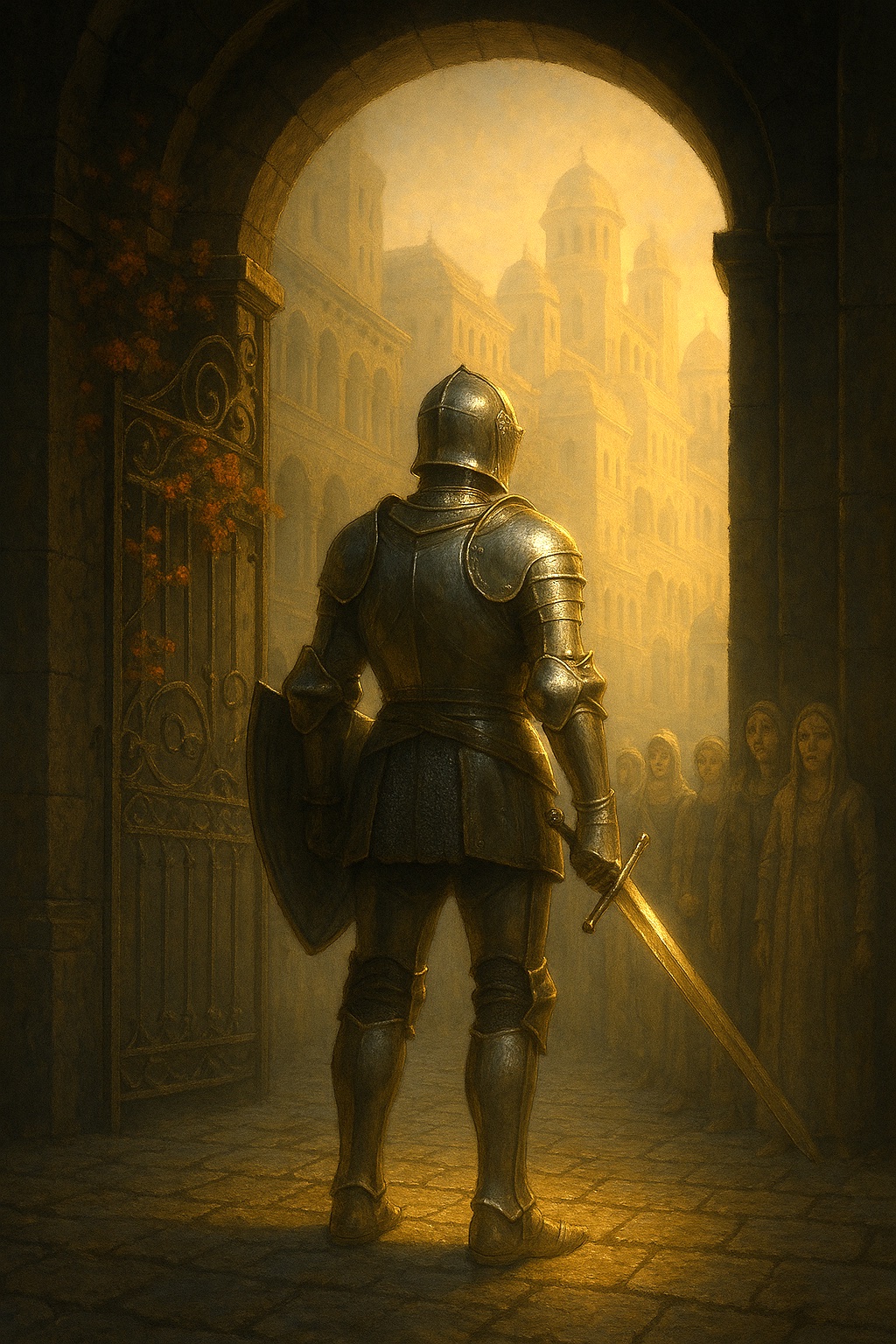
Sir Constant paused beneath the gate. Shaded paths wound through quiet gardens. Men reclined by fountains with serene faces, their brows untroubled. Yet something was wrong.
None wore armor.
None carried sword or shield.
And though some smiled or nodded, their eyes were distant—dreaming.
He watched them, and a darker truth struck him: none of them came out. They dreamed of noble deeds, yet never rose from their reclining places. It was the very warning James once gave—that to hear without doing is to be deceived (James 1:22). True faith does not linger in dreams; it moves with hands and feet, with care and compassion (James 1:27; 2:14–17).Sir Constant’s hand lingered on his hilt. Was this truly rest—or a spell?
From a small lodge by the gate, a bell suddenly rang—deep, urgent, and solemn.
Its cry shook the air like a call to arms. Trees trembled. Fountains stilled. Some within the city staggered where they stood, clutching their chests or pressing their temples, as if waking from a long sleep.
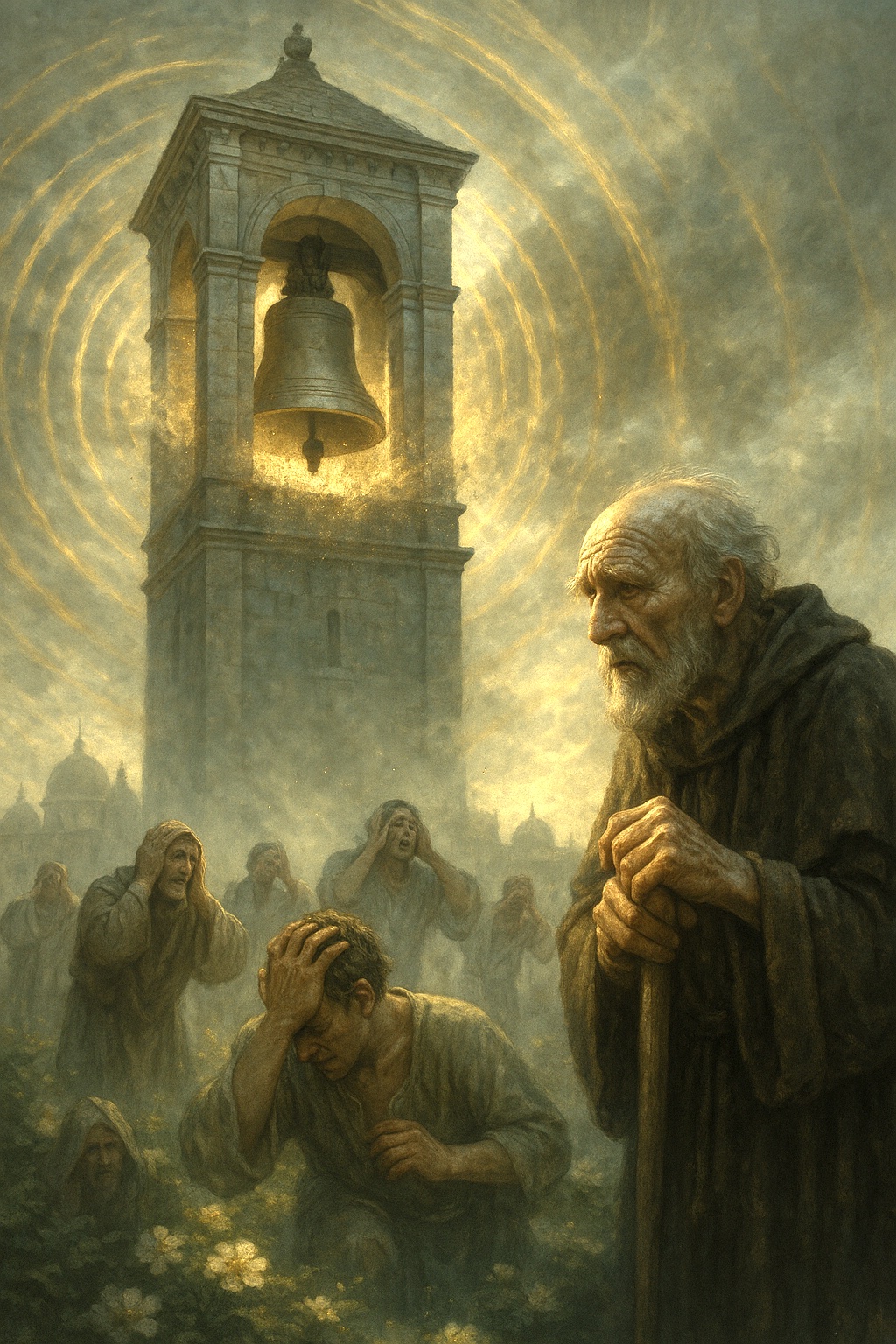
Then the bell ceased.
And the silence that followed was heavier than before.
An old man, weathered like oak, stepped from the bell tower and looked upon Sir Constant.
“It is well you tarry at the threshold,” the man said. “Many a knight has passed these gates with no evil in his heart—only weariness. They came seeking rest. But this city ensnares not the wicked, but the well-meaning. They dream of noble deeds, and know not that they dream. And while they dream, the hours flee—and their days are gone.”
Sir Constant’s gaze darkened. “But one such as I know is already within, do I not? Sir Ardent?”
The old man nodded gravely. “He passed this way long ago. A brave heart. But the longer one lingers in Good Intent, the heavier the armor grows—until at last they set it down.”
Ephesians 5:14 tells us: “Awake, sleeper, And arise from the dead, And Christ will shine on you.” Sleeping and death have something in common, your eyes are closed, you cannot see. It is like living in darkness. This is an exhortation to anyone who is living their life with their eyes closed as if they were in darkness. Wake up, open your eyes and see the light. Rise out of the dead. The imagery is like getting up in the morning and opening the shutters so you can see. Christ is the light and we are to reflect that light so that others in darkness can see clearly.
After this admonition, Paul continues: “Therefore be careful how you walk, not as unwise men but as wise, making the most of your time, because the days are evil” (Ephesians 5:15-16). We are to be careful with our steps—literally it means to look intently and scrutinize your path. Paul is talking about our Christian conduct. Our mission, our goal is to walk carefully.
Notice, he says walking. This is a way of describing the course of one’s life, but it is also describing movement. You cannot reach a destination by standing sill. Those standing still have taken their eyes off the goal. Perhaps they have become distracted by materialism or worry. Whatever they reason, their progress has halted. We must be aware of the darkness (cf. Ephesians 5:3-13) and the dangers of walking foolishly.
The Armor You Abandon Is the Armor You Lose
Then Sir Constant remembered the voice that called him in the Chapel of Voices… the Face of Love that once strengthened him… and the vow he and Ardent had made at the waters of their baptism when first they gave themselves to the King. He gripped his sword tighter.
“I will go in.”
“Then draw your blade,” said the old man, “and bear your shield. Not for battle—but that some, seeing it, may remember.”
So they entered.
No man hindered them. None questioned them. All smiled—but with lips only. The eyes remained clouded.
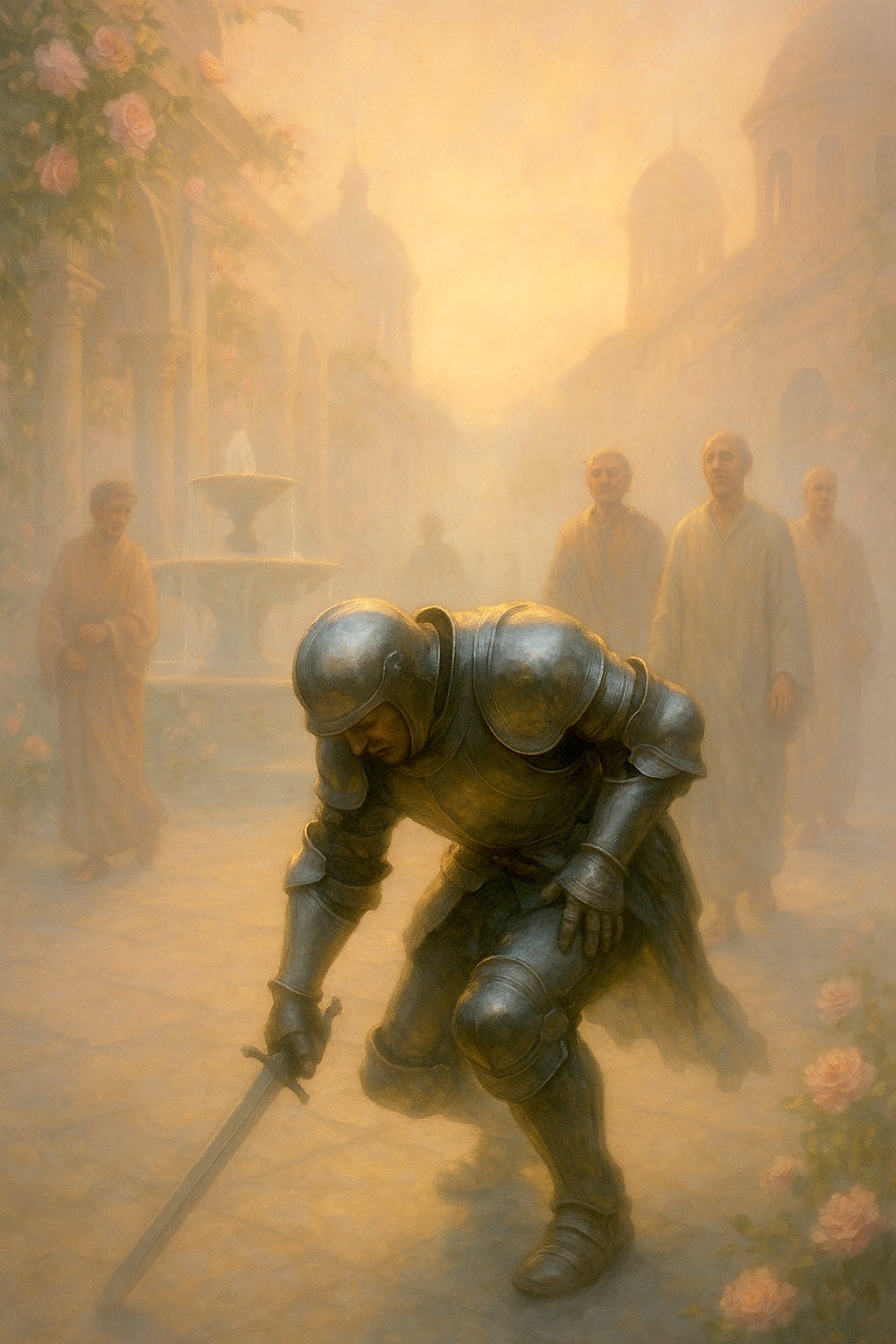
And the air—oh, the air! It was warm and perfumed, like honey and sun-drenched summer. Sir Constant breathed it in and staggered beneath the sudden weight of his armor.
Never had it felt so heavy.
He looked around. Others had once worn arms, he could tell by their gait. But now they strolled in robes and linen, their armor long since discarded.
“This mail is burdensome,” he muttered. “There is no danger here. Perhaps I may lay it down—”
“Nay,” the old man said. “What but a spell would rob a knight of his arms? Forget not how you won them. Forget not how they served you.”
The words struck him deep, and memory stirred. He had once been told to be strong—not in himself, but in the Lord. To stand only by the armor the King supplied (Ephesians 6:10–13). Each piece had been his strength in trial, each a gift of grace (Ephesians 6:14–17). And he knew if he cast them aside now, he would have nothing left when the true battle came.
We are to be strong in the strength of His might—we are not out there by ourselves doing the warfare. It is in regard to our relationship to Him. We draw strength from Him and we are not to depend on ourselves. The head gives the orders to the rest of the body. He gives us our matchings order. We do what He says. We are listening now to Christ. This is where we gain our strength. Christ communicates now to us in the word we have been given.
It is only by putting on and keeping on the full armor of god that we can stand firm against the schemes of the devil. It can be tiring, and we may feel like putting it down and taking the easy route in life, but remember Paul’s admonition to the Galatians: “Let us not grow weary of doing good, for in due season we will reap, if we do not give up.” (Galatians 6:9).
The Cost of Delay
They found him at last—in an arbour, bathed in dappled light. Sir Ardent reclined among the blossoms, head resting against the stone bench, eyes fixed on the horizon.
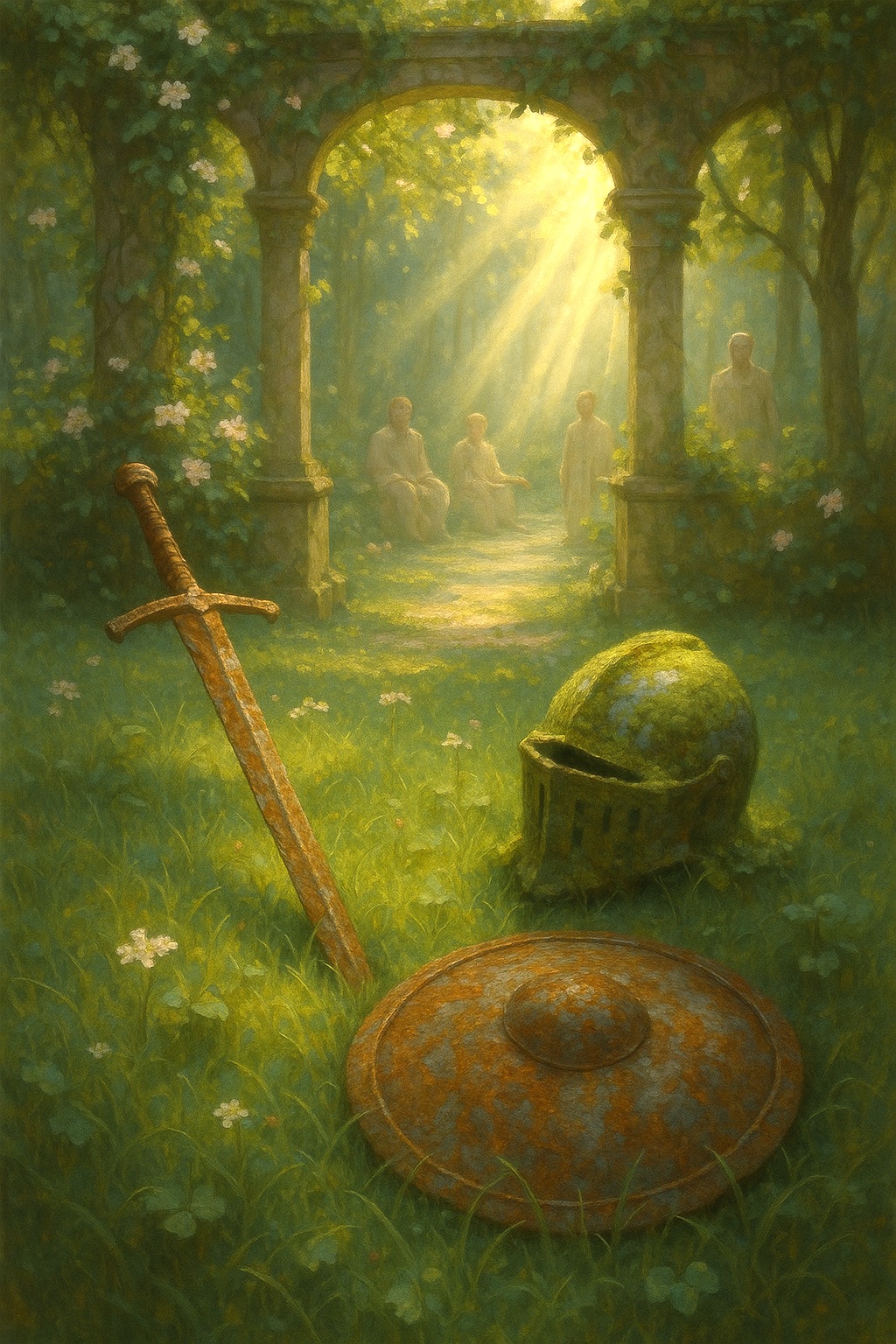
Beside him lay his arms: a rusted blade, a mildewed shield, a helmet marred and dull. His armor was strewn like a boy’s toys forgotten in the grass.
Yet he smiled.
“Do you see him?” he whispered. “There, beyond the hills—there walks a knight of the Splendid Way. The King Himself will soon call his name, and the city gates will open, and—”
“Ardent!” Sir Constant cried, “there is no city beyond the walls! No knights ride there! This dream is a lie that devours your years.”
But Ardent would not stir. “It is no lie. I see it clearer than your face. There is honor ahead, and they will call my name.”
“No,” said Sir Constant, falling to one knee beside his friend. “There is only rust, and time wasted. There is no honor in good intent alone. Only obedience wins the reward.”
Consider the words of James 1:22 again: “But prove yourselves doers of the word, and not merely hearers who delude themselves.” Some hear the Word, but the word has not effected a change within them. Hearing is not enough. We must prove ourselves to be better by actually putting God’s Word into practice. Otherwise, we are just deluding ourselves. Self delusion is among the most dangerous of all delusions. When someone else deludes you they have just won one argument and someone else may convince you otherwise. When you delude yourself, no one else may be able to convince you otherwise.
As Sir Constant continued to speak, his voice softened. “Do you remember the Chapel? Do you remember our vows, the waters, the day we swore our fealty to the King?”
Something flickered in Sir Ardent’s eyes.
The Tears That Burn Away Shame
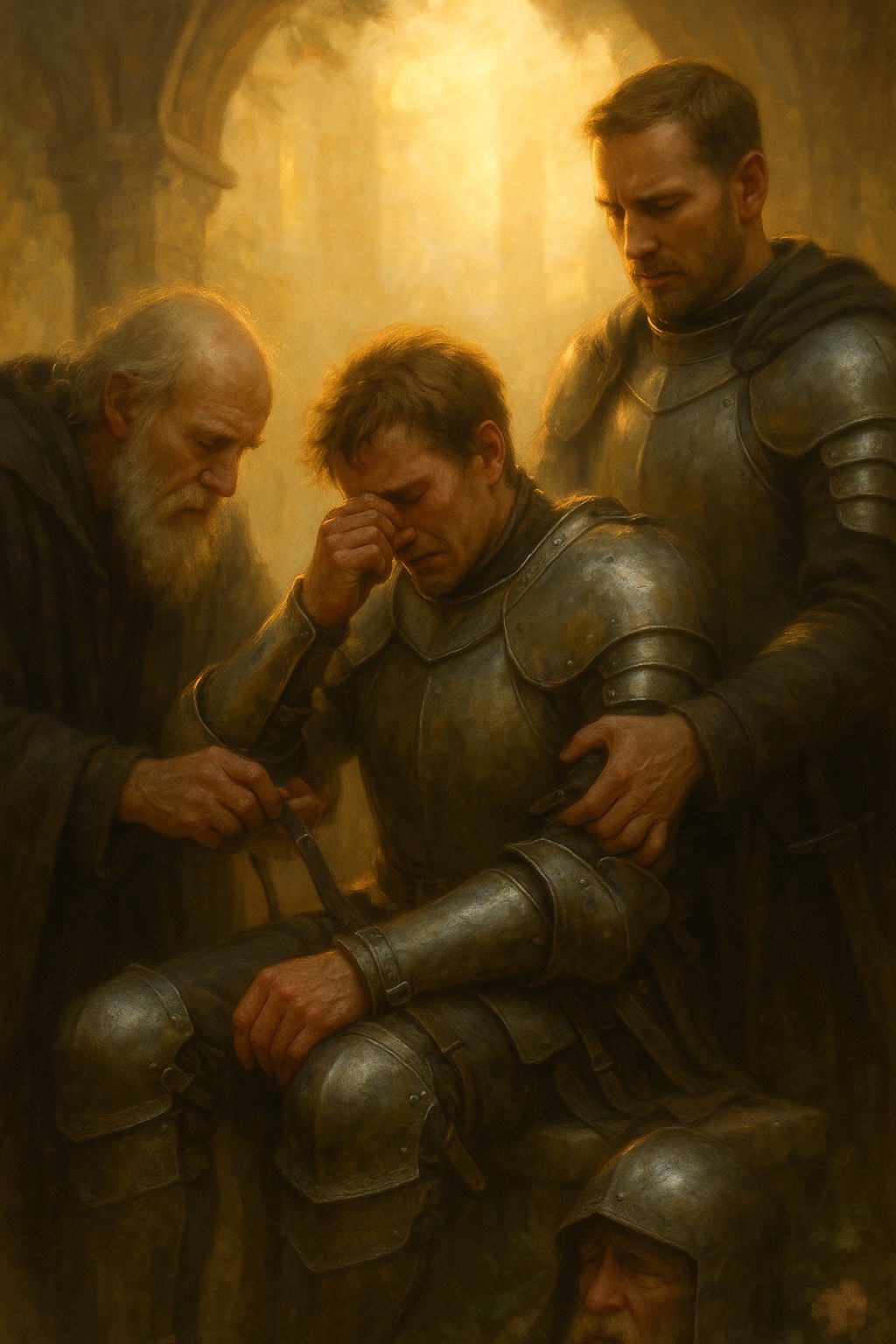
Slowly, Ardent turned. He looked at his mail. He touched the ruined shield. His hand trembled.
“It is too late,” he whispered. “I let the years pass… I cannot lift this armor now.”
But Sir Constant took him by the shoulder. “It is never too late to rise.”
Then Ardent wept—long, wracking sobs of shame and sorrow. But his tears were more than grief. They were the tears God does not despise, the broken and contrite heart He receives (Psalm 51:17). And so, though trembling, he reached for his armor once more
Piece by piece, the knight was rearmed. And though it was hard and slow, though the armor was heavier than ever before, at last he stood—mailed, helmed, and ashamed, but not defeated.
As they turned to leave, dreamers watched them go: the steadfast knight and the broken one reborn. Some blinked. Some stirred. And in days to come, it was said, others began to don their armor again.
And the Emblem Shone Again

As they passed once more beneath the city gate, Sir Constant turned—and saw it.
Upon Ardent’s shield, where once only stain and rust remained, the Emblem of the King now shimmered faintly, like gold beneath a veil.
For the tears of repentance had fallen where soap and polish could not. And the stain was burned away. Such tears are never wasted; they water a different kind of harvest. “Those who sow in tears shall reap with shouts of joy” (Psalm 126:5). And the Knight of Heaven Himself is the restorer, the shepherd who leads the weary back to strength: “He restores my soul. He leads me in paths of righteousness for his name’s sake” (Psalm 23:3).
Lessons for the Modern Knight
- Good intentions are not obedience.
A father may dream of leading his home in prayer, of reading Scripture to his children, of showing patience, of rising early to bless his day with discipline. But dreams are no substitute for deeds. The City of Good Intent is paved with delay—and delay rusts the armor.
“So whoever knows the right thing to do and fails to do it, for him it is sin.” —James 4:17
2. Don’t lay down your arms when the battle feels easy.
Laziness never attacks head-on. It seduces with comfort. “Rest a while,” it whispers. “You’ll get serious tomorrow.” But a shield on the ground is no help in the fight.
“The sluggard does not plow in the autumn; he will seek at harvest and have nothing.” —Proverbs 20:4
“Stay awake, stand firm in the faith, act like men, be strong.” —1 Corinthians 16:13
3. Fathers awaken fathers.
Sir Constant didn’t save Ardent with eloquence or force—but with memory. He reminded his brother of who he was. In a world full of distracted men, a faithful father is a sounding bell.
“Let us consider how to stir up one another to love and good works.” —Hebrews 10:24
4. Repentance redeems what time and shame would erase.
Even if you feel like your best years are behind you, God can restore your strength. The emblem still shines beneath the rust—if you’ll weep, rise, and return to the fight.
“I will restore to you the years that the swarming locust has eaten.” —Joel 2:25
“He who began a good work in you will bring it to completion at the day of Jesus Christ.” —Philippians 1:6
For the King, for your sons, for the path ahead—do not settle for good intent. Press on. Fight on.
By Jeremy Sprouse
Jeremy has been married to Erynn since August 1999. They are blessed with six children: Jaden, Isaiah, Isaac, Ean, Joseph, and Evelyn. Jeremy preaches for the Patrick St. church of Christ in Dublin, TX and is the author of To Train Up a Knight.

 Knights of The Father