
We live in a world flooded with words—tweets, headlines, podcasts, emails, comment sections, political speeches, and advertising slogans. But not all words build up. Many deceive. Some seduce. Others destroy. We’ve learned how to weaponize language: spin replaces truth, sarcasm replaces sincerity, and words become tools of manipulation and self-promotion rather than honesty and connection.
If you’ve ever felt overwhelmed by the noise—if you’ve ever wondered “Where did all the faithful go?”—you’re not alone. David felt it too. Psalm 12 is his cry from the middle of a world drowning in deception.
This is not a long psalm—just eight verses—but it is emotionally powerful. David opens with desperation. He sees a world where the godly are vanishing and lying lips are thriving. But this psalm is not complaining, it is a prayer turning to God for help during a time of moral collapse.
And what makes Psalm 12 unique is this: God answers. Directly. Immediately. That happens in only three other psalms (60, 81, and 95). The Lord doesn’t just listen—He speaks. And when God speaks, His words don’t flatter or falter. They are pure. Powerful. Unshakable.
Psalm 12 is not merely a mirror of a corrupt world. It’s a window into the heart of a righteous God—and a reminder that in a world where words deceive, God’s Word can still be trusted.
Let’s walk through this psalm in three stages:
- David’s Prayer (vv. 1–4) – A cry against the corruption of speech and spirit.
- God’s Promise (v. 5) – A divine answer to the groans of the oppressed.
- David’s Confidence (vv. 6–8) – A renewed trust in the purity of God’s Word and the protection of His people.
Because when truth is trampled and lies are loud, the faithful don’t need louder voices—they need deeper trust. Let’s begin.
I. David’s Prayer (Psalm 12:1–4)
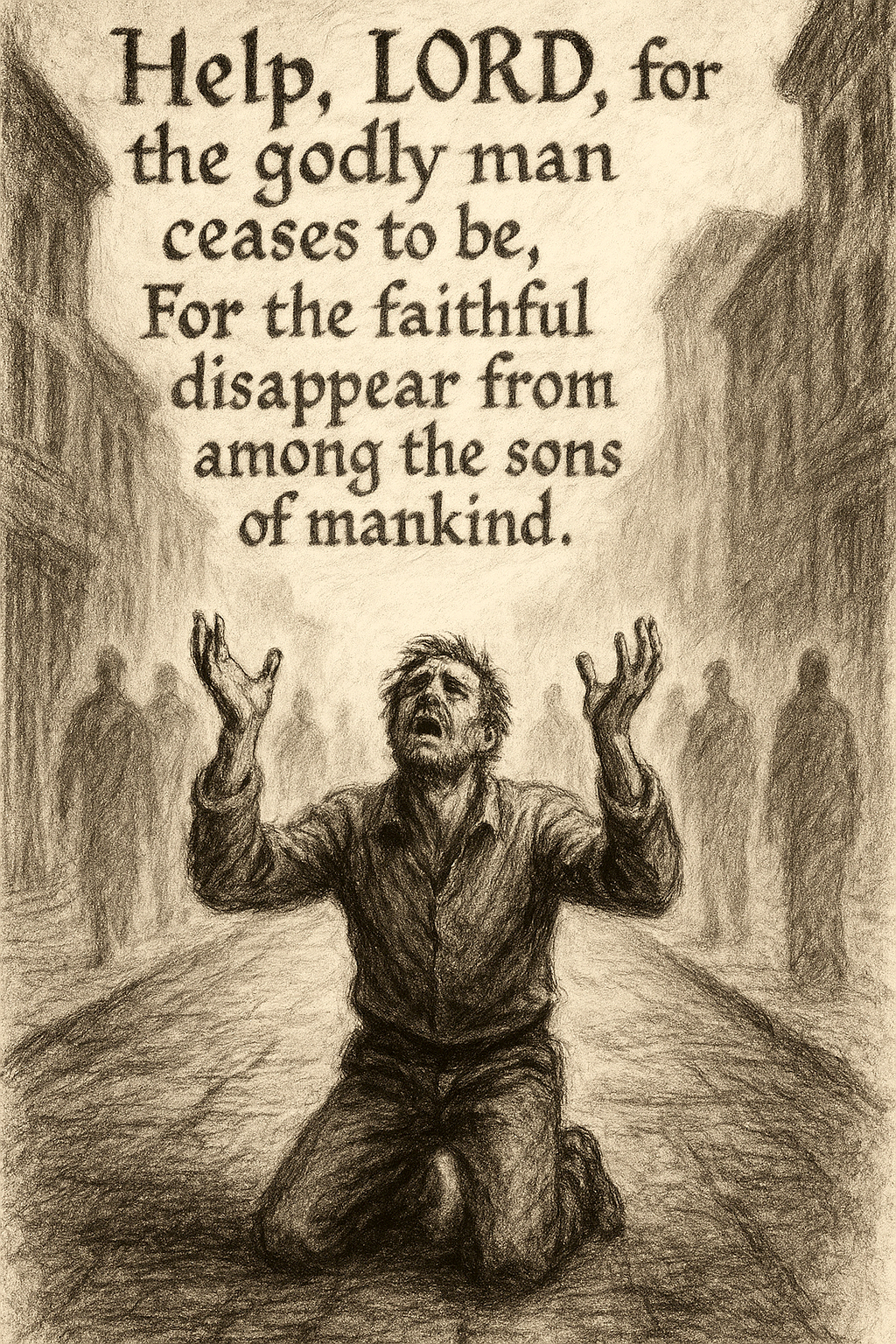
“Help, Lord, for the godly man ceases to be, For the faithful disappear from among the sons of men.” (v. 1)
David begins this psalm with a distress signal—a plea that feels as relevant today as it did in ancient Israel. He looks around and sees a moral and spiritual vacuum. The faithful are few. Integrity is rare. Truth is drowned out by manipulation and lies. In a world where no one can be trusted, David doesn’t turn inward—he calls upon God to act.
“They speak falsehood to one another; With flattering lips and with a double heart they speak.” (v. 2)
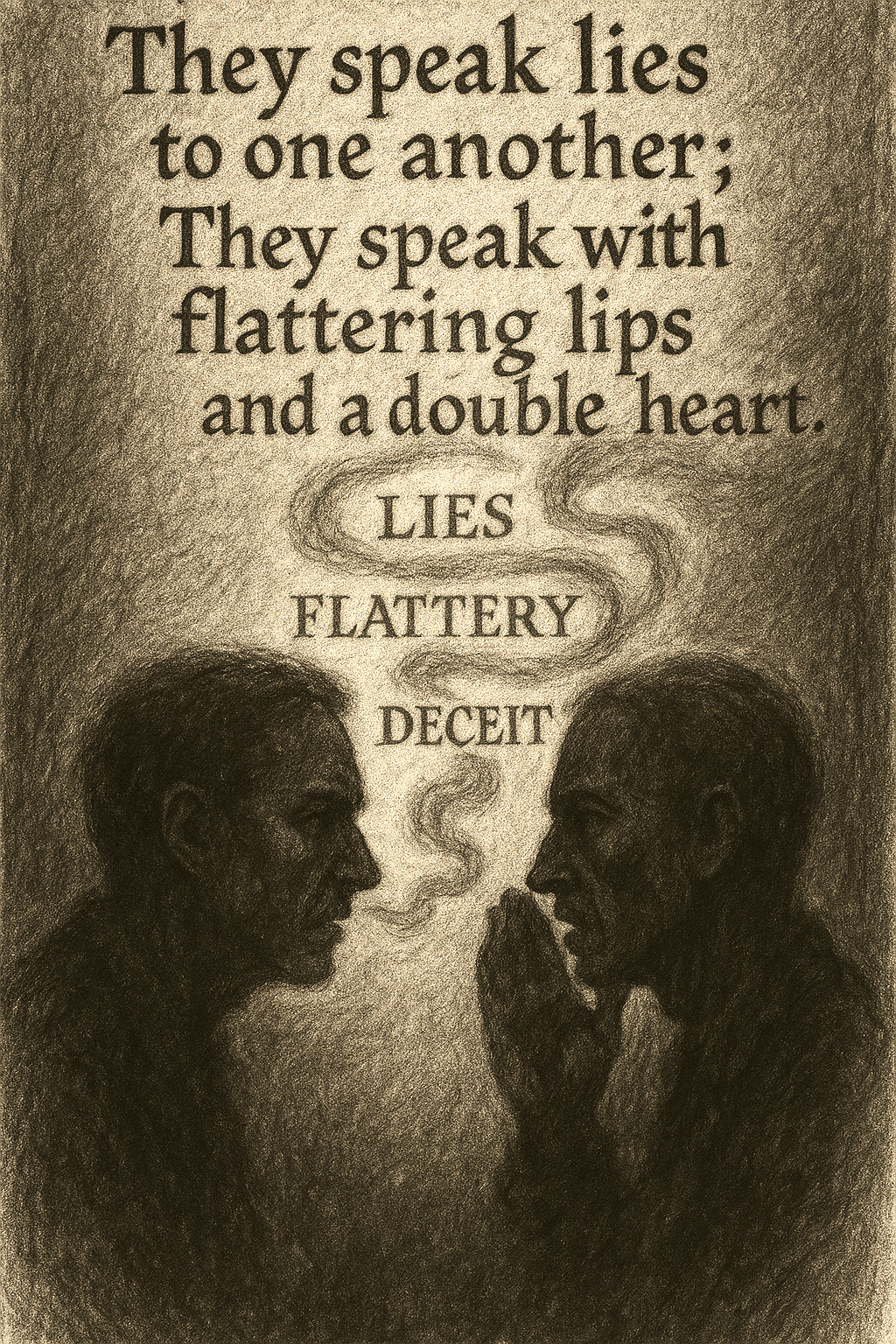
David paints a bleak picture of society’s speech and motives:
- Flattering Lips (v. 2): These are words crafted to manipulate rather than to bless. Flattery is dishonest praise, used to gain favor or advantage. It may sound kind, but it’s rooted in selfishness. It’s praise without sincerity.
- Double Hearts (v. 2): This speaks of duplicity—a divided loyalty. A person may say one thing but mean another. Their heart isn’t unified in truth. Their speech and their spirit do not align. In today’s terms, this is hypocrisy—people wearing one mask in public and another in private.
- Boastful Tongues (v. 4): Their arrogance reaches its peak with this proud declaration: “With our tongue we will prevail; Our lips are our own; who is lord over us?” This is rebellion through rhetoric. The wicked believe their words are power, and they answer to no one—not even God. It’s not just lying that is the problem—it’s the idolatry of speech, using it to control others and exalt self.
David’s response is deeply instructive. He doesn’t ask for easier circumstances or even to be removed from the wicked. He doesn’t merely complain or isolate himself. Instead, he calls on God to purify the world from deceit.
“May the Lord cut off all flattering lips, The tongue that speaks great things” (v. 3)
This is not vindictive—it’s righteous indignation. David sees how toxic, damaging, and contagious false speech is. His cry is not for personal relief, but for a moral renewal—for a world where truth prevails and deceit is exposed.
Psalm 12 gives us a vocabulary to lament what we see. But more than that, it calls us to action:
- Pray for God to purify our lips as well as others’.
- Refuse to participate in flattering, gossip, or boastful speech.
- Remember that divine justice begins not only with silencing the wicked—but also with refining the righteous.
Before we ask God to “cut off flattering lips,” we must let Him cleanse our own.
II. God’s Promise (Psalm 12:5)
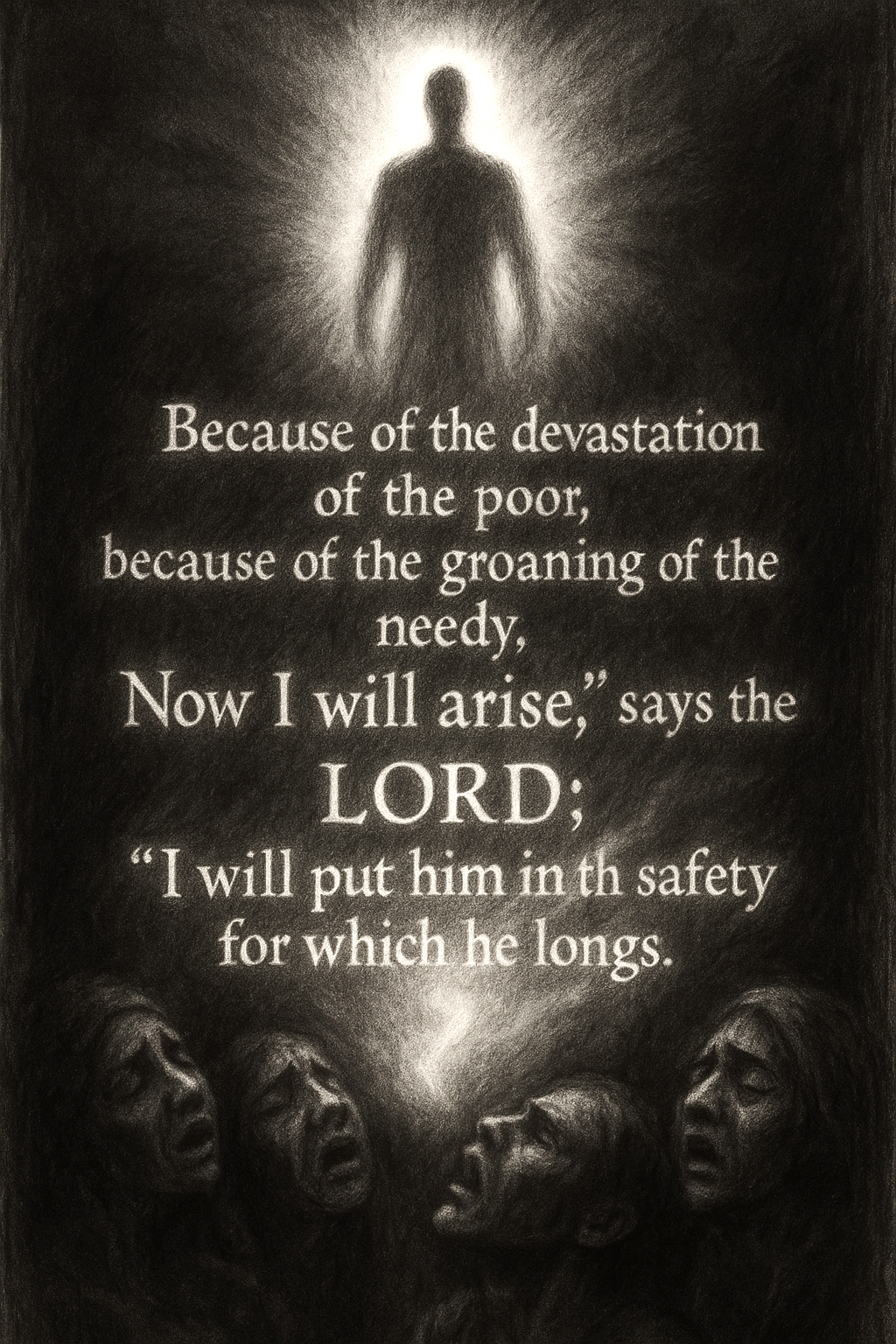
“Because of the devastation of the afflicted, because of the groaning of the needy, Now I will arise,” says the Lord; “I will set him in the safety for which he longs.” (v. 5)
Here is where God directly responds within the text to a human cry for help. David pleads, and the Lord answers—not with vague comfort, but with decisive action.
God’s voice breaks through the noise of corruption and deceit like a trumpet blast: “I will now arise.” This is the turning point of the psalm—a moment of divine intervention.
The cries of the poor and needy do not go unheard. God is not passive in the face of suffering. He rises—a Hebrew term often used for military readiness, courtroom rulings, or royal judgment. This is not just a divine posture change—it’s a promise of deliverance.
The weak may be silenced by human words, but God speaks on their behalf. The Lord promises to place the afflicted “in the safety for which he longs”—the Hebrew word conveys the idea of security from all threats, emotional and physical. The world speaks false promises, but God acts on His Word.
III. David’s Confidence (Psalm 12:6-8)
Immediately after God’s declaration, David affirms the quality and character of God’s words:
“The words of the Lord are pure words; As silver tried in a furnace on the earth, refined seven times.” (v. 6)
This image contrasts sharply with the flattering and boastful speech of the wicked (vv. 2–4). Where their words deceive, God’s words deliver. Where theirs are manipulative, His are meticulously refined.
Refined seven times—a symbol of perfection in Hebrew thought. In a world full of contaminated speech, God’s Word stands alone as utterly trustworthy.

“You, O Lord, will keep them; You will preserve him from this generation forever.” (v. 7)
This is a personal promise for the faithful remnant. While the world is full of smooth talkers and deceitful flatterers, God is actively guarding His people. The verb “keep” implies continual protection, and “guard” evokes the image of a vigilant sentry watching over a city under siege.
Though the righteous may feel surrounded and outnumbered, they are never unprotected. God’s preservation is not just spiritual—it is personal, intimate, and enduring. He guards His people in the midst of corruption, not always by removing the wicked, but by fortifying the faithful.
“The wicked strut about on every side When vileness is exalted among the sons of men.” (v. 8)
The psalm ends with a sober observation, not a fairy-tale resolution. Evil still prowls. The word used here evokes a predator, stalking in the shadows. And worse—vileness is exalted. In David’s world, as in ours, what should be shameful is often celebrated. Corruption becomes trendy. Injustice becomes normal. Lies become powerful.
This verse reminds us that faith does not deny reality—it faces it, anchored in God’s character and promises. The battle between good and evil continues. But God’s people do not fight alone, and they do not fight without hope.
Key Truths from These Verses:
- God takes action on behalf of the oppressed. He does not ignore suffering.
- God’s promises are tested and true—His speech carries no falsehood, spin, or deceit.
- God doesn’t always remove the wicked immediately, but He guards the righteous in the midst of them (v. 7).
- Divine preservation is real, even in a corrupt generation.
When you feel surrounded by lies, flattery, and selfish ambition, anchor your soul in the promises of God. His Word is not only true—it is purifying. While the world tries to reshape reality with its words, God’s words reshape the world.
In times of cultural confusion or personal chaos, Psalm 12 reminds us the Lord has spoken. He has promised to make it right. That is enough.
Conclusion:
Cry out to God in honesty when you see deceit, injustice, and manipulation. Trust that God sees, God hears, and God will act.
Psalm 12 is not merely a cry for help, however, it is a call to live rightly in a crooked generation. Here are three practical takeaways:
1. Pray with Honesty—David doesn’t sugarcoat the state of the world—or his feelings about it. Neither should we. Let your prayers reflect both your pain and your hope. Ask God to deal not only with the sin around you but also the sin within you.
2. Shine with Integrity—The godly may be few, but they are not forgotten. Live righteously in the midst of wickedness. Don’t conform to the society of sin—expose it by contrast. Speak truth when others lie. Be pure when others deceive. Be faithful when others flatter.
3. Trust in God’s Word—Where human words fail, God’s Word shines. It is flawless, trustworthy, and enduring. When you can’t trust the headlines, the influencers, or even your own feelings—trust His voice. Memorize it. Meditate on it. Anchor your life in it.
Don’t be surprised by wickedness—but don’t be overcome by it either.
Personal Study Guide for Psalm 12
Reflection Questions:
- Where do you see dishonest or destructive speech around you (media, politics, relationships)?
- How have you experienced the pain of flattery, lies, or manipulative words?
- What does it mean to trust God’s pure Word in a world of distortion?
Action Steps:
- Memorize Psalm 12:6. Let it shape how you speak and listen this week.
- Journal your honest frustrations. Bring them to God like David did.
- Speak truth with grace. Encourage someone today with honest, life-giving words.
Prayer Points:
- Thank God for His trustworthy promises.
- Ask for wisdom to guard your speech and your heart.
- Pray for those who are hurting from betrayal or deceit.
Couple’s Study Guide
Reflect Together:
- How do we protect our relationship from dishonest or harmful speech?
- How can we help each other cling to God’s Word when we feel surrounded by negativity?
Pray Together:
- Thank God for His promises and for each other.
- Ask Him to make your words a source of truth and healing in your home.
Shared Action: Choose a verse to recite or display in your home this week (suggestions: Psalm 12:6 or Ephesians 4:29).
Family Devotion: Words Matter
Read Psalm 12 Together
Discussion Questions:
- Have you ever been hurt by someone’s words?
- Why do you think David wanted God to stop people from lying?
- What kind of words does God want us to use?
Activity:
- Take turns making a “Words That Build” list (kind, truthful, gentle, encouraging words).
- Create a “God’s Pure Words” poster together using Psalm 12:6.
Prayer:
- Ask God to help your family speak words that help, not hurt.
- Thank God that His Word is always true and good.
Final Thought
Psalm 12 is raw, honest, and painfully relevant. David looks around and sees a culture of corruption—one where deception is celebrated, integrity is rare, and the powerful manipulate language for their own gain. His response is not to fight fire with fire, but to cry out to the only One whose words are always pure.
David asks for God to cut off flattering lips and silence deceitful speech. And God answers—not by immediately eradicating evil from the world, but by rising up in defense of the vulnerable (v. 5). He promises to preserve His people—not from the existence of evil, but through it. This is a vital distinction for every believer.
Psalm 12 ends with tension still unresolved. Evil still prowls. The wicked are still exalted. But God has spoken—and that is enough. God does not reconstruct the world on our timeline. Evil is not instantly erased. But His faithfulness to the faithful remains sure.
Hold fast to His Word. Speak truth. Pray honestly. And trust the God who always rises for the poor and preserves His own.
By Jeremy Sprouse
Jeremy has been married to Erynn since August 1999. They are blessed with six children: Jaden, Isaiah, Isaac, Ean, Joseph, and Evelyn. Jeremy preaches for the Patrick St. church of Christ in Dublin, TX and is the author of To Train Up a Knight.

 Knights of The Father