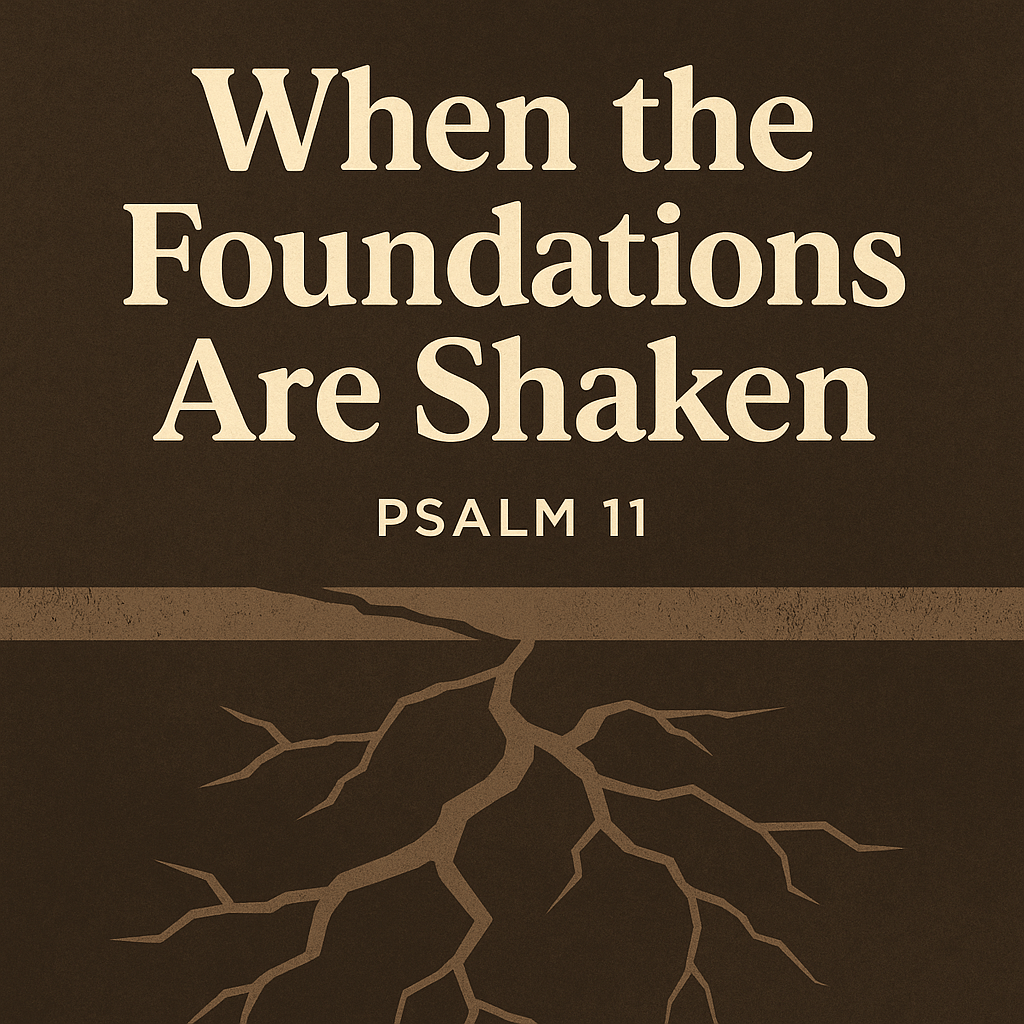
“In the LORD I take refuge; how can you say to my soul, ‘Flee like a bird to your mountain’?” —Psalm 11:1
When life begins to fall apart—when the moral, spiritual, or societal foundations crack—what do you do? Where do you go? Who do you trust?
Psalm 11 gives us the answer: We do not flee in fear—we stand firm in faith.
Written by David during a time of personal danger—perhaps while fleeing Saul or later during Absalom’s rebellion—this psalm offers more than historical insight. It gives us a timeless model of trust in crisis.
While David’s friends urge him to escape, David refuses. Why? Because he knows one unshakable truth:
“The LORD is in His holy temple; the LORD’s throne is in heaven…” (v. 4)
Faith and Fear (Psalm 11:1–3)
Psalm 11 opens not with fear, but with fortitude:
“In the LORD I take refuge…” (v. 1)
This short sentence is not just a theological statement—it’s a spiritual stance. David begins the psalm by planting his feet firmly in faith. When everything around him trembles, he clings to the one place that cannot be shaken: the Lord Himself.
But the very next line reveals a sharp contrast. David quotes the anxious voices of those around him:
“Flee like a bird to your mountain!”
This is the advice of fearful friends—those who see the rising threats and say, “Escape while you can. Get out before it’s too late.”
Their reasoning sounds logical:
- Enemies are lurking, drawing their bows in secret (v. 2).
- The foundations are crumbling—the moral order, social structures, and political stability that once held things together now seem destroyed (v. 3).
“If the foundations are destroyed, what can the righteous do?” (v. 3)
It’s a question loaded with despair. It implies, “There’s nothing left to stand on—so you may as well run.” In other words, they’re saying:
“David, even righteousness has no chance anymore.”
But David refuses to flee.
The world says: Run. Escape. Hide.
David says: Trust. Stay. Stand.
His answer is not naive. He isn’t pretending the threat isn’t real. He sees the same danger his friends do—but his response is shaped not by fear of what might happen, but by faith in what is always true:
“The LORD is in His holy temple; the LORD’s throne is in heaven…” (v. 4)
That’s the foundation David is standing on—the unshakable sovereignty of God. His friends see crumbling systems and invisible enemies. David sees the throne that no crisis can topple.
This moment in the psalm speaks directly to our times. We, too, are surrounded by instability:
- Foundations of truth, justice, and righteousness feel like they’re eroding.
- The arrows of hostility, confusion, and compromise seem to fly from the shadows.
- Fear whispers, “It’s all falling apart—get out while you can.”
But Psalm 11 reminds us that the righteous are not foundationless.
We have a greater refuge than policies or governments. We have a greater protection than retreat.
We have the Lord—unmoved, enthroned, and watching.
True faith isn’t the absence of danger—it’s the refusal to let danger dictate your direction.
Lord and Loyalty (Psalm 11:4–7)
At the center of Psalm 11 stands a truth so foundational that everything else in the psalm—and in life—hinges on it:
“The LORD is in His holy temple; the LORD’s throne is in heaven.” (v. 4)
This verse is the turning point of the psalm, and its theological heart.
While David’s friends see chaos and cry, “Flee!”, David lifts his eyes higher. He doesn’t deny the fear, but he does something far more important—he reorients his vision. His enemies may have bows, but God has a throne. That changes everything.
God’s Holy Temple and Heavenly Throne
This is not just poetic language. In Hebrew thought, the temple was the place where God’s presence dwelled, where prayers were heard, and where justice flowed. But David points beyond the earthly temple to the heavenly throne—the seat of God’s unchallenged authority.
To say that God is on His throne is to say:
- He is not surprised by danger.
- He is not pacing heaven in panic.
- He is not asleep or indifferent.
He reigns.
In this confidence, David gives us four truths that help the righteous stay loyal when life feels unstable:
1. The Lord Sees (v. 4b)
“His eyes see, His eyelids test the children of man.”
God is not blind to what’s happening. His vision penetrates every hidden plot, every whispered lie, every act of cruelty—and every quiet act of faithfulness. He sees the righteous who refuse to run and the wicked who hide behind the shadows.
His gaze is not passive—it is discerning. God sees not just what people do, but why they do it. He searches hearts and examines motives.
You may feel unseen in your suffering. But you are never unseen by your God.
2. The Lord Tests (v. 5)
“The LORD tests the righteous…”
To test is not to destroy—it is to refine. Just as fire purifies gold, trials reveal what is genuine.
The hardships you face aren’t wasted—they are moments of spiritual revealing. Will we flee like frightened birds, or stay anchored in God’s promises?
Faith is not proven in comfort but in crisis. And God uses these seasons not to punish, but to shape.
Your faithfulness in the fire is a testimony that your foundation is the throne of heaven.
3. The Lord Judges (v. 6)
“Let Him rain coals on the wicked; fire and sulfur and a scorching wind shall be the portion of their cup.”
This language echoes God’s judgment on Sodom and Gomorrah (Genesis 19), reminding us that though God’s justice may seem delayed, it is never denied. The wicked may flourish for a time—but that time will end.
David doesn’t celebrate vengeance—he simply affirms that God will deal with evil, thoroughly and righteously. Judgment belongs to the Lord, not to us.
The throne in heaven is not just a place of power—it is a seat of perfect justice.
4. The Lord Loves (v. 7)
“For the LORD is righteous; He loves righteous deeds; the upright shall behold His face.”
Here is the most beautiful truth of all: God is not only holy and just—He is good. He loves righteousness. He delights in faithfulness. He rewards those who remain true, not just with protection—but with His presence.
“The upright shall behold His face.”
This is more than survival. This is the ultimate reward: communion with God Himself. The storms may rage. The foundations may crack. But those who remain faithful will see His face—not just metaphorically, but eternally.
Psalm 11 doesn’t give us an escape plan. It gives us a perspective shift. The key to peace is not found in safer circumstances but in a surer throne. David teaches us to lift our eyes away from fear and toward the One who is enthroned above it all.
God sees.
God tests.
God judges.
God loves.
And He still reigns.
Conclusion: Don’t Flee—Stand in Faith
David’s world was crumbling. Powerful enemies sought his life. Trusted friends gave fearful advice. And yet, David stood firm—not because he was strong, but because his refuge was the Lord.
Psalm 11 reminds us that when the foundations are shaken, God is not. His throne is secure. His vision is clear. His justice is sure. And His love is unshakable.
Rather than run from trouble, we run to the Lord.
Rather than flee to the mountains, we flee to His presence.
Rather than collapse in fear, we kneel in prayer.
He sees. He knows. He rules. And He will not fail those who trust in Him.
Personal Study Guide
Reflection Questions:
- When have you felt pressure to run or retreat instead of standing firm in your faith?
- How does verse 4 (“The LORD is in His holy temple…”) comfort you in seasons of instability?
- What “foundations” have you seen crumble—personally, culturally, or spiritually—and how did you respond?
Personal Action Steps:
- Re-center on the Throne: Begin each morning this week by reading Psalm 11:4 aloud and reminding yourself that God is still on the throne.
- Resist the Flee Instinct: Write down one area where you’ve been tempted to give up or escape. Ask God for courage to stay rooted.
- Anchor a Friend: Share Psalm 11:1 or 11:7 with someone going through a difficult or uncertain season.
Prayer Points:
- Praise God for His unshakable throne and sovereign reign over all things.
- Ask for strength to stand firm when fear or uncertainty tempts you to flee.
- Thank God that He sees, tests, judges, and loves—and that you are never forgotten or forsaken.
Study Guide for Couples
Reflect Together:
- When have you felt like the “foundations” of your life or marriage were shaken?
- What helps you remember that God is still in control when the world feels out of control?
Pray Together:
- Thank God for being your shared refuge and foundation.
- Ask Him to help you grow in faith and stability as a couple, especially in times of stress or hardship.
Action Step: Identify one small way to demonstrate spiritual stability this week—such as praying together when you feel overwhelmed or choosing faith over fear in a decision.
Study Guide for Family Devotion
Read Psalm 11 Together
Discussion Questions:
- What does it mean to take “refuge” in God?
- What would you do if someone told you to run away from your problems? What do you think David did instead?
- Why is it important that God is on His throne, even when bad things are happening?
Activity:
- Draw a picture of a strong tower or fortress. Label it “The LORD is my refuge” and write Psalm 11:1 next to it.
- Build a small tower or fort together out of blocks, pillows, or boxes and talk about what it means for God to be your strong place.
Prayer:
- Thank God that He sees everything and is always in control.
- Ask Him to help your family trust Him when life feels scary or uncertain.
Final Thoughts:
When fear tells you to flee, let faith remind you where to stand.
When the world shakes, remember the throne in heaven never moves.
The Lord sees. He tests. He judges. And He loves the righteous.
“For the LORD is righteous; He loves righteous deeds; the upright shall behold His face.”
—Psalm 11:7
By Jeremy Sprouse
Jeremy has been married to Erynn since August 1999. They are blessed with six children: Jaden, Isaiah, Isaac, Ean, Joseph, and Evelyn. Jeremy preaches for the Patrick St. church of Christ in Dublin, TX and is the author of To Train Up a Knight.

 Knights of The Father