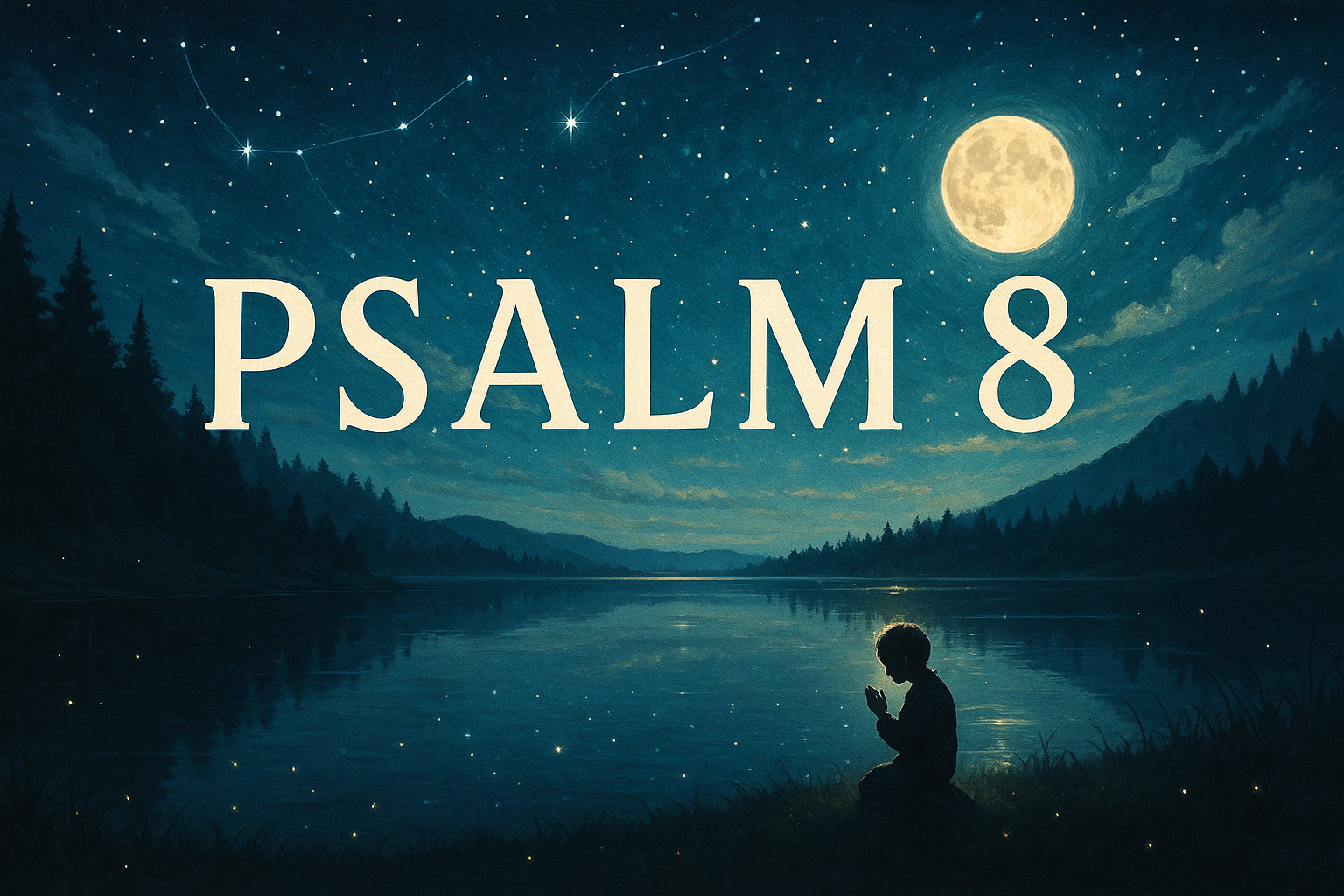
Have you ever stepped outside on a cloudless night—far from city lights—and looked up? The stars stretch across the sky like diamonds scattered on black velvet, and for a moment, the world feels still. As the galaxies shimmer above, you can’t help but feel tiny—just one life beneath a trillion stars.
David knew that feeling. As a young shepherd beneath the same night sky, he was awestruck not only by the heavens—but by the thought that the God who made them thinks about us.
Psalm 8 captures that breathtaking contrast: the vastness of God’s glory and the intimate care He shows to mankind. It’s a psalm for stargazers and soul-searchers—reminding us that though we may feel small beneath the stars, the One who made them has crowned us with glory.
This song of praise invites us to stand in wonder at both the power of our Creator and the purpose He gives to His creation. In all the universe, there is nothing greater than God—and nothing He treasures more than those made in His image.
God’s Glory Shines Across the Cosmos (Psalm 8:1–2)
David opens and closes this psalm with a majestic declaration:
“O LORD, our Lord, how majestic is Your name in all the earth!”
The two titles for God in verse 1 reflect both intimacy and authority:
- “LORD” (all capital letters) translates Yahweh—God’s personal, covenant name. This is the sacred name revealed to Moses at the burning bush (Exodus 3:14), emphasizing God’s faithfulness, self-existence, and eternal presence.
- “Lord” (in lowercase) is Adonai—a title meaning Master or Sovereign. It acknowledges God’s authority over creation and humanity.
This pairing invites us to see God as both deeply personal and absolutely sovereign—He is near to us and yet reigns over all. His glory is not confined to heaven or temple—it fills the earth, and His name is exalted “above the heavens” (v.1b). This poetic contrast—earth and heavens—is a Hebrew way of saying: “God’s majesty fills everything.”
David then draws our attention to an astonishing truth:
“From the mouths of infants and nursing babies, You have established strength, because of Your adversaries, to silence the enemy and the avenger.” (v.2)
This is paradoxical glory: God’s power is revealed not just in stars and storms, but in the cries of newborns. He defeats His enemies not through overwhelming might, but through the unexpected and humble voices of children. Jesus quotes this verse in Matthew 21:16, when the temple children praise Him as the Son of David—while the religious elite scoff in disbelief. God uses the meek and pure in heart to expose the pride of those who consider themselves wise.
This same principle is picked up by New Testament writers to point to Christ:
- Hebrews 2:6–7 applies Psalm 8 to Jesus’ incarnation—He was made “a little lower than the angels” to suffer and die, yet crowned with glory.
- 1 Corinthians 15:27 refers to the Messianic reign of Christ, who has been given authority over all things.
Even from infancy to exaltation, God’s wisdom chooses what seems weak to shame the strong (1 Corinthians 1:27).
As you look into the night sky, you may feel small. But the stars do not speak of chaos or insignificance—they declare the order, power, and purpose of a majestic Creator. And more astonishing still is this: the same God who made the galaxies listens to children and works through the lowly.
He doesn’t need thunder to be heard. He can silence the proud through a child’s song, a newborn’s breath, or a servant’s prayer.
God’s glory does not only reside in the vastness of the cosmos—but in the stillness of humility.
The heavens declare His power.
But the mouths of babes declare His wisdom.
Will you, like David, stand in awe of both?
God’s Care in the Midst of Majesty (Psalm 8:3–5)
There is perhaps no more humbling moment than standing under a sky filled with stars—vast, cold, and ancient—and realizing how small we are in comparison. David, the shepherd-king, must have often paused under such a sky, reflecting on this very thought. And in verses 3–4, he gives voice to the question that has haunted humanity for millennia:
“When I consider Your heavens, the work of Your fingers, the moon and the stars, which You have ordained, what is man that You are mindful of him, and the son of man that You visit him?”
This is not despair. This is awe. David isn’t saying we are worthless. He’s saying: Why would a God so immense even think of us? And yet, He does.
- He is mindful of us—He remembers us.
- He visits us—He draws near to us.
David’s astonishment lies in the personal attention of a cosmic God. In an age where stars were worshiped, David flips the narrative: The One who made the stars cares more for you than for them. This is a revolutionary affirmation of human worth.
In verse 5, he continues:
“You have made him a little lower than the heavenly beings and crowned him with glory and honor.”
The Hebrew word here translated “heavenly beings” is elohim, a term that can refer to God Himself or to divine beings like angels. The Septuagint (Greek translation of the Old Testament) uses the word angeloi, or “angels.” Either way, the point is profound: humanity is not merely above animals—we are just below the divine. We are not insignificant. We are gloriously significant, by design.
God crowned mankind with glory (weight, importance) and honor (dignity, value). He did not create humans as accidents of random processes. In contrast to the worldview of naturalism or evolution, where man is merely an intelligent animal, Psalm 8 insists that we are something more—made in God’s image (Genesis 1:26–27), shaped by His hand, bearing His likeness.
What is man? David’s answer is this: We are small, but we are chosen.
Psalm 8 not only affirms this truth about humanity in general, but also finds its greatest fulfillment in the person of Jesus Christ. According to Hebrews 2:6–9, Psalm 8 is not just about man, but about the Man—Jesus—who became “a little lower than the angels” to die for us. He did not lose His glory by becoming human. Rather, He displayed God’s glory most fully in His suffering and resurrection:
“But we see Jesus… made a little lower than the angels for the suffering of death, crowned with glory and honor…” (Hebrews 2:9)
Jesus descended so we could rise. He shared our humanity so that He might bring many sons to glory (Hebrews 2:10). The crowning glory of mankind is not simply our dominion over the earth—it is our redemption through Christ. He is the perfect fulfillment of Psalm 8, lifting mankind from frailty to exaltation.
To the world, you may look like just one person among billions.
To the heavens, you may seem a fleeting speck.
But to God, you are crowned with glory and honor—loved enough that He would send His Son to die for you.
Will you let that truth shape the way you see yourself—and the way you see others?
God’s Purpose for Mankind (Psalm 8:6–8)
David continues his meditation on the greatness of God by considering the role humanity has been given in creation:
“You have made him to have dominion over the works of Your hands; You have put all things under his feet: all sheep and oxen— even the beasts of the field, the birds of the air, and the fish of the sea that pass through the paths of the seas.” (Psalm 8:6–8)
This language echoes the original purpose God gave mankind in Genesis 1:26–28, where God says:
“Let us make man in our image, after our likeness. And let them have dominion…”
From the beginning, humanity was created with purpose and dignity—to rule and care for God’s creation as stewards, not tyrants. The word “dominion” implies authority, but not autonomy. It is the rule of a steward over the estate of a king, a responsibility to reflect God’s character in how we tend the world He made.
- The sheep and oxen represent domestic animals—creatures close to human life.
- The beasts of the field signify wild creatures beyond our control.
- The birds and fish speak of the skies and seas—domains beyond our reach, but not beyond our care.
Mankind was placed in a unique position: below the angels, but above the rest of creation. We are entrusted with the environment, the animal kingdom, and the resources of the earth. That responsibility is sacred. It is an act of worship to tend the garden well.
Yet when we look at the world today, it’s clear we haven’t lived up to that calling. Instead of stewarding the earth, we often exploit it. Instead of ruling justly, we abuse power. Sin fractured the harmony between God, man, and creation. The dominion once given became distorted by pride, selfishness, and death.
But Psalm 8 doesn’t end in failure—it points forward to restoration. The dominion that was marred in Adam is fulfilled in Christ.
The apostle Paul quotes Psalm 8 in 1 Corinthians 15:24–27 to describe Jesus’ reign:
“Then comes the end, when He delivers the kingdom to God the Father… For He must reign till He has put all enemies under His feet. The last enemy that will be destroyed is death.”
Jesus, the perfect Man, has all things put under His feet—not just sheep and birds, but sin, suffering, Satan, and death itself. He fulfills the psalmist’s words in a way David could not have fully imagined. What Adam lost, Christ restores.
And here’s the most beautiful part: Christ does not keep this reign to Himself. He shares it.
- Through His victory, we are more than conquerors (Romans 8:37).
- Through His Spirit, we are raised to sit with Him in heavenly places (Ephesians 2:6).
- Through His kingdom, we are made royal priests and heirs (1 Peter 2:9; Romans 8:17).
This is God’s purpose for mankind: not simply to rule the animals, but to walk in communion with Him, to reflect His image, and to one day reign with Christ in glory. The psalm that began with a child marveling at the stars ends with the stunning truth that God has crowned us with honor and given us a role in His cosmic plan.
The hope offered in Psalm 8 is bigger than the sky.
It stretches from Eden to Calvary, from dominion lost to dominion restored.
And it calls each of us not just to awe—but to action.
Will you live as a steward of what God has entrusted to you?
Will you walk in the dignity of one crowned with His purpose?
God’s Name Is Worthy of Praise (Psalm 8:9)
“O LORD, our Lord, how majestic is Your name in all the earth!” —Psalm 8:9
David ends this psalm where he began—with pure praise. It’s a literary device called inclusio, where a section begins and ends with the same phrase, forming a frame. In Psalm 8, this frame does more than mark the boundaries of the text—it echoes the truth that God’s greatness surrounds everything, from the highest heavens to the humblest heart.
In between the opening and closing lines lies a journey of reflection:
- From the vastness of the cosmos to the cries of children
- From the grandeur of the heavens to the frailty of mankind
- From our dominion over creation to Christ’s dominion over all things
And when all is said and done, there is only one fitting response: worship.
Verse 9 is not just a repetition. It is a culmination. After considering God’s glory, man’s dignity, and Christ’s reign, David’s praise means even more than when he started. His words now carry the weight of wonder, reflection, and redemption.
Psalm 8 is also structured chiastically—a Hebrew poetic form in which the central idea is surrounded by mirrored statements, like an arrow pointing to the heart of the message.
- Verse 1 & 9: God’s majestic name
- Verses 2 & 8: Dominion and strength
- Verses 3 & 7: Creation
- Verses 4–5: Humanity’s worth
The center of this structure—verses 4–5—is the beating heart of the psalm:
“What is man that You are mindful of him…?”
That’s the wonder. We are small, but seen. Weak, but wanted. Frail, but favored.
If you’ve ever felt insignificant, forgotten, or overwhelmed by the scale of the universe or the burdens of life—Psalm 8 is for you. It reminds us that:
- The same God who flung stars into space also formed you with care.
- The same voice that spoke galaxies into being is mindful of your prayers.
- The same Lord who reigns above all came down in Christ to redeem you.
This psalm lifts our eyes to the heavens—but then brings our hearts back to earth. And in both places, we find reasons to praise.
Your life, your voice, your soul—they were made to glorify His name.
And when you declare, “O LORD, our Lord, how majestic is Your name in all the earth,” you’re joining a chorus that began before time and will echo through eternity.
Let everything that has breath praise the LORD (Psalm 150:6).
Let your breath be among them.
Personal Study Guide
Reflection Questions:
- When was the last time you looked up at the stars and considered your place in God’s creation?
- How does it change your perspective to know that God is mindful of you?
- In what ways are you fulfilling the role God gave mankind to care for His creation?
Personal Action Steps:
- Starry Night Meditation: Go outside one night this week and read Psalm 8 under the stars. Spend a few minutes in prayerful reflection.
- Messianic Connection: Read Hebrews 2:6–10 and 1 Corinthians 15:27. Journal how Psalm 8 deepens your understanding of Christ.
Prayer Points:
- Praise God for the beauty and order of His creation.
- Thank Him for caring so deeply about you in the midst of such a vast universe.
- Ask for a humble heart that recognizes both your smallness and your purpose.
Study Guide for Couples
Reflect Together:
- Share what makes you feel small or overwhelmed. How does Psalm 8 comfort or challenge you?
- Discuss how you can reflect God’s glory together in your home, work, and community.
Pray Together:
- Thank God for placing His image in each of you.
- Ask Him to help you encourage one another to live out His purposes.
Action Step:
- Spend time this week watching the stars together and reading Psalm 8 aloud.
Study Guide for Family Devotion
Read Psalm 8 Together
Discussion Questions:
- What do you see when you look up at the stars?
- Why do you think God cares so much about people?
- What does it mean that God put us in charge of animals and the earth?
Activity:
- Draw a picture of the night sky and write verse 9 underneath: “O LORD, our Lord, how majestic is your name in all the earth!”
Prayer:
- Thank God for making the stars, and for making you special.
- Ask Him to help your family use your voices and lives to praise Him.
Final Thoughts:
Psalm 8 reminds us of a God so powerful He paints the skies with galaxies—and so loving that He crowns us with honor. He not only made the stars, but He also made a plan to redeem us through His Son. When Jesus became “a little lower than the angels,” He showed just how far God would go to bring us into glory.
So, the next time you feel small, remember:You are crowned by the Creator.
“O LORD, our Lord, how majestic is your name in all the earth!”
By Jeremy Sprouse
Jeremy has been married to Erynn since August 1999. They are blessed with six children: Jaden, Isaiah, Isaac, Ean, Joseph, and Evelyn. Jeremy preaches for the Patrick St. church of Christ in Dublin, TX and is the author of To Train Up a Knight.

 Knights of The Father