
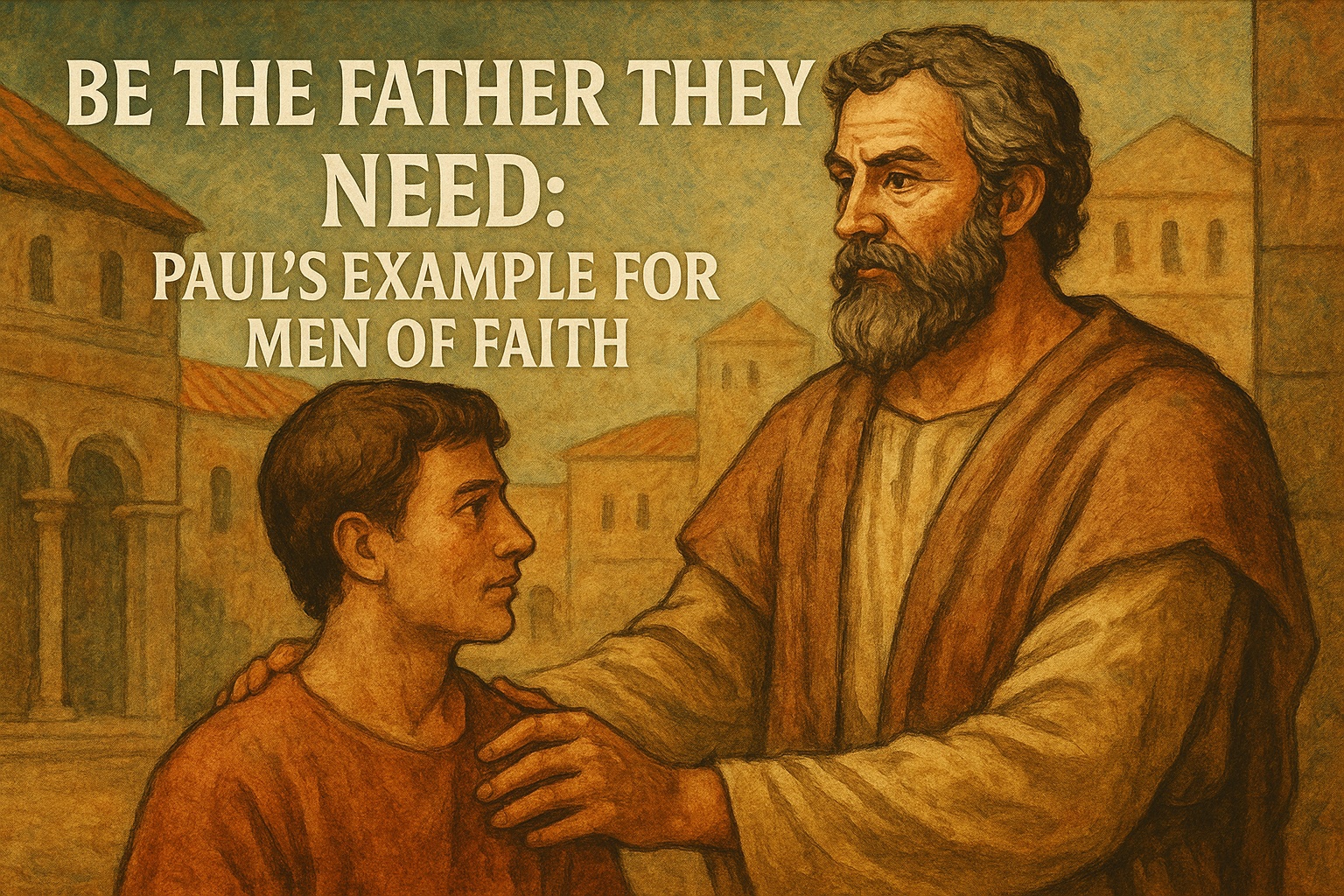
When we think about fatherhood, we usually picture the men who raised us or who are raising children today. But fatherhood isn’t only about biology—it’s also about spiritual influence. In fact, in Scripture, we can see three types of human fathers:
- The biological father—sometimes called “baby daddy” today—who is present or absent in various ways.
- The father who raises a child physically—providing for and guiding them through life.
- The spiritual father—someone who helps another person grow in faith and walk with the Lord.
Sometimes these three roles will be found in the same person, but not every man will have biological children. Every man of faith, however, is called to help others as a father would—to be a mentor to young men and boys whether or not they are your own.
In today’s world, too many young men and women are growing up without strong, godly fathers. Some have never known their earthly father. Others have dads who are physically present but spiritually absent.
This is where you come in.
You don’t need to wear a title. You don’t need to be perfect. But you can be a spiritual father—just as the Apostle Paul was.
Paul had no wife. No children. Yet he became one of the greatest father figures in the church’s history—pouring his life into young men like Timothy and Titus, and strengthening entire congregations.
His example is not just for church leaders. It’s for every man of faith.
Paul, a Spiritual Father
Paul was never married and had no biological children. Yet he often spoke of himself as a father to those he had taught, converted, and trained in the faith.
Paul as a Father to Churches
In 1 Corinthians 4:14–17 and 1 Thessalonians 2:9–12, Paul describes his relationship with the congregations he had helped establish:
- He says that, even though many teachers (tutors) may come into their lives, they would only have one father—the one who first brought them to Christ (1 Corinthians 4:15).
- Paul viewed his role not as one of domination or control, but as one of love, guidance, and example.
- He warned, encouraged, and trained his spiritual children so that they might grow strong in the Lord.
Paul as a Father to Timothy
Paul’s most personal “father-son” relationships were with men like Timothy and Titus.
Timothy was converted by Paul during his first missionary journey (Acts 13–14). Though Timothy had a strong foundation from his mother and grandmother (2 Timothy 1:5), his Greek father likely had little interest in spiritual matters (Acts 16:1). Paul became Timothy’s spiritual father:
- He calls Timothy “my true son in the faith” (1 Timothy 1:2).
- He invested deeply in Timothy’s growth as a Christian leader, encouraging him in sound doctrine and holy living.
Paul as a Father to Titus
Paul also had a special relationship with Titus:
- He calls Titus “my true son in our common faith” (Titus 1:4).
- Though he is not mentioned in Acts, Titus appears multiple times in Paul’s letters (especially 2 Corinthians). He was a trusted missionary and leader.
- Paul gave him important assignments, including the task of strengthening the church in Crete (Titus 1:5).
It’s important to note that when Paul speaks of himself this way, he is not advocating for the use of religious titles like “Father”—a practice Jesus warned against (Matthew 23:9). Rather, he is describing the role of a father who brings up spiritual children “in the training and admonition of the Lord” (Ephesians 6:4). And as we’ll see, Paul modeled this with both his tone and his teaching.
Paul’s Manner as a Father
Paul’s approach to fatherhood models the same qualities God commands earthly fathers to display:
“Fathers, do not provoke your children to anger, but bring them up in the discipline and instruction of the Lord.” — Ephesians 6:4
“Fathers, do not exasperate your children, so that they will not lose heart.” — Colossians 3:21
Paul avoided provoking resentment or bitterness. Instead, he approached his spiritual children with love, patience, and purposeful guidance.
1 Corinthians 4:14–17
- Paul reminded the Corinthians that he was not trying to shame them but to warn and teach them as beloved children.
- He urged them to imitate his example, as his ways were centered in Christ (v. 17).
- He practiced consistency—what he taught in Corinth, he taught everywhere.
1 Thessalonians 2:9–12
Paul’s conduct among the Thessalonians was marked by:
- Devotion—a life directed toward God.
- Uprightness—living with integrity.
- Blamelessness—avoiding reproach.
His interaction with them as a father included:
- Exhorting—encouraging them toward godliness.
- Comforting—offering reassurance and consolation.
- Charging—urging them to live in a way worthy of God.
Paul knew that spiritual maturity required more than instruction. It required a living example.
Good fathers—both biological and spiritual—lead in this same way.
Whether you are raising children or helping young believers grow, this is the tone we need.
Paul’s Guidance as a Father
Just as Ephesians 6:4 calls fathers to bring children up in “training and admonition,” Paul provided clear and personal guidance to those under his care.
To Timothy and Titus, he taught them to:
- Speak sound doctrine (1 Timothy 4:6–7, 13; 2 Timothy 1:8, 13; Titus 2:1).
- Be an example to others (1 Timothy 4:12; Titus 2:7–8, 15).
- Remind others of God’s ways with humility (1 Timothy 4:16; 2 Timothy 2:23–26; Titus 3:1–3).
- Avoid fruitless arguments and dissension (1 Timothy 1:3–4; 2 Timothy 2:23; Titus 3:9–11).
- Pursue righteousness (1 Timothy 6:11–14; 2 Timothy 2:3–7; Titus 2:11–14).
- Preach the word boldly and urgently (2 Timothy 4:1–2).
Paul’s “fatherly” teaching was not soft or sentimental—it was strong, clear, and grounded in truth and love. This wasn’t just for Timothy and Titus. Every young believer today needs men who will guide them in sound doctrine, example, and encouragement—men willing to be the fathers they need”
Conclusion: A Father’s Legacy
Though Paul was not a father in the physical sense, he fulfilled God’s vision of fatherhood in the spiritual lives of many. Through his manner, his example, and his guidance, he helped young men and entire churches walk worthy of the Lord.
Today, the church still needs spiritual fathers—men who will pour their lives into others, setting an example, teaching the truth, and helping younger believers grow strong in Christ.
Look around you:
- Is there a young man in your church who needs guidance?
- A boy without a father in the home?
- A new believer who needs encouragement and truth?
Step into that role.
You don’t need to be perfect—Paul wasn’t. You need to be faithful, loving, and intentional.
Our King is looking for men who will raise His sons in the faith.
Whether you are raising children in your home or helping to disciple others in your congregation, remember this: fatherhood is a calling—and in Paul, we have a powerful model of what that can look like. His example calls each of us—whether we have children of our own or not—to be the fathers they need.
By Jeremy Sprouse
Jeremy has been married to Erynn since August 1999. They are blessed with six children: Jaden, Isaiah, Isaac, Ean, Joseph, and Evelyn. Jeremy preaches for the Patrick St. church of Christ in Dublin, TX and is the author of To Train Up a Knight.

 Knights of The Father