
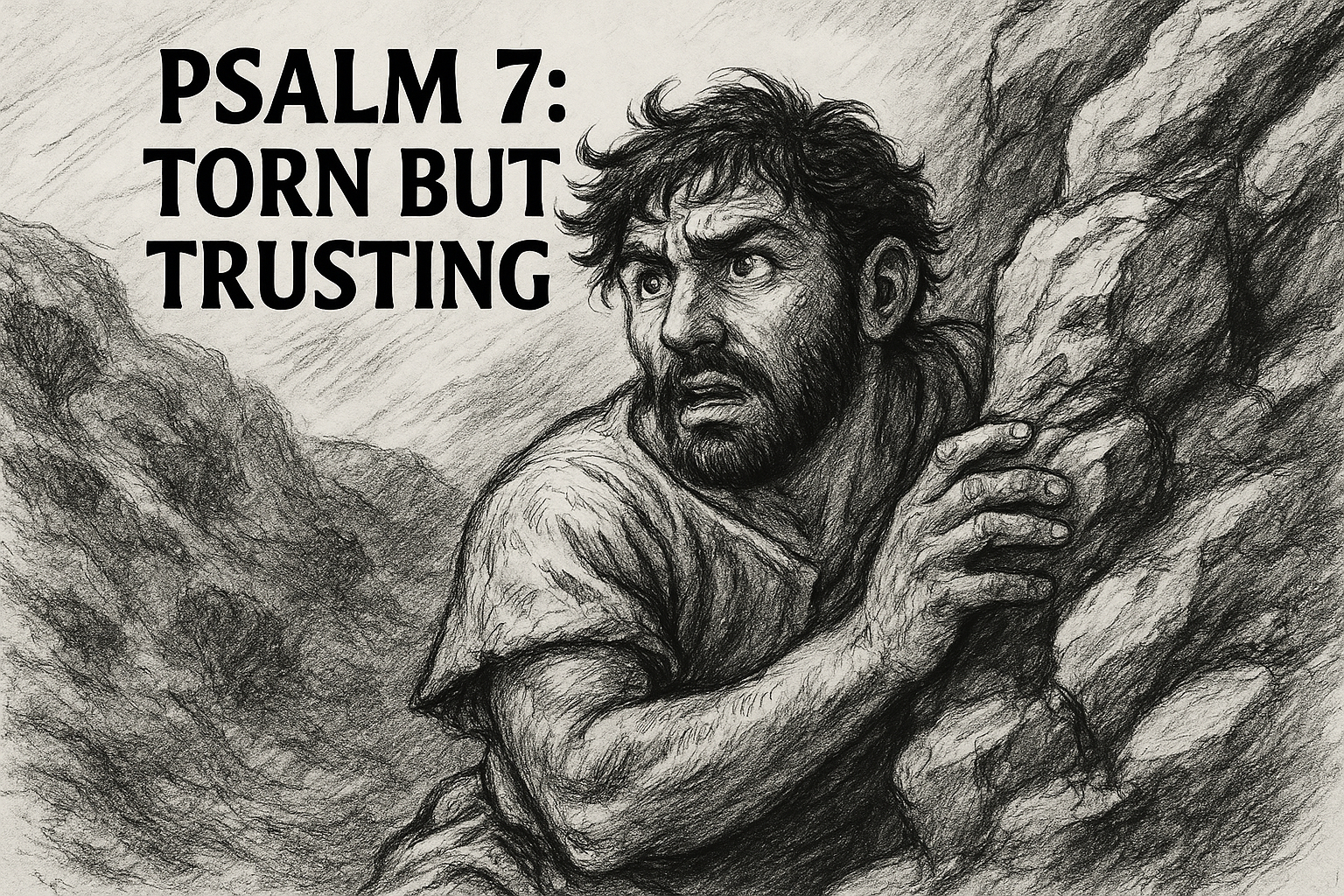
Accused. Misunderstood. Hunted Like Prey.
Psalm 7 is David’s raw and passionate prayer when slander threatened to tear him apart.
Before seeking justice, he sought God’s correction.
Before pleading for vindication, he examined his own heart.
When we face accusations and criticism, Psalm 7 offers a model for a godly response.
This psalm was written during—or reflects upon—a time when David found himself falsely accused, possibly during the long season when Saul hunted him like prey (cf. 1 Samuel 24–26). The psalm’s superscription tells us that the words of a man named Cush the Benjaminite sparked this lament. We know little about Cush, but the situation is clear: David has been slandered.
This is also the first of several psalms marked as a shiggaion—a passionate, emotionally charged song. Through it, David shows us that the righteous person willingly places himself before the divine Judge—not merely seeking justice for others, but humbly opening his own heart to correction.
Psalm 7 exhibits elements of chiastic movement, a literary technique in Hebrew poetry where ideas are arranged in a mirrored pattern (A–B–C–B′–A′). While this psalm is not a rigid, formal chiasm, it does display a balanced rhetorical flow centered on the theme of God’s righteous judgment. The psalm draws the reader inward from personal appeal to divine justice, then outward again to personal praise.
A (vv. 1–2) — David’s Plea for Deliverance
David begins by seeking refuge in the Lord, asking for protection from his enemies.
B (vv. 3–5) — David’s Self-Examination
He opens his heart before God, willing to accept judgment if he is guilty.
C (vv. 6–11) — Call and Confidence in God’s Judgment (hinge of the psalm)
At the heart of the psalm is a twofold focus on divine justice:
- vv. 6–8: David calls for God to rise up and judge rightly.
- vv. 9–11: David affirms that God tests hearts and protects the upright.
B′ (vv. 12–16) — The Examination of the Wicked
David contrasts his own openness before God with the stubbornness of the wicked, whose evil ultimately leads to their downfall.
A′ (v. 17) — David’s Praise for God’s Righteousness
The psalm closes where it began—with personal trust in God and praise for His justice.
This chiastic movement reflects a spiritual journey:
- From personal fear → to heart-searching → to trust in God’s justice → to confidence in the fate of evil → to joyful praise.
- At the center of it all is this truth: God is the righteous judge who tests every heart.
Let us walk through this psalm and learn how to face unjust accusations—not in fear or pride, but in trust and humility.
I. The Trial — A Plea for Deliverance (Psalm 7:1–2)

“Yahweh my God, I take refuge in you.
Save me from all who pursue me, and deliver me,
lest he tear my life apart like a lion,
ripping apart, and with none to deliver.”
(Psalm 7:1–2, LEB)
It hurts when someone accuses us falsely. David likens it to being mauled by a lion—his very soul feels torn.
When we read the story of David and Saul we see David as the hero. Not everyone in Israel at the time it was occurring, however, probably thought this way. They didn’t know all the details. David’s men were in the minority.
If this was during the time Saul was hunting David. Thought the exact nature of the accusation is unknown, Cush might have accused David of trying to take Saul’s life or trying to take the throne.
Both would have been hurtful to David who was diligent not to harm the Lord’s anointed.
We regard David and Saul as enemies, but that isn’t quite true. Saul regarded David as an enemy, but David served Saul and loved him as a friend. David had consistently honored Saul as the Lord’s anointed—even sparing his life more than once (1 Samuel 24–26). Though David served Saul faithfully, he was regarded as an enemy by many.
Whatever the case, David feels as if his emotions are being torn as a lion would tear flesh.
However, David realizes the Lord is the One to Whom he must turn in such pain and grief (1). Instead of trying to defend himself, He puts his defense in the Lord’s hand.
David’s response is instructive. Despite the intense emotional pain and the unfairness of the situation, he didn’t lash out or try to vindicate himself forcefully. Instead, he turned to God, trusting that God would be his defense. This teaches us that in times of trial, when we’re wrongfully accused or misunderstood, our best recourse is not to retaliate or become consumed with self-defense. Rather, like David, we can place our trust in the Lord, knowing that He sees all and will bring justice in His time.
Paul echoes this sentiment in 2 Thessalonians 1:3-6, where he encourages believers who are enduring persecution. He reminds them that God is just and will repay those who afflict them. Our role is to remain steadfast in faith, letting God handle our defense and deliverance. This gives us the strength to endure, knowing that God is our ultimate judge and protector.
II. The Consideration — A Moment of Self-Examination (Psalm 7:3–5)

“Yahweh my God, if I have done this,
if there is injustice in my hands,
if I have repaid my ally with evil,
or plundered my enemy without cause,
let the enemy pursue my soul and overtake it.”
(Psalm 7:3–5, LEB)
David is not claiming perfection. Rather than insisting on his innocence, he invites divine scrutiny: “If I have done this…”
He knows how easy it is to become blind to one’s own faults. Though the psalm suggest David’s conscience, he does not presume upon that. He opens himself to correction—even judgment—if necessary.
This is profound humility. David is not only asking God to punish the wicked; he is asking God to reveal and punish any wickedness in himself.
How often, when falsely accused, do we pause to examine our own hearts first?
David’s example calls us to ask hard questions: Have I contributed to this conflict? Have I sinned in any way? Like David, we can pray as Paul urged in 2 Corinthians 13:5: “Examine yourselves to see whether you are in the faith.”
A heart open to God’s correction is a heart God will honor.
III. The Plea — A Call for Divine Judgment (Psalm 7:6–11)

“Rise up, O Yahweh, in your anger,
lift yourself up against the wrath of my enemies…
Let Yahweh judge the peoples;
judge me, O Yahweh, according to my righteousness
and according to my integrity that is in me.”
(Psalm 7:6–8, LEB)
David has examined his own heart and laid it bare before God (vv. 3–5). Now, with the freedom of a clear conscience, he turns outward—pleading for God to rise up and execute justice on a broader scale. His call is not only personal but cosmic:
“Let Yahweh judge the peoples.”
This is not a cry for blind revenge—it is a cry for righteous judgment. David knows the situation is bigger than himself. The world is filled with injustice, and he longs to see God intervene in that arena. At the same time, David submits himself fully to this judgment: “Judge me, O Yahweh, according to my righteousness and according to my integrity that is in me.”
It is a bold and humble prayer—a willingness to be weighed by God’s perfect scales.

“Let the evil of the wicked come to an end,
but establish the righteous.
And he who tests hearts and innermost parts is the righteous God.”
(Psalm 7:9, LEB)
Here is the heart of the psalm—a key affirmation about God’s nature:
- God does not judge superficially.
- He does not judge merely by words, appearances, or even actions alone.
- He tests hearts and innermost parts—the deepest motivations and unseen realities of every person.
This is both comforting and sobering. David entrusts his defense to the One who sees perfectly—not only the wrong done to him but also the condition of his own heart.
He longs for two outcomes:
- The end of evil — that God would bring wickedness to a close.
- The establishment of the righteous — that those who live with integrity would be strengthened and upheld.

“My shield is with God,
who saves the upright of heart.
God is a righteous judge,
and a God who has indignation every day.”
(Psalm 7:10–11, LEB)
David affirms that his defense—the “shield” over his life—is not military might or self-justification. It is God Himself, who saves the upright in heart.
And he reminds himself (and us): God is not passive in the face of evil.
He is a righteous judge, and He feels holy indignation daily against wickedness. In a world that often seems indifferent to injustice, this truth steadies the heart of the faithful.
When we are wronged or falsely accused, our natural tendency is to take matters into our own hands—to become judge, jury, and executioner in our thoughts and actions. But Psalm 7 teaches us another way:
- Entrust judgment to God. He alone sees motives and hearts clearly.
- Invite His examination first. Like David, ask Him to test your own heart before crying out about others.
- Wait with trust. God will establish the righteous and bring evil to an end—not always on our timetable, but on His perfect one.
This posture frees us from bitterness and self-righteousness. It allows us to remain upright and at peace, even when surrounded by false accusations or injustice. As Romans 12:19 echoes:
“Vengeance is mine, I will repay, says the Lord.”
IV. The Need — The Certain Fall of the Wicked (Psalm 7:12–16)
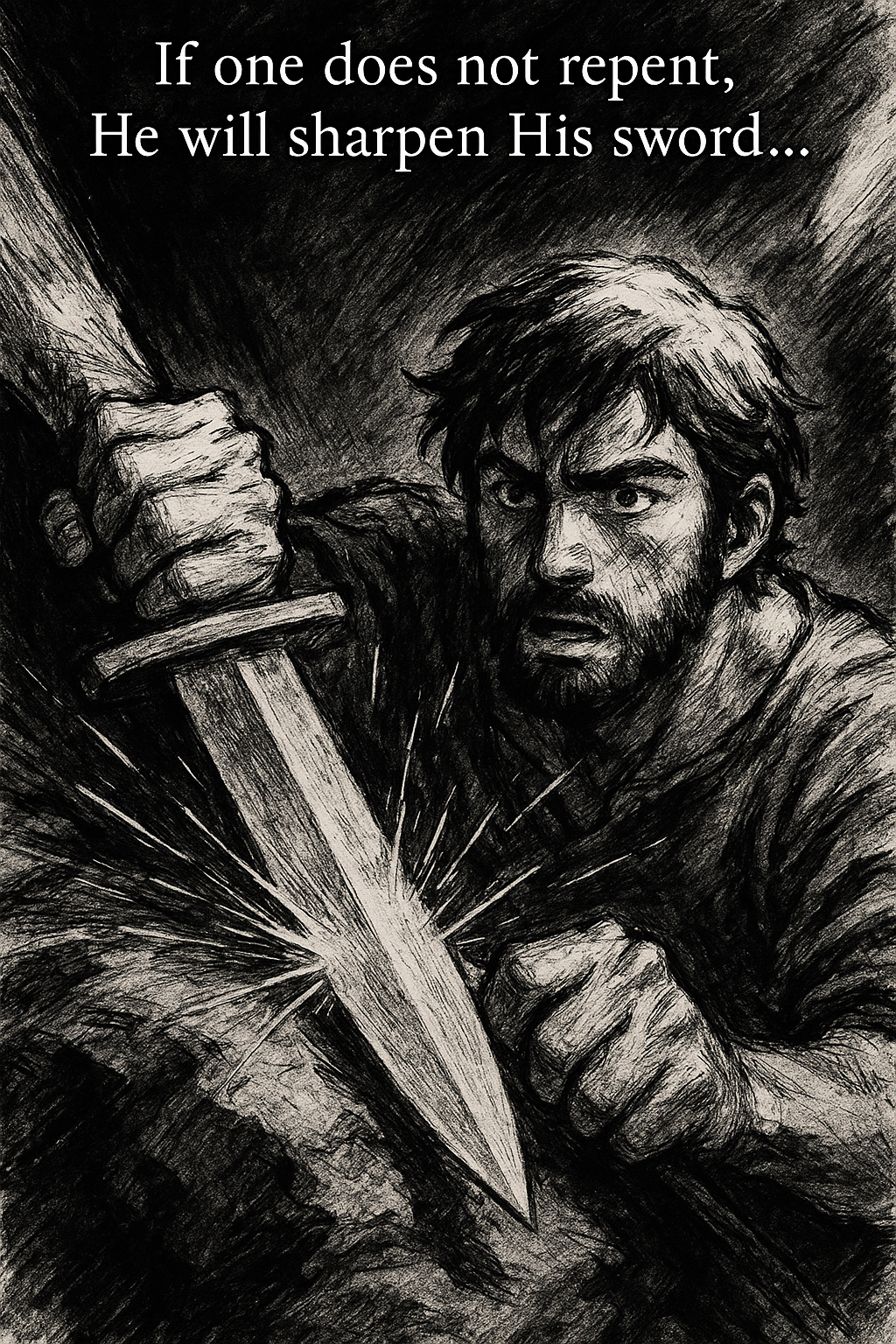
“If one does not repent, he will sharpen his sword.
He has bent his bow and he has strung it.”
(Psalm 7:12, LEB)
David turns his gaze to the fate of the unrepentant. He recognizes a crucial truth: Though one may think he or she can evade justice, those who do not repent cannot escape the Lord’s judgment.
David describes God as a warrior preparing for battle, ready to unleash His judgment on those who remain obstinate in their sin (verses 12-13). This imagery serves as a stark reminder that no one can evade divine justice. While someone might think they can escape accountability, God’s judgment is certain and unstoppable.
“Look, he is pregnant with mischief,
and he has conceived trouble.
And he gives birth to lies.
He has dug a pit and hollowed it out,
then falls in the trap he has made.”
(Psalm 7:14–15, LEB)
The person described in verses 14-16 is the exact opposite to the one who would repent. This evildoer is portrayed as a woman “pregnant with mischief” and giving birth to lies. They are actively working to harm others, digging a pit in which they intend to trap the innocent. However, the very trap they set for others will be their downfall. This vivid picture illustrates a key principle: the wicked often bring about their own destruction. Their schemes and lies ultimately ensnare them, and their evil deeds come back to haunt them.
We do not need to destroy our enemies—they are destroying themselves. When wronged, our calling is to walk in integrity, leaving judgment to God.
As Paul reminds us in Romans 12:19: “Vengeance is mine, I will repay, says the Lord.”
Instead of focusing on bringing justice ourselves, we can trust that God will handle it. He is fully aware of every situation and is preparing to act in His perfect timing. Our responsibility is to remain faithful, leave judgment in God’s hands, and trust that He will ensure that justice is done. This allows us to focus on living righteously and repenting when we fall short, knowing that God’s justice will ultimately prevail.
V. Praise for God’s Righteousness (Psalm 7:17)

“I will thank Yahweh according to his righteousness,
and I will sing praise to the name of Yahweh, the Most High.”
(Psalm 7:17, LEB)
David ends with praise.
Though the outcome is still unseen, he trusts God’s justice. He moves from plea to peace—not because his circumstances have changed, but because his heart is anchored in God’s righteousness.
Notice the arc of faith:
- Commitment: I take refuge in You (v. 1)
- Calling: Save me (v. 1)
- Confidence: I will thank and praise You (v. 17)
When we entrust our reputation and defense to the Lord, we can experience peace—even amid false accusations. Praise is the fruit of trust. As we meditate on God’s justice, we can face trials with joy and confidence, knowing that the righteous Judge reigns.
As we witness God’s faithfulness, our faith should naturally lead us to a place of praise. Even when we start in lament, we can end in worship, knowing that God is righteous and just. This is the journey of faith—a progression from commitment to calling on God, and finally, to trusting Him fully, which allows us to praise Him with a joyful heart.
Conclusion
Themes of Psalm 7:
- Appeal for Justice: The psalm teaches us to appeal to God, not man, for ultimate justice.
- Trust in Divine Judgment: David models a heart that trusts God to deal with both the wicked and the righteous.
The center of this chiasm—verse 9—reminds us of three great truths:
- The wicked will be stopped.
- The righteous will be established.
- The Lord tests every heart.
When falsely accused or misunderstood, we must run first to the Lord. We must open our hearts to self-examination and repentance where needed. We must trust Him to vindicate us—and praise Him whether or not we see that vindication immediately.
Right now, is there someone you need to forgive? Is there an accusation you need to release to the Lord?
Follow David’s example. Begin with honest prayer. Let God search your heart. And rest in His perfect justice.
Personal Study Guide
Facing False Accusation with Faith
Reflection Questions:
- When was the last time you felt falsely accused, judged unfairly, or misunderstood?
- How do you typically respond—defensiveness, anger, self-justification, or turning to the Lord?
- Are there situations where you need to pause and ask, “Have I done this?” (Psalm 7:3–5)
- How does trusting God’s justice free you from bitterness or revenge?
Personal Action Steps:
- Each morning this week, pray: “Lord, test my heart and mind.” (Psalm 7:9)
- Identify one past offense or accusation you need to release into God’s hands.
- Praise God in advance for His perfect justice—even if the outcome is still unseen.
Prayer Points:
- Ask God for humility in self-examination.
- Pray for faith to trust God’s justice with false accusations.
- Thank God that He is your refuge and righteous Judge.
Couples Study Guide
Walking Together in Integrity and Trust
Reflect Together:
- As a couple, how do you typically handle criticism or unfair accusations from others?
- Have there been times in your relationship when one or both of you responded out of defensiveness rather than humility?
- How can you model David’s example of self-examination and trust in God before each other and your children?
Pray Together:
- Ask the Lord to search your hearts individually and as a couple.
- Pray for unity in how you handle conflict and false accusations.
- Thank God for being the refuge and shield of your marriage.
Couples Action Steps:
- Memorize Psalm 7:1 together this week:
“Yahweh my God, I take refuge in You…” - In times of conflict, remind one another of your shared commitment to trust God rather than fight for your own vindication.
Family Devotion Guide
Teaching Our Children to Trust God with Injustice
Read Psalm 7 Together
Discussion Questions (adjust as needed for age):
- Have you ever been blamed for something you didn’t do? How did it feel?
- What should we do when someone says something about us that isn’t true?
- Why is it better to trust God to take care of it than to try to get even?
- What does it mean that God “tests hearts and innermost parts”?
Family Activity:
- Draw a picture of a shield together and write on it: “Yahweh my God, I take refuge in You.”
- Talk about what it means that God is our shield when we’re treated unfairly.
- Each family member can share one situation they want to trust God with this week.
Family Prayer:
- Pray for humility when you’re wrong and courage when you’re right.
- Ask God to help you forgive and trust Him when others are unkind or unfair.
- Praise God as a family for His righteousness and justice.
By Jeremy Sprouse
Jeremy has been married to Erynn since August 1999. They are blessed with six children: Jaden, Isaiah, Isaac, Ean, Joseph, and Evelyn. Jeremy preaches for the Patrick St. church of Christ in Dublin, TX and is the author of To Train Up a Knight.

 Knights of The Father