

When the night feels endless, where do you turn?
When your heart is heavy with guilt, your body weary with grief, and your soul hollowed by regret—what words remain?
The Psalms are filled with praise and triumph, but not every song rises from joy. Some are carved from sorrow. Some are whispered through tears. And some—like Psalm 6—are cries from the edge of collapse.
There are seven psalms traditionally known as the Penitential Psalms—soul-deep laments expressing sorrow, repentance, and the longing for restoration. Psalm 6 is the first among them. Though born from a heart weighed down by trouble, it offers a path forward through the dark: confession, petition, and renewed trust in God’s mercy.
David’s prayer here comes after a sleepless night. His body is exhausted. His spirit is broken. His eyes are swollen from weeping. And yet—he turns to Yahweh eight times in just ten verses. He does not hide from God. He draws nearer.
This psalm unfolds in three stages:
- A Plea for Mercy (vv. 1–3)
- A Portrait of Pain (vv. 4–7)
- A Promise of Deliverance (vv. 8–10)
Psalm 6 is more than just a confession. It is a model of how to pray when the soul aches. Let’s walk with David through his night of trouble—and witness how God’s compassion meets the contrite heart.
I. The Plea – A Cry for Mercy (vv. 1–3)
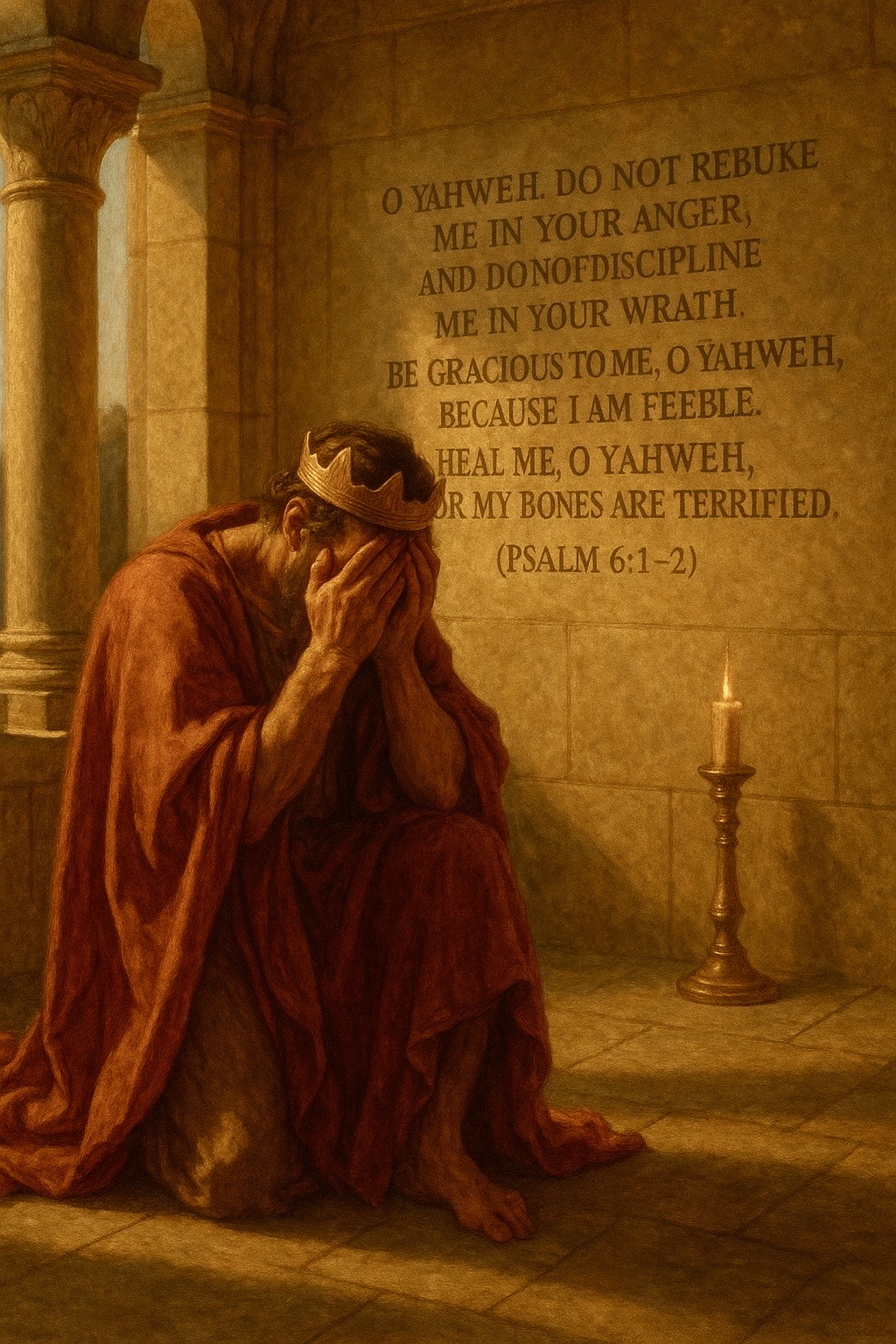
“O Yahweh, do not rebuke me in your anger,
and do not discipline me in your wrath.
Be gracious to me, O Yahweh, because I am feeble.
Heal me, O Yahweh, because my bones are terrified.
And my soul is extremely terrified.
But you, O Yahweh—how long?” (Psalm 6:1–3, LEB)
David’s prayer opens not with confidence—but with collapse. His first words are not self-defense or excuses, but a plea for grace. He does not say, “I didn’t deserve this,” or “I’ve done my best.” Instead, he simply begs: Do not rebuke me in anger. Do not discipline me in wrath.
David knows God is just. He doesn’t question the need for correction. But what he fears is the full weight of divine wrath—a righteous response too heavy for any mortal to bear. So he pleads not for justice, but for mercy.
“Be gracious to me… because I am feeble.”
The language here expresses physical and emotional fragility—“feeble,” “pining away,” “terrified.” His strength is gone. His bones—the very frame of his being—are shaking. He’s not just emotionally distraught; he’s physically unraveling. It is the picture of a man who cannot go on unless something changes.
And then he adds:
“And my soul is extremely terrified.”
This is more than fear. The word implies deep inner anguish, the kind that doesn’t sleep, doesn’t eat, and doesn’t see a way out. David is coming undone at the seams—body, soul, and spirit.
Then comes the question that has echoed through centuries of sorrow:
“But you, O Yahweh—how long?”
There is no punctuation after this phrase in the Hebrew. It’s a half-sentence. A trailing prayer. It’s as if David can’t even finish the thought. “How long… must I suffer? How long until You answer? How long until You forgive?” And yet, even in that cry, there is hope. He is still praying. Still speaking to Yahweh. He hasn’t turned away; he’s reaching out through the fog.
This is the true posture of repentance—not defensive or demanding, but desperate and dependent. The penitent does not approach God with rights or entitlements, but with empty hands. David doesn’t just want relief—he wants reconciliation.
When you’ve hit bottom—when your body is weak, your heart is heavy, and your soul is trembling—Psalm 6 shows us what to say. You don’t need perfect words. You need honest ones. You don’t need to fix yourself before coming to God. You come as you are, not hiding your sin, but trusting His mercy.
II. The Pain – A Night of Weeping (vv. 4–7)

“Return, O Yahweh, rescue my life.
Save me for the sake of your loyal love.
For there is no remembrance of you in death;
in Sheol who will praise you?
I am weary with my groaning;
I cause my bed to swim all night with my tears;
I flood my couch with my weeping.
My eye wastes away because of my grief;
it grows old because of all my enemies.” (Psalm 6:4–7, LEB)
David’s cry now becomes even more personal and urgent. In verse 4, he pleads:
“Return, O Yahweh…”
This is the language of someone who feels abandoned, even by God. Whether David’s sense of distance is the result of his own sin or simply the weight of his suffering, we aren’t told. But we know this—he longs for God’s nearness again. He is not content with simply being delivered from trouble; he wants God Himself to return.
“Save me for the sake of your loyal love.”
This is one of the most important phrases in the entire psalm. David does not appeal to his own goodness or repentance. He rests his hope on God’s character—specifically, God’s ḥesed, often translated “steadfast love” or “loyal love.” This is God’s kindness, His faithful love that never fails. David is essentially saying, “Save me—not because I deserve it, but because You are faithful.”
Verse 5 strikes a sobering note:
“For there is no remembrance of you in death; in Sheol who will praise you?”
This is not a denial of life after death, but a plea grounded in the limitations of human worship. David’s concern is this: “If I die, I can no longer praise You in the land of the living. Let me live—not just for my sake, but so that I can keep glorifying You.” This reflects a heart that sees worship as the ultimate purpose of life.
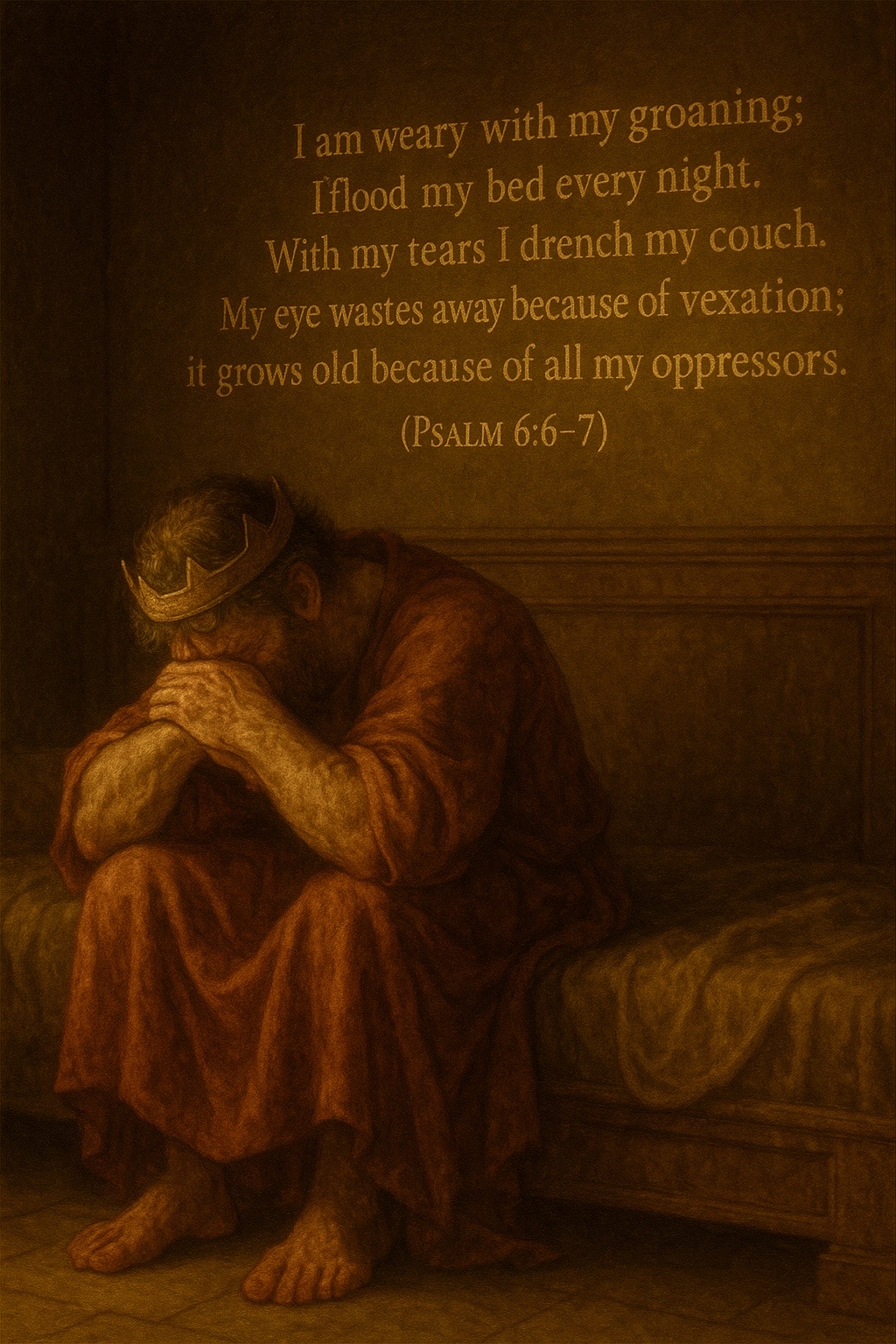
Then comes the emotional core of the psalm. Few passages in Scripture are as raw:
“I am weary with my groaning; I cause my bed to swim all night with my tears. I flood my couch with my weeping. My eye wastes away because of grief.”
David is not exaggerating—he is pouring out the truth of his condition. His sorrow has physical effects: exhaustion, sleeplessness, blurred vision. His crying is not momentary—it is nightlong, soul-deep lament. Every part of him is broken, from his spirit to his tear-stained face.
The phrase “my eye wastes away” (v. 7) is an idiom describing decline and decay. He is deteriorating emotionally and physically, worn down not just by grief but by the opposition of enemies. He ends the section with:
“It grows old because of all my enemies.”
The pain of external conflict has compounded the internal anguish. It’s not just guilt or sorrow—it’s the added weight of being attacked, judged, misunderstood, and possibly betrayed. David feels pressed on every side.
Psalm 6 gives us permission to be honest with God. Sometimes we weep. Sometimes we groan. Sometimes we feel forgotten. And yet, God invites it all. If the “man after God’s own heart” could soak his bed in tears and still pray in faith, so can we. God is not weary of your grief. He draws near to the brokenhearted (Psalm 34:18), and He welcomes the voice of lament.
Tears are not weakness. They are worship—when offered to the One who sees.
III. The Promise – Confidence in God’s Mercy (vv. 8–10)

“Turn away from me, all workers of evil,
for Yahweh has heard the sound of my weeping.
Yahweh has heard my plea for grace;
Yahweh accepts my prayer.
All my enemies shall be ashamed and shall be very terrified.
They shall turn back; they shall suddenly be ashamed.”
(Psalm 6:8–10, LEB)
A shift has occurred.
David, once crushed by sorrow and sleepless grief, now stands with boldness. His words are no longer heavy with despair—they surge with confidence and hope.
“Turn away from me, all workers of evil…”
This is a line of resolve. David is not merely asking for protection—he is drawing a spiritual boundary. The enemies who once taunted him (v. 7) are now dismissed. Why?
“For Yahweh has heard the sound of my weeping.”
“Yahweh has heard my plea for grace; Yahweh accepts my prayer.”
Three affirmations form the heartbeat of David’s renewed strength:
- God hears.
- God is gracious.
- God welcomes his prayer.
This is more than hope—it’s assurance. David doesn’t say, “I hope God heard me.” He says He has. God has turned His face toward David in mercy. The tears of verses 6–7 were not wasted; they were seen. Heard. Received.
This triple repetition of “Yahweh has…” is a deliberate refrain. It’s David preaching to his own soul: God is not far off. God is not ignoring you. God is not angry forever.
And so, his perspective shifts. His enemies, who once seemed overwhelming, are now the ones who will be overwhelmed:
“All my enemies shall be ashamed and shall be very terrified.
They shall turn back; they shall suddenly be ashamed.”
These words don’t come from vengeance—but from confidence in divine justice. David is entrusting judgment to the Lord. He’s not fighting back in his own strength; he’s leaving the outcome in God’s hands. Evil will not win. It will not go unanswered. It will be exposed and reversed.
The end of Psalm 6 teaches us something essential: we can move from weeping to worship without knowing how the story ends. David doesn’t say his circumstances have changed—only that he knows God is near.
This is the promise of the penitent: when we come broken, God listens. When we confess, God receives. When we cry, God answers.
So take courage. Your prayers may begin in darkness, but they are not buried there. By the final verse, David is still waiting—but now he’s waiting with confidence. And so can we.
Summary
Psalm 6 begins with a sob and ends with a song—not because the pain is gone, but because God has drawn near.
David does not deny his guilt. He does not downplay his sorrow. He lays it bare—bones aching, soul dismayed, eyes worn out from tears. But in that vulnerable place, he finds something greater than relief: he finds God’s compassion.
He does not demand rescue as a right. He pleads for grace as a penitent. And God answers—not because David is strong, but because God is merciful.
This is the rhythm of every true repentance:
- A humble cry for mercy
- An honest account of pain
- A hopeful trust in God’s hearing
David’s strength wasn’t in holding it together—it was in pouring it out. And that’s what Psalm 6 invites us to do: to bring our regret, our grief, our weariness before the Lord—not to be crushed, but to be cleansed and comforted.
It’s a reminder that brokenness is not the end—it’s the beginning of healing. The cries of the contrite are not ignored in heaven. They are gathered, heard, and answered in grace.
So if you are weary, if you are ashamed, if you are afraid—remember Psalm 6.
The God who receives your weeping will also restore your joy.
“Yahweh has heard my plea for grace;
Yahweh accepts my prayer.” (Psalm 6:9, LEB)
Study Questions:
Personal Reflection:
- What troubles are you currently facing—physical, emotional, spiritual?
- Have you honestly brought them before the Lord?
- Are there any sins weighing on your conscience that require confession?
For Couples:
- Read Psalm 6 together. Discuss what verses stand out and why.
- Talk about how you can encourage one another in seasons of discouragement or repentance.
For Families:
- Ask: What do you do when you feel bad or sad?
- Teach: David told God how he felt. We can too.
- Activity: Draw a picture of a tearful face turning into a smiling face—remind them God hears and helps.
By Jeremy Sprouse
Jeremy has been married to Erynn since August 1999. They are blessed with six children: Jaden, Isaiah, Isaac, Ean, Joseph, and Evelyn. Jeremy preaches for the Patrick St. church of Christ in Dublin, TX and is the author of To Train Up a Knight.

 Knights of The Father