
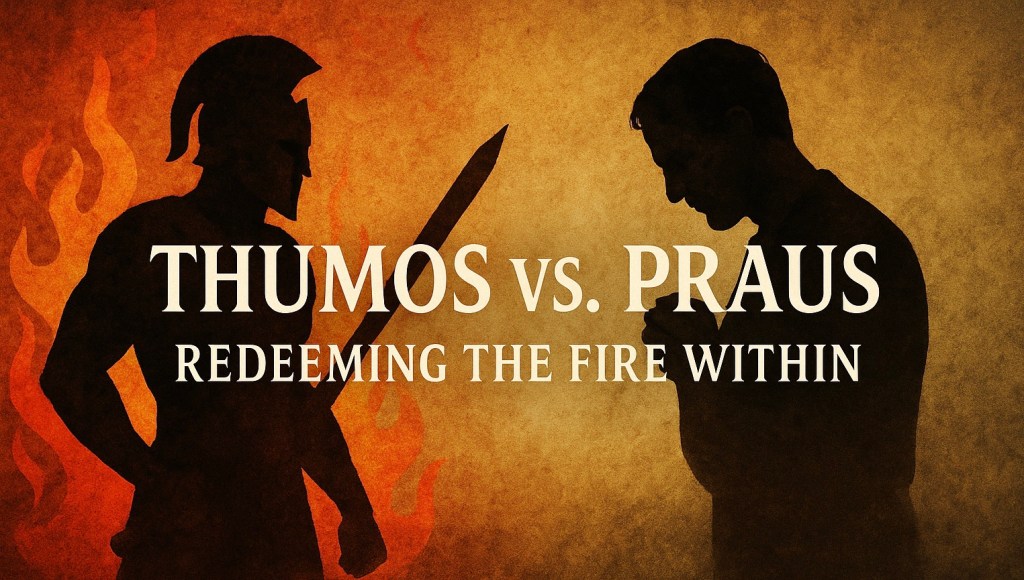
In the ancient world of Homeric heroes and Spartan warriors, thumos was celebrated as the burning fire within—the spirited core that drove a man to pursue honor, glory, and greatness. It surged in the chest of Achilles, flared in the speeches of Socrates, and stood tall as a virtue in the soul of the noble Greek.
But then comes Jesus, standing on a Galilean hillside, pronouncing a strange beatitude: “Blessed are the meek” (Matthew 5:5)
The Greek word He used was praus—gentle, humble, power under control. To many modern readers, this sounds like a contradiction, even weakness. Yet in truth, it is praus, not thumos, that is the true sign of strength in the kingdom of God.
This article explores the tension—and transformation—between thumos and praus, and how the Bible doesn’t extinguish the fire of the soul but redeems it.
Thumos: The Ancient Fire of the Soul
In classical Greek thought, thumos (θύμος) referred to the spirited part of a person’s inner life—the seat of emotion, drive, courage, anger, and ambition.
Homer (750-700 BC) used the term to describe both the noble rage of a warrior and the vital force that makes life worth living. Thumos was considered essential to personal excellence (areté). It was the fire that enabled a man to fight for justice, stand against shame, and rise above mediocrity. It was a zeal for honor—the force behind heroic action.
When Hector steels himself before facing Achilles in battle, he says:
Now is the time, my thumos, to be brave and show your mettle. (Iliad 22.304)
His thumos stirs him to courage and duty, even in the face of certain death.
Yet the Greeks also knew it could be dangerous. Unchecked, thumos became rashness, fury, or destructive pride. It had to be tamed—not extinguished, but ruled by reason.
In the Iliad, Achilles wrestles with his thumos. Raging in his tent, his honor wounded, his thumos burns with indignation and pride. This is heroic thumos at its most volatile:
I have suffered many things in my thumos, and I’ve risked my life in battle time and again… But now he [Agamemnon] has taken my prize from me… Do not try to persuade me, Odysseus, with speeches. (Iliad 9.615–620)
Later, in the Odyssey, Odysseus prepares for vengeance but restrains himself. He speaks directly to his thumos, calling it to self-control:
Bear up, my thumos; you’ve borne worse before. (Odyssey 20.18–20)
This shows thumos as something that can be commanded—it’s not inherently evil, but it requires mastery.
Plato (428-348 BC) sought to redeem thumos by presenting it as the guardian of the soul, so long as it was aligned with reason.
In the Republic, Plato divides the soul into three parts:
- Logos – reason
- Thumos – spiritedness
- Epithumia – appetite/desire
Plato used an allegory of a chariot to explain this.
In the allegory, a chariot (representing the soul) is pulled by a rebellious dark horse (symbolizing man’s appetites) and a spirited white horse (symbolizing thumos). The charioteer, or Reason, is tasked with harnessing the energy of both horses, getting the disparate steeds into sync, and successfully piloting the chariot. . . (Brett and Kate McKay, Got Thumos?)
Plato elevates thumos when it is subject to logos. It becomes a protector of virtue—essential, but not supreme.
When a man’s thumos rises up and fights on the side of what he judges to be right, even against the desires of the appetitive part—this is the mark of a just soul. (Republic 440c)
In Plato’s just society, the guardian class must possess thumos—not just courage, but a righteous fierceness aligned with wisdom:
We say that auxiliaries (warriors) are by nature more thumoeides (spirited), and they need this thumos to carry out the will of the rational rulers. (Republic 440e–441a)
But language evolves. By the time the New Testament was written, thumos was no longer the noble flame of Homer—it had become a warning flare.
During the Hellenistic Age, the meaning of thumos began to shift, in part due to Stoic philosophies that viewed all emotion with suspicion.
When the Old Testament was translated into Greek (the Septuagint), thumos was frequently used to describe divine wrath or human rage. By the time of the New Testament, the meaning of thumos had narrowed significantly. It no longer referred to a noble, inner vitality, but to rage, violent emotion, or explosive outbursts of anger.
What began as a noble inner flame had, by the New Testament era, become a warning sign. Unredeemed thumos no longer pointed to courage—it pointed to uncontrolled emotion, spiritual danger, and a life ruled by the flesh.
Biblical Warnings: When Thumos Goes Wrong
In the New Testament, thumos is often paired with orge (wrath). While orge can describe settled, even righteous indignation, thumos connotes boiling, volatile emotion—something reckless and dangerous.
Scripture treats it with consistent caution and disapproval.
Let all bitterness and wrath (thumos) and anger and clamor and slander be put away from you, along with all malice.— Ephesians 4:31
In Galatians 5:20, “outbursts of anger (thumoi)” are listed among the works of the flesh—characteristics of a life ruled by self rather than by the Spirit. Colossians 3:8 has thumos in a list of attitudes/actions that Christians are to remove from their lives (cf. 2 Corinthians 12:20).
In two passages, thumos is used to describe the rage of people rejecting God’s message. First, by those of the Synagogue in Nazarath that were filled with rage at the words of Jesus and sought to throw Him off a cliff (Luke 4:28). Second, by the crowd the silver smiths of Ephesus had whipped up to oppose the success of the gospel (Acts 19:28).
In these passages, thumos is not a noble fire, as in Homer or Plato, but a spiritually dangerous force. It reflects a heart governed by impulse, not wisdom or righteousness.
This aligns with the broader biblical witness: human anger is rarely trustworthy and often destructive.
This you know, my beloved brethren. But everyone must be quick to hear, slow to speak and slow to anger (orge); for the anger of man does not achieve the righteousness of God.— James 1:19–20 (In context, this anger prevents one from hearing God’s Word)
For the churning of milk produces butter, And pressing the nose brings forth blood; So the churning of anger produces strife.— Proverbs 30:33
These verses remind us that anger, even when seemingly justified, often leads to conflict rather than peace, and to self-righteousness rather than God’s righteousness.
Even Ephesians 4:26 (quoting Psalm 4:4) which is often used as a permission slip for anger—includes both a concession and a constraint:
BE ANGRY (orge), AND yet DO NOT SIN; do not let the sun go down on your anger,
This verse implies that anger may be legitimate in some cases, but only under strict conditions: it must not lead to sin, and it must be short-lived. Anger is acknowledged—but it is never allowed to rule.
When thumos is left ungoverned, it becomes:
- Antagonistic — turning others into enemies
- Self-centered — focused on offense and personal pride
- Morally reckless — quick to justify harmful words and actions in the name of being “right”
Instead of defending truth or justice, it defends ego.
The ancient world saw thumos as a sign of heroic fire. The Bible, however, warns that such fire can easily become a consuming blaze—destroying relationships, witness, and even the soul if not surrendered to the Spirit’s control.
Praus: Strength Under Submission
So what does Scripture offer in place of thumos—the volatile, destructive force of unrestrained passion?
It offers praus (πραΰς)—a word often translated as meekness or gentleness. But don’t mistake this for weakness. In biblical and classical usage, praus describes a warhorse that has been trained—still powerful, but responsive to the lightest command of its master. It is strength brought under control, not surrendered.
Nelson’s Bible Dictionary defines meekness as:
an attitude of humility toward God and gentleness toward men, springing from a recognition that God is in control. Although weakness and meekness may look similar, they are not the same. Weakness is due to negative circumstances, such as a lack of strength or lack of courage. But meekness is due to a person’s conscious choice. It is strength and courage under control, coupled with kindness.
The word for meekness/gentleness (PRAUS) is used in other Greek writings to describe:
- A soothing medicine–something powerful that does not destroy, but heals.
- Sailors used it to refer to a refreshing breeze–a steady and secure wind that did not threaten their lives.
- A bridled horse–strength brought under control.
Jesus uses this word to describe Himself: “I am meek (praus) and lowly in heart…” (Matthew 11:29). And He calls His disciples to this same posture: “Blessed are the meek (praeis), for they shall inherit the earth.” (Matthew 5:5)
Paul urged others “by the meekness and gentleness of Christ” (2 Corinthians 10:1). Moses was described as more meek than anyone on earth (Numbers 12:3). David spared Saul—twice—when he had every right to kill him.
Meekness is a warrior’s discipline. It doesn’t suppress strength—it sanctifies it.
Kindled for Righteousness: Other Words for Redeemed Fire
The New Testament doesn’t eliminate fire—it channels it.
Zēlos (ζῆλος) – Zeal, earnestness, passionate commitment
- Zēlos is perhaps the most direct heir to noble thumos—it’s inner fire redirected toward God’s purposes.
- Positive use: “It is fine to be zealous (zēlos) for good things always” – Galatians 4:18
- Negatice use: zēlos can also be negative (e.g., “jealousy” or rivalry), as in 1 Corinthians 3:3 or Galatians 5:20. Understanding it in context is key.
- Paul refers to his own past zeal: “…as to the law, a Pharisee; as to zeal, a persecutor of the church” – Philippians 3:6
- But now he calls believers to zeal for good works (Titus 2:14) and to be “fervent in spirit” (Romans 12:11).
Spoudē (σπουδή) – Diligence, earnest effort, moral seriousness
- Used to describe urgency and eagerness for doing what is right:
- “Make every effort (spoudē) to add to your faith virtue…” – 2 Peter 1:5
- “Be diligent (spoudazō) to present yourself approved to God…” – 2 Timothy 2:15
- While quieter than thumos, spoudē reflects a focused, noble drive—a disciplined version of spirited courage.
Arete (ἀρετή) – Virtue, moral excellence, nobility
- Arete was the ideal outcome of a trained thumos—courage, honor, and virtue in action.
- Found in 2 Peter 1:3 and 1:5—a word that classical Greeks like Aristotle and Plato associated directly with the expression of a virtuous thumos:
- “His divine power has granted to us all things that pertain to life and godliness, through the knowledge of him who called us to his own glory and excellence (arete).”
En theō zeontes (ἐν τῷ πνεύματι ζέοντες) – Boiling over in spirit
- Romans 12:11: “Do not be slothful in zeal, be fervent (zeontes) in spirit, serve the Lord.”
- Zeontes comes from zeō—“to boil.” It’s intense spiritual energy—exactly what thumos once meant at its best.
Each reflects a refined fire—passion ruled by purpose. True manhood, then, is not cold or passive. It is fierce in faith, disciplined in action, and burning with love for righteousness.
Righteous Anger: When Fire Is Justified
Anger is not always wrong. The Bible reveals that righteous anger can reflect God’s character.
Righteous anger is a passionate response to sin, injustice, or dishonor toward God. It is not driven by wounded pride or personal offense but by a deep moral conviction that something is truly wrong and must be confronted.
This kind of anger is not rooted in ego—it is born from love for what is holy and hatred of evil (cf. Psalm 97:10). It reflects the heart of God Himself. It is slow to arise and anchored in a love for what is good and holy. It is not rooted in self-interest but in a concern for God’s glory and the wellbeing of others.
Unlike thumos in its raw, unrestrained form, righteous anger is not explosive or vengeful. It is measured, focused, and under the control of conscience. It grieves before it acts. It seeks justice, not revenge.
God’s wrath (thumos) is used ten times in Revelation and once in Romans 2:8 to describe His just judgment. His anger is always principled and purposeful—slow to ignite, but powerful when it comes.
Jesus displayed righteous anger when He cleared the temple (John 2:13–17). In Exodus 11:8, Moses leaves Pharaoh’s court in hot anger probably as a rightoues reaction to the pain and devastion Pharoah was causing with his stubbornness.
Righteous anger is guided by truth, submitted to God’s will, and expressed with the aim of correction, protection, or restoration. Whereas thumos rages without purpose, righteous anger grieves over evil and seeks redemption. It is never used as a license for harm, pride, or prolonged hostility, and always remains within the boundaries of self-control and spiritual maturity.
This kind of righteous anger is not thumos in the classical Greek sense—a raw emotional eruption that seeks glory or domination. It is a redeemed form of fire—one that burns hot with justice but remains under the Spirit’s control.
It grieves over evil.
It moves us to protect the innocent.
It acts—but it acts in righteousness.
God does not call us to be indifferent to evil. There are things in this world that should make us angry—injustice, abuse, hypocrisy, sin that harms others.
But the Christian does not fight fire with fire. We fight fire with righteousness, truth, and meekness. We bring our anger—like every other passion—under the rule of Christ.
Remember: “The anger of man does not achieve the righteousness of God” (James 1:20). We must be honest: many who claim to be acting in “righteous anger” are really masking personal offense, pride, or bitterness. This is one of the great dangers of anger—it disguises itself as justice, even when it is nothing more than the flesh seeking revenge or control.
Even when our anger begins from a just concern, we must ask:
- Is this about God’s holiness or my wounded ego?
- Am I motivated by truth and love, or by a desire to be right?
- Am I aiming to restore or simply to vent?
It should not be self-driven—grieving before it speaks, and always seeking redemptive outcomes rather than retaliation.
Even righteous anger must be kept on a short leash. It should never be an excuse for cruelty, bitterness, or pride. Remember Ephesians 4:26 which we looked at earlier: “BE ANGRY (orge), AND yet DO NOT SIN; do not let the sun go down on your anger.” The fire may be justified—but it must be short-lived and controlled.
In addition, we must remember we cannot overcome evil with evil, we can only overcome it with good (Romans 12:21).
So yes, there is such a thing as righteous anger. But the better question for most of us is this:
“Is my anger righteous—or just my thumos looking for an excuse?”
Let your fire be governed by grace.
Let your passion bow before God’s will.
And when you must be angry—be holy. Be brief. Be Christlike.
Redeeming the Fire Within
The Bible doesn’t call us to extinguish the fire inside us. It calls us to redeem it.
That inner drive—your passion, ambition, zeal—was never meant to be erased. It was meant to be transformed by the Holy Spirit into something powerful and pure. Righteous passion isn’t suppressed; it is sanctified. What once served pride and impulse now serves love, truth, and the Kingdom of God.
The fruit of the Spirit is… gentleness (prautēs), self-control…— Galatians 5:22–23
We see this vividly in the life of Paul. He once lived in raging thumos, driven by zeal for the law and hatred toward the church. But when Christ confronted him, that fire didn’t die—it was refined. Paul didn’t become soft or passive. He became meek: strong, unshakable, and Spirit-led. He used that same intensity to preach the gospel, endure persecution, and love the very people he once sought to destroy.
So how do we live this out today?
- Feel anger?
Examine it. Pause and ask: “Is this about my ego, or about something truly unjust?” If it’s about pride, let it go. If it’s about evil, grieve over it—and ask God how to respond in truth and love. - Desire greatness?
Pursue meekness. Don’t settle for passivity or people-pleasing. Be strong—but under God’s rule. Let your power be guided, not glorified. - Face injustice?
Respond with Christ-like courage, not reactive rage. Righteous anger is rare and dangerous if mishandled. Be slow to anger, quick to act in wisdom, and always ready to forgive. - Burning with passion?
Redirect it. Don’t quench your inner fire. Let it fuel your service, prayer, discipline, and compassion. Passion is powerful when it bows before the Lord.
God doesn’t want you cold or dull. He wants you on fire and under control—like a warhorse trained for battle, or a sword sharpened for His purpose. That’s the life of praus. That’s what it means to be a faithful knight in the service of the King.
Conclusion: Praus Inherits the Earth
The world cheers the man who conquers by force.
Jesus blesses the man who surrenders by faith.
Thumos may start revolutions.
But praus inherits the kingdom.
So don’t kill the fire in your chest—bring it to the King.
Let Him teach it to walk in step with His will.
The biblical authors are not condemning all passion—but they are condemning unrestrained, self-centered emotional outbursts. The thumos of Achilles must die or be transformed into the praus of Christ.
By Jeremy Sprouse
Jeremy has been married to Erynn since August 1999. They are blessed with six children: Jaden, Isaiah, Isaac, Ean, Joseph, and Evelyn. Jeremy preaches for the Patrick St. church of Christ in Dublin, TX and is the author of To Train Up a Knight.

 Knights of The Father
❤️❤️❤️❤️❤️
LikeLike