A lesson from chess, warfare, and Scripture
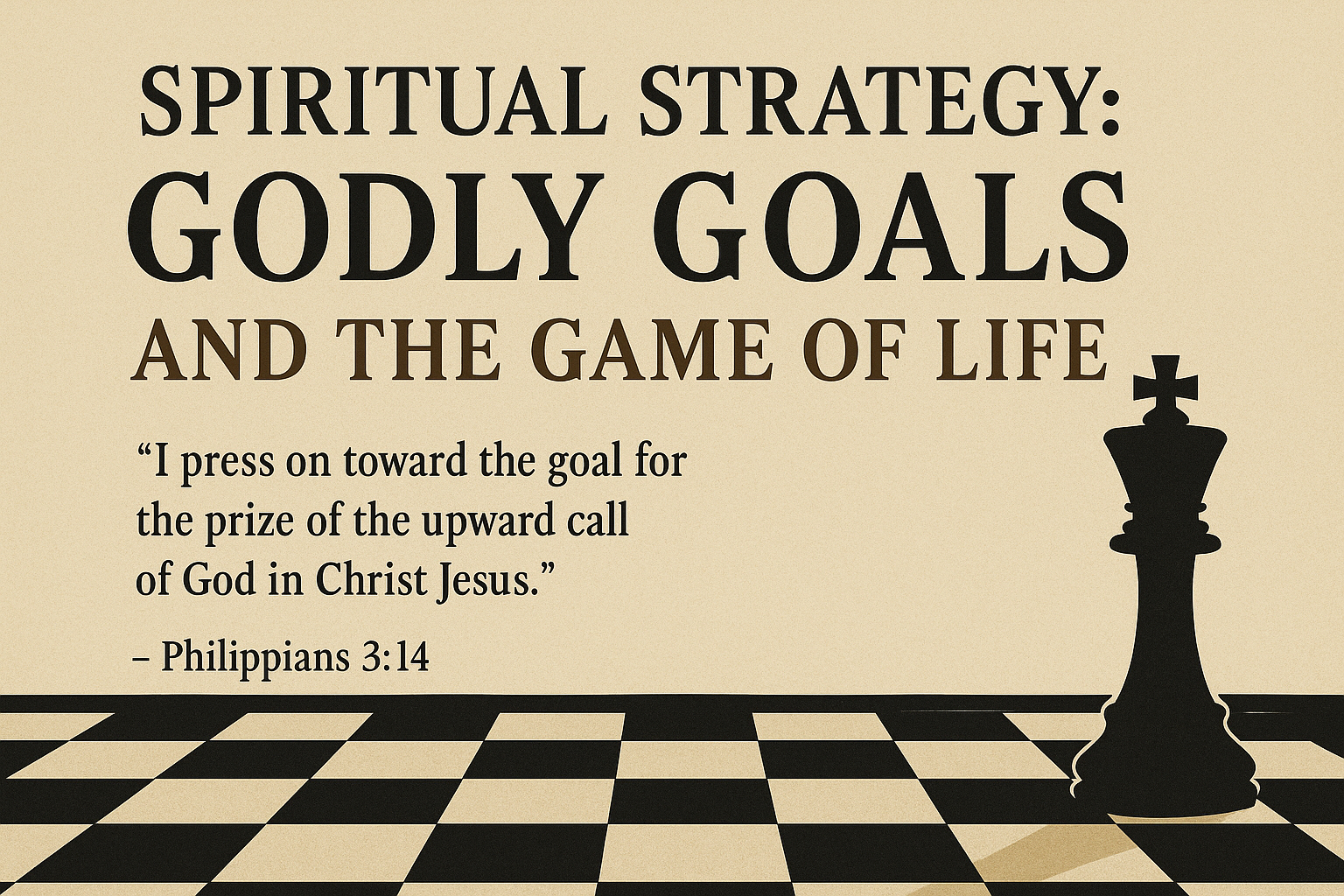
“I press on toward the goal for the prize of the upward call of God in Christ Jesus.” – Philippians 3:14
The Power of Goal Setting: From the Chessboard to the Battlefield
In chess, the winner is rarely the one who reacts impulsively. Victory comes to the player who thinks ahead—who sets short-term goals (control the center, develop pieces, safeguard the king) and keeps the long-term objective in mind: checkmate. Every move is intentional, often part of a sequence planned many turns in advance.
It’s no coincidence that chess has long been used to teach military strategy. Great commanders—whether on literal battlefields or in spiritual warfare—don’t stumble into success. They identify the objective, assess their position, and move decisively. Napoleon once said, “War is ninety percent information.” In other words, knowing where you’re going and how to get there is more than half the battle.
Yet many people live without clear direction—spiritually aimless, making scattered moves, reacting instead of planning. A knight without a cause drifts. A father without a mission flounders. A Christian without godly goals is vulnerable.
So what if we began treating our spiritual life like a chess match? What if we made plans to win the war for our soul?
Note: In this illustration, the “game” begins when we obey the gospel—when we die to sin, are buried with Christ in baptism, and rise to walk in newness of life (Romans 6:3–4). This article is talking about strategy in the new life.
I. The Ultimate Goal: Victory in Christ
In chess, everything revolves around one singular objective: checkmate the opponent’s king. Every tactic, every exchange, every sacrifice is aimed at this goal. Without that focus, a player might win battles but lose the war.
The same is true in the Christian life. We aren’t just called to “be good” or “try hard.” We are called to win—not in prideful self-achievement, but in faithful perseverance. The prize isn’t a trophy or a title. It’s the crown of life.
“Be faithful unto death, and I will give you the crown of life.” – Revelation 2:10
God has already declared the victory in Christ. The death and resurrection of Jesus secured the path. But He calls us to walk it intentionally, “pressing on toward the goal” (Philippians 3:14).
What does that look like?
- Knowing your King: You can’t serve Christ if you don’t know Him. We must walk with Him, listen to His voice, and align our will with His Word.
- Seeing the board clearly: In chess, careless players lose sight of the endgame. Spiritually, distractions—career, comfort, comparison—can obscure our goal. We must refocus regularly.
- Playing for eternity: Every day is a move. Every choice matters. The way we spend time, treat people, lead our homes, and serve in the kingdom—all of it is either drawing us closer to the goal or pulling us off-course.
Some play to avoid losing. Others play to win. Christians are not called to play it safe. We are called to fight the good fight and finish the race (2 Timothy 4:7). That means keeping our eyes fixed not on what is seen, but on what is unseen and eternal (2 Corinthians 4:18).
The King has already overcome. Our job is to finish the game faithfully, bringing glory to Him with every move we make.
II.The Opening: Build Strong Foundations
In chess, the opening is critical. It’s where you lay the groundwork for everything that follows. A careless or passive opening leads to a weak position that can quickly collapse under pressure. But a wise, well-prepared opening? It sets the stage for control, defense, and eventual victory.
In the spiritual life, our “opening” begins the moment we obey the gospel—when we die to sin, are buried with Christ in baptism, and rise to walk in newness of life (Romans 6:3–4). That’s when the game begins. What we do next sets the tone for our walk with God.
“Therefore, as you received Christ Jesus the Lord, so walk in him, rooted and built up in him and established in the faith…” – Colossians 2:6–7
Just as a chess player has goals in the opening, so does the new Christian:
- Develop your pieces → Develop your faith
- Spend time learning the Word of God (2 Timothy 2:15)
- Seek out mentors and fellowship with other believers
- Practice spiritual disciplines like prayer, service, and worship
- Control the center → Take control of your spiritual priorities
- Don’t let the world dictate your schedule or values
- Choose habits that give God the central place in your life
- Begin each day with intention, not distraction
- Castle early → Protect your heart and mind
- In chess, castling gets the king to safety and connects your rooks. In your spiritual life, make early decisions to shield yourself from sin and align with the church, where strength and support are found.
- “Above all else, guard your heart, for everything you do flows from it.” – Proverbs 4:23
Many fall in the opening—not because they didn’t mean well, but because they didn’t plan well.
They obeyed the gospel but never studied.
They were baptized but never built habits.
They stepped into the light but never left the shadows behind.
The enemy knows how to exploit a weak opening. If your foundations are shaky, your entire game is vulnerable.
But if you start strong—if you take those first spiritual moves seriously—you can build a faith that endures the middle game and thrives in the endgame.
III. The Middlegame: Tactical Living
In chess, the middlegame is where the real battle unfolds. The pieces are in play. The board is contested. Mistakes are punished. Success depends not just on raw power, but on position, timing, and wisdom. Every move either strengthens your position or leaves you vulnerable. The middle game is where chess is won or lost. It’s also where real life happens—work, family, stress, temptation, and ministry.
The spiritual middlegame is life in full motion. It’s where your faith intersects with real-world challenges: your job, your family, your temptations, your responsibilities, your suffering, and your service. This is the long stretch between the joy of beginning and the hope of finishing. And it’s where many grow weary or lose their way.
“We do not wrestle against flesh and blood, but against the rulers, against the authorities, against the cosmic powers over this present darkness…” – Ephesians 6:12
This is where tactical living matters:
- Recognize the threats.
- In chess, you always ask: What is my opponent threatening?
- Spiritually, we must be alert: Where is Satan trying to tempt me, distract me, or divide me?
- “Be sober-minded; be watchful.” – 1 Peter 5:8
- Use your resources wisely.
- A good player doesn’t waste their strongest pieces. Likewise, don’t waste your gifts, time, or energy on things that don’t matter. Serve with intentionality.
- “Look carefully then how you walk… making the best use of the time, because the days are evil.” – Ephesians 5:15–16
- Position for impact.
- Sometimes a single piece, placed well, controls the whole board. In your life, that could be your influence at work, your leadership at home, or your encouragement to someone in crisis. Small acts of obedience often have wide spiritual reach.
- “Let your light shine before others…” – Matthew 5:16
- Prepare for sacrifice.
- No middlegame is without loss. You may give up comfort, pride, convenience, or even popularity to advance your position in the kingdom. That’s not failure—it’s strategy.
- “Whoever would save his life will lose it, but whoever loses his life for my sake will find it.” – Matthew 16:25
- Stay flexible, not frantic.
- Your plans may not unfold as expected. Life changes. Trials hit. Just like in chess, you may need to adjust without abandoning your purpose. The goal hasn’t changed, even if the board has.
The middlegame tests maturity.
It’s not about flash—it’s about faithfulness.
It’s not about making the most noise—it’s about making the next right move.
And when you live with tactical awareness and spiritual courage, you’re no longer reacting to life—you’re shaping it under the leadership of your King.
IV. The Endgame: Finish Faithfully
In chess, the endgame is where the board clears, the pressure tightens, and every decision carries weight. It’s no longer about gaining material or flashy tactics—it’s about using what remains to secure victory. Some of the most beautiful wins in chess come from endgames that are quiet, precise, and deeply intentional.
Spiritually, the endgame represents the later phases of life—or simply seasons of greater reflection and urgency. The beginning may have been exciting. The middle may have been full of struggle. But it is the end that reveals whether the strategy held firm.
“I have fought the good fight, I have finished the race, I have kept the faith.” – 2 Timothy 4:7
That’s the goal. Not to merely believe at one time. Not to start strong and fizzle out. But to finish well—with our faith intact, our mission completed, and our eyes fixed on Jesus.
What does it mean to finish faithfully?
- Persevering in trials.
- The later stages of life often bring new hardships—loss, health issues, weariness. The faith that started strong must now be deep-rooted and unwavering.
- “Let us not grow weary of doing good, for in due season we will reap…” – Galatians 6:9
- Investing in legacy.
- In chess, a pawn can become a queen—if it reaches the other side. In the spiritual endgame, your influence can multiply. Share wisdom. Teach younger believers. Pour into the next generation.
- “One generation shall commend your works to another…” – Psalm 145:4
- Simplifying to what matters most.
- As the board clears, only the most vital pieces remain. So too in life: we must shed distractions and center our lives more fully on the Lord.
- “Set your minds on things above, not on earthly things.” – Colossians 3:2
- Remaining watchful.
- Many have stumbled late in the game—not from ignorance, but from complacency. Don’t coast. Don’t assume faith will maintain itself. Be alert to the enemy’s final traps.
- “Be faithful unto death, and I will give you the crown of life.” – Revelation 2:10
- Welcoming the checkmate of grace.
- For the Christian, the end of the game is not defeat—it’s homecoming. Death is swallowed in victory (1 Corinthians 15:54). Jesus doesn’t just wait at the finish line—He walks with us to the end.
Faithfulness is not measured by a moment—it’s proven across a lifetime.
Whether you’re approaching life’s endgame or just becoming aware of its importance, now is the time to prepare your heart and strengthen your steps. You don’t have to finish with fireworks. But you must finish with faith.
V. Small Moves Matter
In chess, grand strategies and brilliant sacrifices are often remembered—but they are built on countless small, quiet moves. Moving a pawn may not seem important… until it opens the path to victory. A single overlooked square can lead to checkmate—or disaster.
Likewise, in the Christian life, it’s not just the “big moments” that define us. It’s the daily decisions, the habits formed, the thoughts guarded, and the words spoken in passing. These are the small moves that shape a life of faith.
“One who is faithful in a very little is also faithful in much…” – Luke 16:10
Here’s how small spiritual moves shape the game:
- A short prayer in a stressful moment is a move.
- It may only last seconds, but it turns your attention toward God and away from panic.
- Turning off a tempting show or scrolling past something ungodly is a move.
- You protect your heart with a quiet act of obedience no one else may see—but God does.
- Reading one chapter of Scripture when you feel too tired is a move.
- It deepens your roots even if you don’t feel it right away.
- Speaking a word of encouragement, or apologizing when you’re wrong is a move.
- It creates peace, restores relationships, and shows Christ’s character.
- Getting your family to worship, even when it’s difficult, is a move.
- You’re teaching consistency, building spiritual endurance, and showing what matters most.
Individually, these might seem insignificant. But spiritual maturity is not forged in great leaps—it’s formed in faithful steps. And just like in chess, small moves made with the right purpose eventually shift the entire board in your favor.
The enemy wants you to believe your choices don’t matter.
He wants you to believe the little compromises are harmless.
He wants you to believe that if you’re not doing something “big” for God, you’re not doing anything at all.
But he’s wrong.
Every faithful move you make is an act of resistance against the darkness.
Every holy habit you form strengthens your position.
Every quiet act of obedience gets you one step closer to the crown.
“And whatever you do, in word or deed, do everything in the name of the Lord Jesus…” – Colossians 3:17
Final Thoughts: Play to Win
Chess teaches us to think ahead. War teaches us to fight with purpose. Scripture teaches us to live with eternity in view.
You are not on this board by accident.
You have not been drafted into the battle by mistake.
Your life is not a series of random moves—it is a campaign of eternal consequence.
“No soldier gets entangled in civilian pursuits, since his aim is to please the one who enlisted him.” – 2 Timothy 2:4
God has already revealed the endgame. The victory is secure—for those who remain faithful. So whether you’re just beginning your walk, in the thick of life’s battles, or nearing the finish line, you have a strategy to follow and a King worth serving.
So ask yourself:
- What’s my next move?
- Where is the enemy pressuring me?
- What small, faithful action can I take today to align with God’s greater plan?
Don’t play spiritually passive. Don’t just survive the game—win it.
And when the final move is made and the board is cleared, may it be said of you:
“He fought the good fight. He finished the race. He kept the faith.”
By Jeremy Sprouse
Jeremy has been married to Erynn since August 1999. They are blessed with six children: Jaden, Isaiah, Isaac, Ean, Joseph, and Evelyn. Jeremy preaches for the Patrick St. church of Christ in Dublin, TX, and is the author of To Train Up a Knight.

 Knights of The Father